Courtesy of Michael Stefaniw
Working as a pharmacy technician within adult social care has completely changed how I view medicines and their impact on people’s lives. Traditionally, pharmacy roles are often based in hospitals or community pharmacies, but my role sits between discharge services and reablement. This means I get to see first-hand how medicines can either support someone’s recovery — or unintentionally hold them back.
If medicines are not optimised, they can easily become a barrier rather than a benefit
Reablement is all about helping people regain their independence after illness, a hospital stay or a decline in their ability to cope at home. While therapy and social support are at the heart of this, I’ve found that medicines often play a much bigger role than people realise. If medicines are not optimised, they can easily become a barrier rather than a benefit.
When I receive a referral, it’s often because something about the person’s medicines just isn’t working. Many of the individuals I visit are on multiple medications, sometimes with recent changes made during a hospital admission. It’s not uncommon to find people still taking medicines that were meant to be stopped, or struggling with confusing instructions that even healthcare professionals find difficult to follow.
What makes my role different is that I visit people in their own homes. That environment tells you so much more than any medical record ever could. I can see how medicines are actually being stored, how they’re being taken and whether the patient — or the person supporting them — understands what they’re doing. These visits often reveal issues that would otherwise be missed entirely.
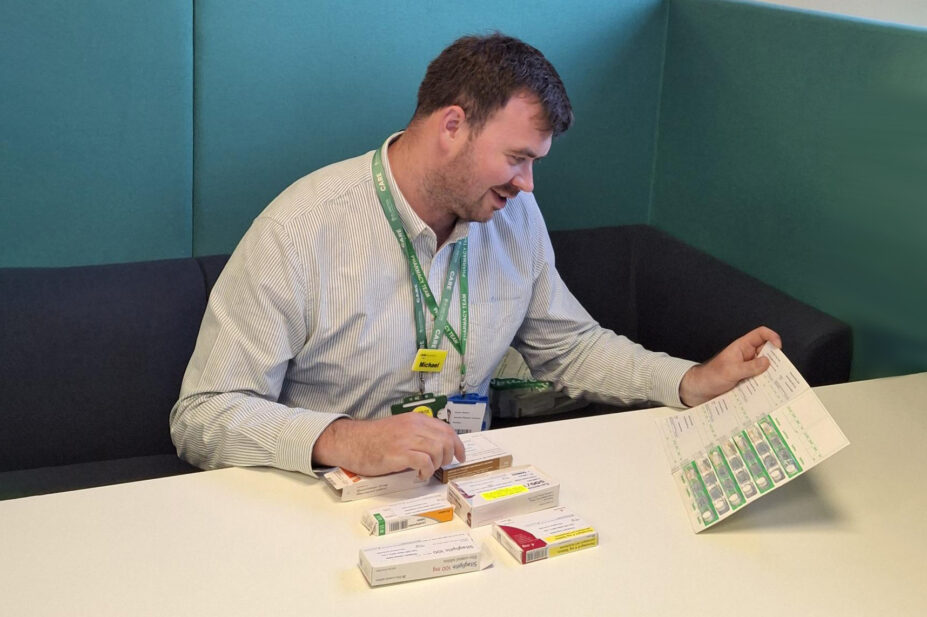
During each visit, I carry out a full medicines review. I check everything against GP and hospital records, looking for discrepancies, duplications or medicines that are no longer appropriate. But more importantly, I look at whether the medicines actually fit the person’s day-to-day life. Can they open the packaging? Do the timings work alongside their care calls? Are side effects, such as dizziness or sedation, affecting their mobility? These practical considerations are just as important as the clinical ones.
One of the most rewarding parts of my job is working with carers. Carers are often expected to administer medicines shortly after a patient is discharged, sometimes with very limited information. This can create a lot of uncertainty and stress. I spend time making sure they feel confident — clarifying which medicines are essential, simplifying schedules where possible and providing clear, written guidance that fits into their care routines.
Something as simple as aligning medicine timings with care visits can make a huge difference
I’ve seen how much of a difference this makes. When carers are no longer worried about whether they’re giving medicines correctly, they can focus more on supporting the person’s recovery and independence. Something as simple as aligning medicine timings with care visits can make a huge difference, particularly for conditions such as Parkinson’s disease or when strict timings are important.
Another important part of my role is making sure medicines align with reablement goals. For example, if someone is too drowsy to engage in physiotherapy, we need to ask why. Is it a sedating medicine? Could it be adjusted? On the other hand, if pain is preventing someone from moving, we need to ensure their analgesia is adequate. These conversations often involve working closely with GPs and the wider multidisciplinary team to make changes that genuinely support recovery.
What makes this role unique is that it sits outside traditional pharmacy structures. I work autonomously, directly with patients and carers, focusing not just on medicines optimisation but on functional outcomes — what really matters to the person at home. In many ways, I act as a bridge between health and social care, translating clinical decisions into practical, person-centred solutions.
The impact of this work is something I see every day. Patients often become more confident in managing their medicines, and carers report feeling less anxious and better supported. In many cases, medicines-related issues no longer delay progress, allowing reablement to move forward more smoothly.
The data reflect this too. I track caseloads and outcomes and found that between January 2026 and April 2026, 42% of patients became fully independent with their medication, while 18% managed safely with family support. Just over one-quarter (28%) needed short-term follow-up within reablement, while only 8% required long-term care support. That means 88% avoided long-term care, highlighting the significant impact of medicines optimisation on independence and recovery.
Being able to see the direct impact of medicines optimisation on someone’s independence and quality of life is something I value deeply
Of course, the role is not without its challenges. Working across multiple locations, managing time effectively and adapting to different home environments can be demanding. Each situation is unique and not everything goes to plan. But despite this, the role is incredibly rewarding. Being able to see the direct impact of medicines optimisation on someone’s independence and quality of life is something I value deeply.
As healthcare continues to shift into community settings, I believe roles such as this will become increasingly important. Pharmacy technicians have a lot to offer beyond traditional environments, particularly in supporting integrated, person-centred care.
From my perspective, this role is not just about medicines — it’s about helping people regain control of their lives. That’s what makes it so meaningful.