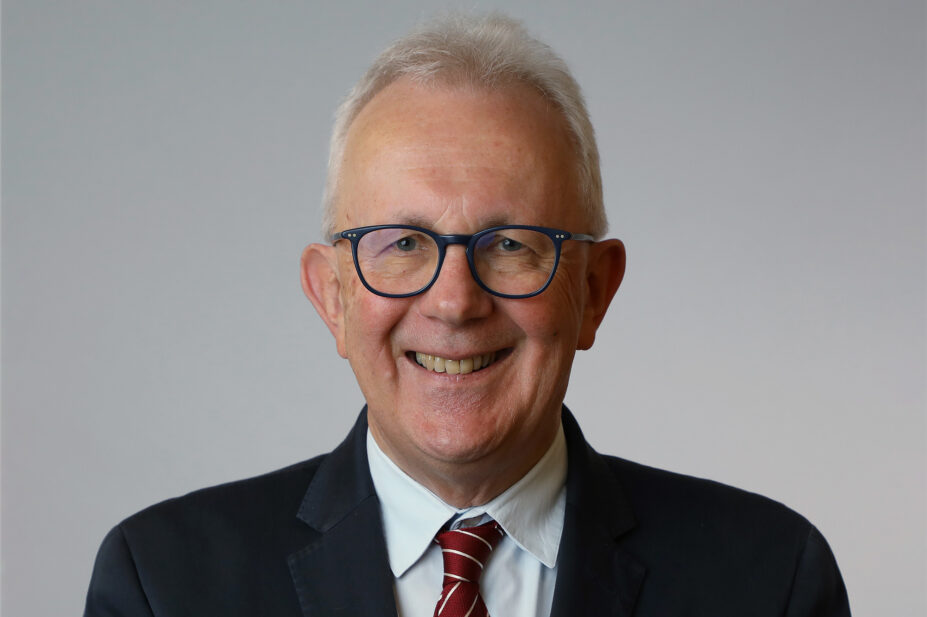
Courtesy of Hugh Taylor
Sir Hugh Taylor chairs the UK Pharmacy Professional Leadership Advisory Board (UKPPLAB), which was launched in 2023 to help implement recommendations made by the UK Commission on Pharmacy Professional Leadership. Sir Hugh spoke to The Pharmaceutical Journal about progress so far and why professional leadership is important for everybody working in the pharmacy sector.
As independent chair of UKPPLAB, Sir Hugh has spent the past few years deep in conversation with people from right across the pharmacy workforce, as well as people who use pharmacy services. It’s clear that — although not a pharmacist himself — he feels very warmly towards the sector: he speaks with palpable enthusiasm about the future and seeing the entire workforce at the top of its game.
Into the mix, in March 2025 came the Royal Pharmaceutical Society (RPS) member vote in support of becoming the Royal College of Pharmacy. Sir Hugh spoke to The Pharmaceutical Journal about this, as well as why UKPPLAB’s work matters to everyone in the sector and why he’s optimistic for a collaborative future.
Why should the average pharmacist be interested in the work of UKPPLAB?
Well, I don’t expect them to be thinking about it every day of the week. But for professionals working in pharmacy, professional leadership should matter. It’s how they get represented in the world, in national policymaking and in working with other health professions. But also, having a strong and effective professional body should provide you with professional support in areas such as education and training, and in helping you and your teams face some of the challenges that pharmacy — and indeed the whole health sector — is facing.
UKPPLAB is helping, I hope, to build a stronger, more inclusive form of professional leadership
Also, if you are a member of a profession then contributing to the development of issues such as education and training, scope of practice and all these sorts of issues, gives you an opportunity to give back. UKPPLAB is helping, I hope, to build a stronger, more inclusive form of professional leadership. But I don’t expect people to take a detailed interest in governance — that is the responsibility of the leaders of those organisations working with their members.
People don’t go to work in the morning worrying about what’s going on in UKPPLAB; they worry about the pressures they’re going to face at work. But you do want your professional representation to be as strong and effective as possible, both for your profession and in terms of supporting your professional career.
When UKPPLAB was set up, there was a lot of talk about the importance of pharmacy speaking with one voice. How is that going?
I’ve learned to be a little bit careful about that expression because there are lots of voices in pharmacy that need to be heard and don’t want to be levelled out. I think what people mean by this is a stronger collective leadership. The professional leadership landscape in pharmacy is fragmented. I’m not a pharmacist or a pharmacy technician, but I think since the split with the regulatory body in 2010, that’s become more of an issue. What the board is trying to do is to establish a stronger sense of collective leadership, bringing people together and ensuring that the different sectors, settings or specialisms represented within pharmacy all have voices. The stronger the consensus around where pharmacy as a profession wants to position itself within health, the stronger its voice will be.
How do you see the royal college move changing the pharmacy leadership landscape?
That’s the US$64,000 question. As a board, we were set up to do two things: one was to bring together the eight bodies within the spectrum of pharmacy professional leadership, to ensure that they work together on the bread-and-butter issues of professional leadership, such as education and training, scope of practice and professional standards. We’re making good progress on all those areas. Part of that has been to publish a statement of common vision and purpose, which was co-created by all the organisations, with the support of the independent expert members.
But we are an advisory body. We don’t have executive power. But is that a permanent mechanism for collaboration? I think we all have a big question mark about that. So, the other question we were asked to address was: can we come forward with an effective and sustainable model of pharmacy professional leadership for the future?
The stronger the consensus around where pharmacy as a profession wants to position itself within health, the stronger its voice will be
Into that discussion came the added dimension of the RPS’s proposal to establish a royal college. I think it’s been clear from the outset that it has to be seen in the context of the recommendations of the UK commission on pharmacy professional leadership. From the earliest board discussions, the RPS made it clear that it was open to co-create the future of the royal college. I think that’s very important because if it’s simply a reset of the RPS, then nothing much changes.
It’ll be a better governance model. And there are very good reasons for the RPS to do this. But if you’re going to call yourself the Royal College of Pharmacy, the question is: are you going to be more ambitious in your reach within pharmacy? So, is the royal college the make-or-break opportunity we are looking for to transform the landscape of professional leadership in pharmacy, a potentially unifying and inclusive force that meets the aspirations of professionals working in pharmacy in the UK?
There’s a strong sense of commitment on our board to move in that direction: to say, yes, we think this is a real opportunity. And we came to that conclusion for four reasons.
What are those reasons?
First, we feel the time is right to make this move. That’s to do with recognising that fragmentation in professional leadership and pharmacy has probably weakened it, and we’ve already begun to see the power of closer, collaborative working. But coming down the road in pharmacy is a whole host of stuff: technology-driven change, AI and more integrated health services, which is going to cut across professional and organisational boundaries. And the changes that are happening within pharmacy itself around prescribing and the developing roles of pharmacy technicians. All of these things are no respecters of boundaries, and they’re pointing towards the need for a more unified, inclusive model of leadership, without suppressing any part of the system.
The second thing is that the door is open. That’s because of the welcome commitment of the RPS to do this on a co-creation basis. It has been part of the liaison group (see Box) that we set up precisely to get to the heart of these issues. That means there’s an opportunity, and the model of governance that they’ve established for the new royal college is flexible enough to permit changes for the future. Our feeling is the time is to get that right is straight away, rather than wait for things to solidify and then see if you can change them.
The third reason is that it could be a game changer. What we’ve heard in our engagement exercises suggests people have high aspirations for what they want from their professional leadership body: a strong collective voice and ability to bring people together to thrash through tricky issues. And to really focus thinking around patients and the public in a way that crosses sector and organisational boundaries.
The royal college is a very big opportunity for pharmacy, and if pharmacy gets it right, I think it has the opportunity to be quite distinctive
We believe that together we can find a way forward, and that will be about continuing to work collaboratively — and, crucially, taking members along with us on this journey. We want the result, if we can secure it, to be a more inclusive body, and that will raise questions for all the bodies that surround professional leadership and pharmacy at the moment. But those are questions that they’ll have to ask themselves and take members along with them.
We’re committing ourselves to take the plunge on this, to make proposals for how that could be taken forward both on the strategy and on the form of a model for the future. Obviously, this is going to be for the royal college and the bodies then to work through.
It’s also not really a question for the board. It’s a question for professionals working in pharmacy and potentially draws in people who’ve historically seen their membership as lying principally with either the Primary Care Pharmacy Association (PCPA), or the UK Clinical Pharmacy Association (UKCPA) and other bodies, including of course the Association of Pharmacy Technicians in the UK (APTUK). The point is that nobody wants either to diminish what the members of those bodies get from their bodies, or to underestimate the existing achievements and strengths of the RPS.
The royal college is a very big opportunity, I think, for pharmacy, and if pharmacy gets it right, I think it has the opportunity to be quite distinctive. Pharmacy has the potential to play an even more significant role in health systems. Going forward, it really needs a strong professional body to help position that. To me, as an outsider, it looks like a win–win all around.
Am I correct that this board is a transitional board?
That would be the measure of success for us: how quickly we can do ourselves out of the job. It is transitional in the sense that we were set up for three years to look for a more stable, sustainable form of professional leadership. Going forward, we think we can see a way forward on that, which we’ll talk about more in more detail in February 2026.
These things can seem a bit dry. The stuff that’s more interesting, really, is the strategy for the royal college, what it’s going to do, how it’s going to support people and how it becomes a more inclusive body, which is a question of governance and how the relationships work and how you bring specialisms and professions together. So, it doesn’t set the blood racing. What should, is a really a strong voice for pharmacy going forward — a strong voice both to the outer world — and in terms of people knowing that they’ve got a professional body that’s there for them.
It’s not difficult to see within pharmacy how there are potential developments alongside the royal college or its equivalent: credentialing courses and creating clearer career progression routes for people, much in the way that nursing has done successfully. I think there’s plenty to go for there, on what I would call the more technical side, but also in the advocacy side as well, and speaking up for people who are experts in safety of medicines.
And then you have all the other issues that pharmacy and health professionals are dealing with — misinformation on the internet, complexity of medication treatment as people age and suffer chronic disease, all that stuff which is right at the heart of what pharmacists and pharmacy technicians actually do — it’s just so important within the whole medical framework. There’s a risk that pharmacy is always a bit on the outside, so it needs to push itself into the middle. But yes, we’d like to do ourselves out of a job as quickly as possible. I would love to see pharmacy working together to really secure a strong future leadership.
What are you most proud of from what’s happened so far, and is there anything that you’d like to have seen a bit more progress on?
On behalf of the board, I was very proud of the vision and common purpose, because I think it’s such an important statement for a group like that to start with principles and values, rather than trying to get too quickly into structures and all that stuff. But it’s been really great, from my perspective, to see a group of people get to know each other better, work well, learn more about each other’s organisations and learn more about what drives their memberships. I think what I’ve most enjoyed is seeing collaboration work. We had a lot of challenge at the beginning, which was probably needed, but we’ve moved past that.
If there’s a frustration — and I think it’s important for people not to beat themselves up too much on this — there is a concern that all the members of the board feel, which is that we’re not reaching far enough and deep enough into the world of pharmacists and pharmacy technicians. In the engagement processes which we have, you become rather conscious you’re speaking to people who do take an interest in this stuff, who are prepared to come and turn up at a webinar and listen to what’s going on in professional leadership. But as a proportion of pharmacists and pharmacy technicians, it’s still quite a small number.
I’m hoping that the legacy will be an inclusive, thriving, Royal College of Pharmacy
So, I think that’s a challenge for the leadership bodies generally, and for the royal college, is how it can reach further and deeper into the front line of pharmacy, in a time when the pressures are huge, the threats are obvious and there’s not much light at the end of the tunnel. It’s about speaking up for the profession and supporting the professionals. It’s how we make that relevant.
I don’t think we should be dewy eyed about this. It’s never going to be totally comprehensive. No professional body succeeds in doing that. As money’s tighter, membership fees become more of an issue. All of those issues are there to be grappled with for the future. So, I’m just a bit conscious that there’s a risk of an echo chamber for a board such as ours. I think we are all conscious of it — sometimes frustrated by it — and we just need to remember it.
So, in five year’s time, what would you like to look back on as the lasting legacy of the work?
Well, I’m hoping that the legacy — certainly not of my work but of this particular exercise — will be an inclusive, thriving, Royal College of Pharmacy, which is a byword for excellence in medicines, which offers tremendous support to all its members, and through those members, to the patients and the public. A centre of excellence for research and innovation, really pushing the boundaries on education and training. Creating stronger career frameworks for pharmacists and pharmacy technicians, well-accredited post-registration education and training, which is absolutely related to supporting confident, safe activity on the part of pharmacists and pharmacy technicians.
I think that’s within reach, which brings together specialisms with generalists, which sees pharmacists and pharmacy technicians as working in distinct but complementary roles and talking together about the boundaries around scope of practice. I think that’s a really exciting proposition and within five years, if it all plays out well, as I hope it will. I think that’s definitely a comfortable time horizon of really having a humdinging Royal College of Pharmacy.
Box: The UK Pharmacy Professional Leadership Advisory Board’s subcommittees and groups
- The programme subcommittee leads the board’s programme of work on training and education, with representation from the eight professional bodies on the board and inputs from the UK pharmacy deans and regulators;
- The communications and engagement subcommittee supervises the board’s engagement exercises;
- The co-creation liaison group enables collaborative planning on the future form of pharmacy professional leadership between the Royal Pharmaceutical Society and other professional leadership bodies and specialist professional groups on the UK Pharmacy Professional Leadership Advisory Board (UKPPLAB);
- The pharmacy stakeholder forum supports UKPPLAB in communication and engagement with stakeholders across the sector;
- The patient and public reference group brings together people who can speak on behalf of patients and the public, both from lived experience and from working in the area.
You may also be interested in

‘We’re in our early days’: the Royal College of Pharmacy’s first national advisory council chairs on their priorities

Alex Williams: ‘There’s a risk to the resilience of the supply chain if government doesn’t invest’