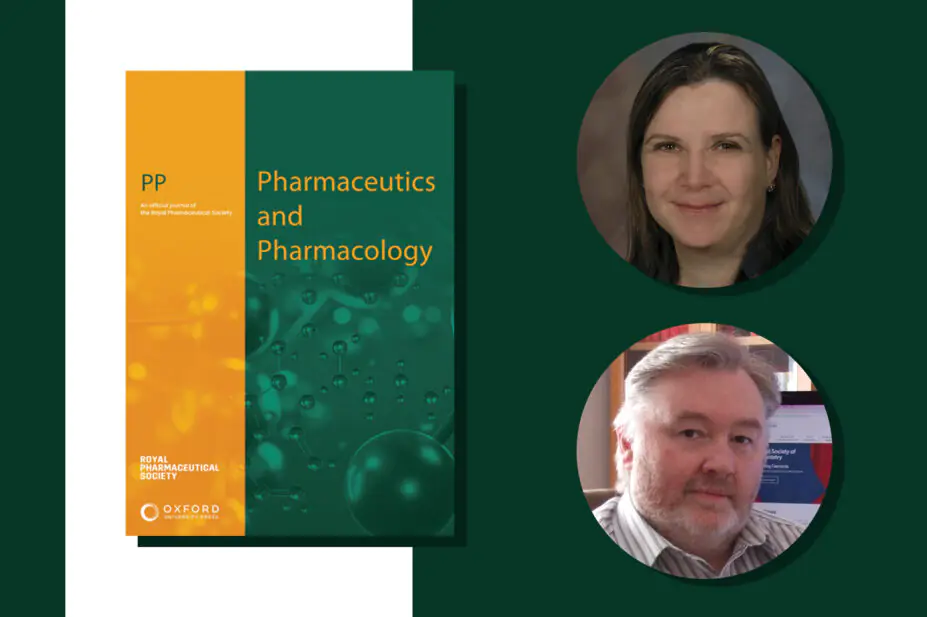
Courtesy of Catherine Sherwin and Gary Moss
Pharmaceutics and Pharmacology, part of the Royal Pharmaceutical Society (RPS) portfolio of peer-reviewed research journals published in partnership with Oxford University Press (OUP), has relaunched with new editors-in chief and an updated research focus.
Pharmaceutics and Pharmacology was originally launched in 2022 as part of the RPS’s then new partnership with OUP, as RPS Pharmacy and Pharmacology Reports. Under the editorship of Dennis Douroumis, professor of pharmaceutical technology and process engineering at the University of Greenwich, it was established as an interdisciplinary journal, covering the lifespan of pharmaceutical research from drug discovery to drug development. It is also the first fully gold open access journal in the RPS journal portfolio, with all research free to read at the point of publication.
In January 2026, the journal underwent a rebrand. Under its new name, the journal is being led by editor-in-chief Catherine Sherwin, discipline lead in clinical pharmacology at the University of Western Australia Medical School and vice president of clinical pharmacology and pharmacometrics at Differentia Biotech, and deputy editor-in-chief Gary Moss, a senior lecturer in pharmaceutics at Keele University School of Pharmacy in Staffordshire.
Sherwin said that, as editor-in-chief, she is looking forward to “building a proper interdisciplinary home for work that improves how medicines are used”, and that the journal is looking for work that “advances safe, effective medicine use, whether through formulation innovation, better understanding of drug action, or dose optimisation”.
The Pharmaceutical Journal spoke to Sherwin and Moss to find out more about their vision for the relaunched publication.
Could you tell us a little bit about your backgrounds?
Catherine Sherwin (CS): My background is in clinical pharmacology and pharmacometrics, predominantly in special populations and paediatrics and maternal-foetal orphan diseases. I’ve been doing that for about 20 years now. I’ve worked in regulation, academia and in industry, across a variety of different settings. I took over as editor-in-chief in the middle of 2025.
Gary Moss (GM): I studied chemistry at Queen’s University, Belfast, and then did a PhD in pharmacy in the Queen’s School of Pharmacy. The purpose of that PhD was to develop anaesthetic products so that they could be used for certain patient groups before surgery.
What appealed to you about this journal?
CS: It builds on a historical background of journals in this group that have good track records, have historically found good readership and have been used as benchmark journals. I saw the opportunity to be at the beginning of something like that; to help build the foundations and help with the direction of it. I felt that I would be able to bring something to the journal based on my experiences, which are quite varied, and felt I would be able to help build up a new scope and focus and help direct the journal to grow.
GM: I had been working with Pharmaceutical Press (PhP) already, as editor of the Handbook of Pharmaceutical Excipients. Before that, I was on the book’s steering committee and I wrote monographs. I’m coming towards the end of my involvement with the handbook in June 2026, which has been a real privilege.
The focus is not just laboratory based, but translational from the bench to the patient — expanding the scope in that perspective
Catherine and I offer different things in terms of subject expertise and different experiences. In terms of editorial backgrounds, Catherine has that more relevant focus on journal publication. I’ve had the experiences with the Handbook of Pharmaceutical Excipients, which is very different type of editing. Together, it makes a nice package. I’m willing to learn and take what I can from both the PhP team and from Catherine as the editor-in-chief.
The journal’s name has changed, but has the journal itself changed?
CS: The fundamental premise of the journal has not changed. What we are trying to achieve is to make ourselves a little more distinctive from some of the other journals within the RPS journal family by bringing in a more distinctive title, focusing more on pharmaceutics and pharmacology, and trying to apply that to a clinical, translational setting where we are looking across the board. The focus is not just laboratory based, but translational from the bench to the patient — expanding the scope in that perspective.
GM: If you look at the Journal of Pharmacy and Pharmacology (JPP), that’s a landmark RPS journal in pharmaceutical sciences that has been published for a long time. It’s important to retain that heritage, and then to try and differentiate from JPP.
For me, the point of differentiation is that idea of more applied research: research that it is more on the development edge of things. Compared with JPP, which is more fundamental science, more novel science. So I think the two journals sit well together.
What difference does this journal make?
CS: I would love to see it being the journal that addresses that space between pharmaceutical science and pharmacology. There are a lot of very specific pharmaceutics journals out there and there are a lot of very specific pharmacology journals out there. There’s very little in the space that bridges those two areas.
As we move forward — particularly in the areas of drug development and in translation from bench to clinical — there’s a home for a journal like this that brings those areas together. I would love to see us be the journal that people are looking for when they think: “OK, this drug was developed. What was its journey; how did we go from the bench, how did the pharmacology evolve?” I would love to see us be at the forefront of that.
GM: The opportunity with the journal is, from my perspective, to look at the manufacturing, industrial, development side of formulation. It really goes all the way back to that idea of the patients being at the centre of this. You learn a lot from seeing the patient group. That’s the one thing that’s stuck with me — maybe more than anything else — where you look at the patient group and think: “Right, how will they respond to a certain type of formulation?” What do you think a six-year-old is going to do with a patch if you stick it on their arm? It doesn’t get left alone! That’s really the root of where good formulation comes from — it’s understanding the patient. The journal has a real opportunity to develop in that space and to open that space out to researchers.
How do you find peer reviewers for the journal?
GM: The more reviewers, the better. What we’re always interested in is the quality and the independence of the review. With any specific area, you would know people who do the major research in that area and within that, you can see people who’ve developed into different areas, whether more fundamental or more applied, so we have a good knowledge. Those people are often incredibly busy and they’re being identified by other journals and being asked by them to be peer-reviewers. There’s a lot of pressure in the academic sector at the moment.
Getting involved in a journal can be a fundamentally important thing to do
We would like younger academics to contribute. These are important roles that develop things such as external reputation, decision making skills and a very broad knowledge of what’s happening in your field. So, for researchers and younger researchers, getting involved in a journal can be a fundamentally important thing to do.
Who should consider submitting to this journal? What advice would you give to someone who thinks this might be the place to publish their research?
CS: Although we don’t have some storied impact factor yet, you can think of it as an investment in your own research; in the audience that will come to a journal such as this because it is associated with OUP and the wider RPS journal group that we are part of. That negates concerns about impact factors. We have enough of a structure within the journal, which we’re building and growing, that we will be able to convince people that it’s worth the investment to publish with us.
GM: First, industry would be the real source for me: those people out there making things and trying to jump over from research into development. That’s a real space I’d like to occupy in terms of where this journal identifies itself. Second, thinking about the idea of novelty in research, there is value in being able to understand the more applied research: using a new chemical for the first time, using a new method of analysis for the first time, taking those things and moving them into a space that’s more applied, more relevant for end users.
CS: It’s a great opportunity to get published and achieve high visibility of your work. It means that the editors, myself and Gary, are going to give your paper good attention. I pride myself on trying to give authors good feedback, even if it doesn’t fit the scope or even if the manuscript is not up to standard. It’s a good opportunity for people to publish in a newer journal.
GM: Part of the process of getting a good impact factor will be to maintain the high quality of science. It’s almost a circular thing to think about, but the structure of what we’re considering is to put the journal in a unique space and to badge it with that unique heritage. I do think, certainly in pharmaceutics, there’s space for a journal such as this.
Box: More on Pharmaceutics and Pharmacology
Zita Zachariah, managing editor of the RPS research journals, describes Pharmaceutics and Pharmacology as “an inclusive venue to publish quality research across the breadth of the pharmaceutical sciences”.
“Essentially, we are a ‘sound science’ journal — if the science is accurate and reproducible, the journal will not reject a paper based on the novelty and/or potential impact of the work,” she explains.
“The Royal Pharmaceutical Society and Oxford University Press are looking forward to working with Catherine and Gary to take Pharmaceutics and Pharmacology through the next stage of its growth.
“The complementary scientific expertise of the editors-in-chief will ensure that the journal is represented across the breadth of the pharmaceutical sciences.”
Pharmaceuticals and Pharmacology is published quarterly. Researchers thinking of submitting a manuscript to the journal can read detailed author guidelines here.
You may also be interested in

Tase Oputu: ‘Be part of the conversation. Nobody’s opinions are invalid’

‘We’re in our early days’: the Royal College of Pharmacy’s first national advisory council chairs on their priorities