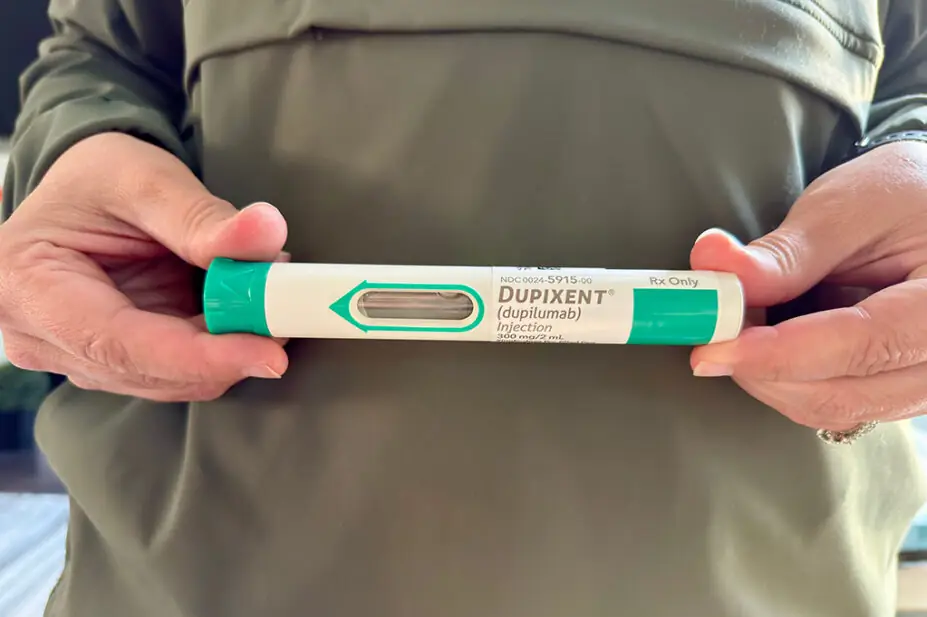
An injection that “offers new hope” for patients with COPD has been recommended for use on the NHS in England and Wales by the National Institute for Health and Care Excellence (NICE).
In final draft guidance published on 26 January 2026, NICE approved dupilumab (Dupixent; Sanofi and Regeneron Pharmaceuticals), a monoclonal antibody that can be offered as an add-on maintenance treatment option to adults with uncontrolled COPD and raised blood eosinophil levels.
The guidance has defined uncontrolled COPD as having experienced one or more severe exacerbations or two or more moderate exacerbations in the previous 12 months.
To be eligible under the NICE recommendation, patients must also be taking triple therapy, including an inhaled corticosteroid, a long-acting beta-2 agonist (LABA) and a long-acting muscarinic antagonist (LAMA), or double therapy, including a LABA and a LAMA, if inhaled corticosteroids are not appropriate.
Dupilumab comes in pre-filled pens and is self-administered every two weeks. The drug reduces inflammation by inhibiting the signalling of the interleukin-4 and interleukin-13 pathway.
Raised blood eosinophil levels are a clinical indicator of type 2 inflammation, which is seen in 30–40% of patients with COPD.
The Medicines and Healthcare Regulatory Agency approved dupilumab in 2023.
Sarah Sleet, chief executive of Asthma + Lung UK, commented: “Today’s NICE final draft guidance recommending the use of dupilumab on the NHS for people with uncontrolled chronic obstructive pulmonary disease, is a major milestone for COPD treatment. Subject to final guidance, this would become the first biologic therapy available on the NHS for people with uncontrolled COPD, who have high levels of a type of blood cell called an eosinophil.
“Alongside major developments like this, there needs to be a drive to get the basics right. Our data indicates [sic] that fewer than 1 in 10 people with COPD receive the basic care they need to stay well. Ministers can radically improve COPD care by committing to a respiratory modern service framework to drive up the care standards across the country.”
Darush Attar-Zadeh, honorary clinical fellow respiratory pharmacist at North West London Integrated Care Board said: “The approval of dupilumab by NICE is very welcome news for people living with COPD. Dupilumab was approved for use in severe asthma in 2021, and it is encouraging to now see strong evidence demonstrating its effectiveness in a specific cohort of COPD patients.
“This decision represents a significant step forward. It is important that eligible patients are now able to access these treatments in a timely and equitable way. Achieving this will require appropriate training and support for healthcare professionals. Charities like the Primary Care Respiratory Society (PCRS) can support with this.”
In documents accompanying the recommendation, NICE said that clinical trials showed that among patients taking dupilumab, the annual rate of moderate or severe exacerbations per year was 0.79 (95% confidence interval [CI] 0.69 to 0.92), compared with a rate of 1.16 (95% CI 1.01 to 1.33) for patients taking a placebo.
NICE figures show that there are 1,151,474 people diagnosed with COPD in England.
According to the draft guidance, when making its recommendation, NICE’s technology appraisal committee took into account the fact that COPD “disproportionately affects people of certain demographics. For example, it is more common in men, people over 40 and people from lower socioeconomic backgrounds”.
“But [the committee] acknowledged that more people from lower socioeconomic groups would benefit from dupilumab. It agreed that this was an uncaptured benefit that could help reduce health inequalities,” it added.
Ahmed Moussa, country lead at Sanofi UK and Ireland, said: “We are delighted that today’s final draft guidance proposes eligible COPD patients a new reimbursed option for care, particularly for those with uncontrolled disease. Subject to final guidance, dupilumab would become the first targeted biologic reimbursed for COPD in the UK and comes after years of limited innovation in this area.
“Our next task will be to work together to ensure a positive decision is followed by clear implementation and delivered in a timely way to eligible patients.”
- This article was amended on 27 January 2026 to clarify how many people there are in England diagnosed with COPD