Courtesy of Claire Anderson
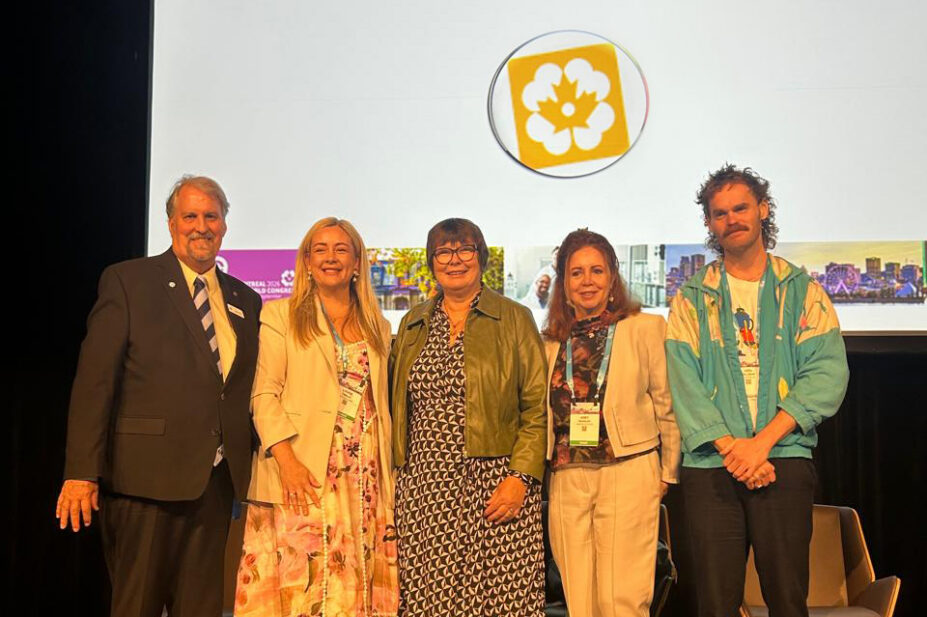
Our session at this year’s International Pharmaceutical Federation (FIP) World Congress — entitled, ‘Global initiatives to advance pharmacists’ prescribing practice and education’ — was packed. It was a sign of significant interest in pharmacist prescribing around the world.
Abby Kahaleh, associate professor of clinical administrative sciences at the Roosevelt University College of Pharmacy in the United States, opened the session by introducing the FIP ‘Global prescribing competency framework’ (GPCF). Pharmacist prescribing is expanding across health systems, but countries vary widely in scope, in the level of autonomy pharmacists have and in how competencies are defined and assessed, she explained. Once developed, the GPCF will be aimed at promoting safe, patient-centred prescribing and global consistency worldwide. It is expected to be completed in 2027.
What do we mean by prescribing?
Louise Curley, senior lecturer in pharmacy at the University of Auckland in New Zealand, set out a definition of prescribing from the Australian Department of Health, Disability and Ageing: “A dynamic process involving the steps of information gathering, clinical and shared decision-making, communication and evaluation, which results in the initiation, continuation or cessation of a medicine.”1
She highlighted four key stages: information gathering; clinical and shared decision-making; communication; and monitoring and review. Competency expectations around the world sit on a continuum of increasing authority — from responding to traditional queries in community settings through to fully autonomous diagnostic and prescriptive privileges, Curley said. The main categories are general, extended, dependent and independent prescribing.
The UK: every new pharmacist is a prescriber
My own contribution focused on the UK, where we have moved from a model in which more experienced pharmacists qualified as prescribers through a postgraduate certificate to one in which all pharmacists qualify as prescribers at registration from 2026. The Master of Pharmacy (MPharm) course has had to change to accommodate this, with a greater clinical focus and more simulation and experiential learning.
This shift brings implementation challenges that have been researched at the University of Nottingham. Research, published in May 2026, revealed that prescribers are ultimately accountable for their own actions; newly qualified prescribers need to start prescribing, with support, immediately after qualifying; and ongoing support — both in real-time and reflective — is critical. That support is a shared responsibility between prescribers, employers and commissioners, which should be built into commissioning frameworks. Experiential learning should also be built into all training programmes.
Community pharmacy can become a frontline prescribing service in England but only if education, support, governance and culture are aligned and resourced
His further work on community pharmacy identified a series of challenges: delays in starting to prescribe, gaps in support, difficulty securing placements, variable governance, risk culture, confusion over liability and performance oversight. Community pharmacy can become a frontline prescribing service in England but only if education, support, governance and culture are aligned and resourced. Immediate next steps could include a planned transition from patient group directions (PGDs) to commissioned independent prescribing services, prioritising the commissioning of support hubs and funding more simulation and placement capacity.
In hospitals, the results of an ethnographic study, published in May 2026, highlighted how systemic structures — especially IT — interprofessional collaboration and individual capabilities interact to shape pharmacist prescribing.
I also compared the picture of pharmacist prescribing across the UK: Pharmacy First Plus in Scotland and the pharmacist independent prescribing scheme in Wales. The situation in England is more complex: five new areas are being added to Pharmacy First, along with the possibility of local commissioning. Meanwhile, many community pharmacist prescribers are now offering private prescribing outside of NHS services, particularly in areas such as weight management and vaccination.
Different routes elsewhere
Curley described the situation in New Zealand, where pharmacists must complete a postgraduate certificate or postgraduate diploma, plus two years of collaborative practice after registration, before they can enter the prescribing programme — a postgraduate certificate in clinical pharmacy (prescribing). It takes a minimum of eight years to become a prescriber, while, historically, it has taken longer in practice. A proposed new pathway could cut this to six years: a Bachelor of Pharmacy (Hons) followed by a one year, work-integrated learning MPharm degree that would allow entry into the prescribing programme.
Prescribing for long-term conditions also varies internationally. In New Zealand, only designated pharmacist prescribers can prescribe — within their area of practice — apart from a couple of protocol-driven exceptions. In Australia, a limited number of states endorse pharmacist independent prescribing. In Canada, it depends on the province: pharmacists in Alberta are independent prescribers, while other provinces vary in their approach on collaborative prescribing and the ability to extend prescriptions.
What helps and what hinders
I finished by setting out what enables pharmacist prescribing: regulation, funding, clinical governance, post-registration continuing education and curricula, support from stakeholders beyond pharmacy, infrastructure and training, as well as the confidence and trust of pharmacists, other health professionals, the public and patients.
We should not lose sight of the purpose of pharmacist prescribing: to benefit patient care
The barriers are, in part, the absence of those enablers. However, they also include the lack of a career pathway and funding, uncertainty around how pharmacists fit into the team and the wider health system, interprofessional identity, limited understanding of the role among pharmacists, other healthcare professionals and the community, and workforce pressures including skill mix.
Curley closed the session with a Māori proverb: ‘He aha te mea nui o te ao? He tangata, he tangata, he tangata.’ This translates to: ‘What is the most important thing in the world? It is the people, it is the people, it is the people.’ It was a fitting reminder that we should not lose sight of the purpose of pharmacist prescribing: to benefit patient care. This should be forefront in our minds.
- 1.National Prescribing Competencies Framework – Embedding Quality Use of Medicines into Practice . 3rd ed. Australian Government ; 2025. https://www.ahpra.gov.au/About-Ahpra/Our-engagement-activities/National-Prescribing-Competencies-Framework