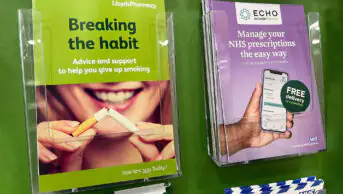
England is on a mission to become smoke-free. Under the Tobacco and Vapes Bill, expected to take effect in 2027, it will be illegal to sell tobacco products to anyone born on or after 1 January 20091. The aim is to create “a smoke-free generation” and reduce the burden of smoking, which is estimated to cost England at least £21.8bn a year, £1.9bn of which is from the NHS, according to charity Action on Smoking and Health (ASH)2.
However, support for quitting is inconsistent among current smokers. Only a handful of community pharmacies are regularly providing the national smoking cessation service and analysis of Community Pharmacy England (CPE) data by The Pharmaceutical Journal has revealed that payment claims tend to hover below 1,000 per month (see Figure 1)3.
Figure 1: How smoking cessation payment claims stack up
At the same time, there is variability in what is available from local authorities. Fewer than half of local authorities in England commission a smoking cessation service from community pharmacy, according to a Company Chemists’ Association (CCA) report published in partnership with Pfizer in January 20264.
Variability in local public health commissioning … has led to a postcode lottery in commissioning
Alastair Buxton, director of NHS services at Community Pharmacy England
“Variability in local public health commissioning, driven by the variations in local population need for stop smoking support and also the historic squeezes applied to public health budgets, has led to a postcode lottery in commissioning,” says Alastair Buxton, director of NHS services at CPE.
CPE hopes upcoming changes to the service specification — to involve the wider pharmacy team and include the use of varenicline and cytisinicline, as well as nicotine replacement therapy (NRT) — will enable pharmacies to make a greater impact (see Box 1).
Box 1: What is the national pharmacy smoking cessation service and how is it changing?
What does the service involve?
The national pharmacy smoking cessation service in England includes an initial consultation, followed by a programme lasting no longer than 12 weeks, involving follow-up consultations, exhaled carbon monoxide (CO) tests, and provision of behavioural support alongside smoking cessation tools. The final consultation includes self-reported smoking status, followed by a CO test.
Who can provide it?
Currently, the service can only be provided by pharmacists and pharmacy technicians, but it will be expanded to allow “trained and competent” staff to offer consultations, as part of changes agreed under the 2024/2025 and 2025/2026 funding settlement.
Which tools are included?
The service currently includes nicotine replacement therapy, supplied for a maximum of two weeks at each consultation; however, it will be expanded to offer the option to prescribe varenicline and cytisinicline under a patient group direction, under changes agreed in the 2024/2025 and 2025/2026 funding settlement.
What training is needed?
Individuals providing the service must obtain certification from the National Centre for Smoking Cessation and Training and complete modules on providing specialist support to patients with mental health conditions and pregnant women.
How does payment work?
Contractors receive a set-up fee of £1,000. For each patient, they receive £30 for the first consultation, £10 for interim consultations and £40 for the final consultation.
Limited service
The national pharmacy smoking cessation service launched in 2022. The aim was to reduce health inequalities by enabling pharmacists to provide ongoing, free-of-charge NRT and behavioural support to patients, who would be referred from NHS trusts upon discharge.
Four years later, Buxton reports the service has only “a very limited scope” in England, compared with Scotland and Wales (see Box 2).
Box 2: Smoking cessation services in Scotland and Wales
Scotland: ‘Quit your way’
The Company Chemists’ Association report pointed to Scotland’s pharmacy smoking cessation service as a model example of what could be achieved with consistent commissioning and self-referral. According to Public Health Scotland, pharmacy accounted for over two-thirds (70.4%; n=21,888) of quit attempts made in Scotland in 2024/2025. Patients can contact a ‘Quit your way’ adviser to be referred to a local pharmacy or specialist smoking cessation service provider.
Wales: ‘Help me quit’
The Welsh smoking cessation service was rebranded as ‘Help me quit’ in 2019. Pharmacies play a significant role in supporting successful quit attempts. A total of 929 smokers who successfully quit — defined as patients who passed a CO test four weeks after their quit date — did so using pharmacy support in the year ending quarter two of 2025/2026*. According to data from Stats Wales, this is out of a total of 1,868 successful quit attempts over that period.
“Referral numbers from trusts into the service have been very low, meaning many pharmacies that signed up to provide the service have never received a referral,” he explains.
That point is also underscored by a CCA report published in February 2026 — ‘Expanding smoking cessation support through community’ — which argues that, in its current form, the national smoking cessation service fails to meet demand and adequately address health inequalities4.
This assessment plays out in the numbers. CPE data show that 5,043 pharmacies were registered to provide the national smoking cessation service as of January 20262. Considering there are 10,458 contractors in England, this suggests that nearly half are engaged.
Figure 2: Pharmacies registered to provide the national smoking cessation service as of January 2026
However, the number of payment claims paints a far less positive picture. Only 338 contractors claimed payment for providing smoking cessation services between April and July 2025, according to CPE’s quarterly clinical services dashboard, with only 2,782 claims made over that three-month period2.
On a monthly basis, data show that the number of payment claims regularly falls below the 1,000 mark2. In September 2025, 672 claims were made for smoking cessation services, which pales in comparison with the likes of the new medicine service, for which 951,214 payment claims were made in the same month.
With millions of people still smoking … community pharmacy may not be fully realising its potential role in supporting smoking cessation
Rachel Maynard, senior policy officer at Action on Smoking and Health
ASH provides a caveat to these figures. “These numbers are a cause for concern, but they are unlikely to be the whole picture,” says Rachel Maynard, the charity’s senior policy officer.
“Community pharmacy’s contribution is increasingly happening through wider system pathways and dispensing/supply models rather than the traditional service. For example, pharmacies may be commissioned to provide dispensing-only NRT supply schemes, or deliver patient group direction (PGD) supply services for medications, such as varenicline and cytisinicline, which inhibit people’s enjoyment of nicotine,” she adds.
“However, with millions of people still smoking — many in disadvantaged communities — community pharmacy may not be fully realising its potential role in supporting smoking cessation.”
One of the main recommendations of the CCA report into smoking cessation was that the English system should be modelled on the nationally commissioned service in Scotland, which “could lead to a more than ten-fold increase in provision” (see Box 2)4.
Hospital referrals
In certain parts of England, high smoking rates are translating to a substantial number of pharmacy referrals. Online pharmacy Meds at Home, based in the West Midlands, receives a steady stream of referrals from the local hospital. As a result, it made the highest number of payment claims for smoking cessation services (n=335) during the first quarter of 2025/20262.
“When I started offering the service [in 2025], only one other pharmacy had become accredited. They were being sent everyone in Dudley,” recalls Ash Hussain, pharmacist director at Meds at Home.
Hussain says smoking cessation has become a rewarding service — both professionally and financially — in his business. Still, he can see why not everyone feels the same way.
He believes some contractors are wary owing to the previous, locally commissioned pharmacy smoking cessation service, which involved teams recruiting patients themselves.
“I’ve spoken to some colleagues who own businesses and they had totally misunderstood, they thought they needed to get people onto the service,” Hussain says. “They didn’t realise that actually it’s referrals coming in from the hospital so you just need to be ready and waiting.”
However, hospital referrals are not always forthcoming. That was one element tackled in the CCA report, which called for “digital pathways”, whereby GPs, hospital teams or health and social care workers could refer patients to community pharmacies. It argues that a standardised, seamless process would make it far easier to promote the service.
Still, even if referrals were plentiful, there are other issues. Hussain says some contractors are deterred by the training involved. Anyone providing the service must secure certification from the Centre of Smoking Cessation Treatment and complete modules on providing specialist support to patients with mental health conditions and pregnant women.
However, he points out contractors receive a set-up fee of £1,000 to cover costs.
For Hussain, the crux of the issue is time pressure. “We deal with people remotely, which has forced me to put in place procedures to actively manage my workflow.
“Whereas in a walk-in pharmacy, they have to wait for patients to turn up and it can be a bit chaotic.”
That time pressure is one factor that CPE is hoping to minimise with latest changes to the service specification, made as part of the 2024/2025 and 2025/2026 funding settlement5. They will allow “trained and competent” staff to provide the service alongside pharmacists and pharmacy technicians.
Although there is no set date for the update to come into force — it will depend on changes to IT systems — Buxton believes it will free up more time for contractors.
“These changes will support pharmacy owners to better manage workload across their team,” he says.
Smoking cessation medications
Another crucial change is the addition of varenicline and cytisinicline to the service. Buxton says the medications will be supplied by pharmacists and pharmacy technicians under PGDs to offer patients “a wider range of treatment options”.
That could prove a game-changer for certain patients.
Hussain says he already receives a “few requests” for varenicline.
In addition, a 2023 Cochrane analysis named cytisinicline and varenicline among the most effective smoking cessation tools6. The same review pointed to a lack of access to varenicline resulting from supply issues at the time and the unavailability of cytisinicline in countries, including the UK.
Since then, both medicines have become more readily available — in theory. But until now they have not fallen under the national community pharmacy service and there is confusion over who should prescribe them. As a result, the expansion of the service to include the prescription of varenicline and cytisinicline could be a pivotal move, given the reported difficulties in access.
James Madan, pharmacy manager of Currie’s Chemist in Bradford, Yorkshire, witnessed the problem first hand when his mother was diagnosed with stage one lung cancer and sought support to quit smoking. Initially, she accessed the local authority service, which supplied NRT for 12 weeks.
“She really struggled to quit with just a 12-week programme. She’s spent 40 years smoking and then, after 12 weeks, that support falls off a cliff,” he says.
Gaps or inconsistencies in access are a concern
Victoria Tzortziou Brown, chair of the Royal College of General Practitioners
Getting access to varenicline for ongoing support was far from easy. The GP refused to prescribe the drug because it should fall under the local authority’s smoking cessation service; but that service did not have a prescriber available.
“It’s not really just about my mum,” says Madan. “It’s a much bigger picture. If I couldn’t get this provided for her, then other people will struggle.”
That’s especially true in certain areas. Smoking cessation support and the prescription of specialist medications, such as varenicline, are delivered by locally commissioned stop smoking services rather than GPs, the Royal College of General Practitioners explains.
Yet “gaps or inconsistencies in access are a concern”, says its chair Victoria Tzortziou Brown.
In Leeds, for example, there is no option currently available for the prescription of varenicline, a source tells The Pharmaceutical Journal.
As a result, the council has decided to commission a PGD supply route via community pharmacy, which is in the “early stages”.
The addition of cytisinicline and varenicline to the national service could therefore be an important step in the right direction. Madan would also like to see longer-term support for people who are looking to quit smoking.
He says pharmacies could offer that — but only if they are funded accordingly.
Financial constraints
Madan sees finances as the driver behind the low uptake of the smoking cessation service overall. “According to government’s own economic analysis, pharmacy is £2bn+ short,” he says. “So why would we promote another service and undergo training for something that might not have a good uptake?”
The funding question will also likely dictate the future of the national smoking cessation service. Although Buxton is happy to have secured the latest changes in the 2024/2025 and 2025/2026 funding settlement, but it is by no means job done.
“So many more people could be benefiting from stop smoking support through community pharmacies,” he stresses. “We will continue to advocate for the commissioning of a more comprehensive national service from pharmacies, building on the existing limited advanced service.”
There are millions of smokers who could benefit from the support of pharmacies
Gareth Jones, director of corporate affairs at the National Pharmacy Association
First, CPE would like to roll out an ‘open access’ smoking cessation service that is available to all smokers, without the need for a referral. This could be a win for commissioners, given that a 2016 review funded by the National Institute for Health and Care Research found stop-smoking interventions at community pharmacies were “effective and probably cost-effective for stopping smoking among adults, especially when compared to usual care without nicotine replacement”7.
While the ambition for a national, widely available smoking cessation service has the support of the CCA, which called for an end to regional variations in provision in its report, it also has backing from the National Pharmacy Association (NPA).
“There are millions of smokers who could benefit from the support of pharmacies, which have a long track record of success in this area and in public health more broadly,” says Gareth Jones, its director of corporate affairs.
“The NPA believes pharmacies should be able to offer a nationally commissioned walk-in smoking cessation service, which would end the current postcode lottery for accessing support,” he says.
Ultimately, Maynard believes community pharmacy has a far greater role to play in smoking cessation as a whole — a point that most agree on.
“Community pharmacies are often as the most accessible point of contact within the health system and are well placed to connect people to support and medication,” she says.
- 1.The Tobacco and Vapes Bill 2024. Department of Health and Social Care. November 2024. Accessed March 2026. https://www.gov.uk/government/collections/the-tobacco-and-vapes-bill-2024
- 2.Latest figures show cost of smoking in England up 25% to at least £21.8bn. Action on Smoking and Health. May 2024. Accessed March 2026. https://ash.org.uk/media-centre/news/press-releases/latest-figures-show-cost-of-smoking-in-england-up-25-to-at-least-21-8-billion
- 3.Clinical services statistics. Community Pharmacy England. Accessed February 2026. https://cpe.org.uk/funding-and-reimbursement/nhs-statistics/clinical-services-statistics/
- 4.Expanding smoking cessation support through community pharmacy. Company Chemists’ Association. Accessed March 2026. https://thecca.org.uk/resource/expanding-smoking-cessation-support-through-community-pharmacy/
- 5.CPCF settlement: 2024/2025 and 2025/2026. Community Pharmacy England. Accessed March 2026. https://cpe.org.uk/our-work/negotiations/cpcf-settlement-2024-25-and-2025-26/
- 6.Lindson N, Theodoulou A, Ordóñez-Mena JM, et al. Pharmacological and electronic cigarette interventions for smoking cessation in adults: component network meta-analyses. Cochrane Database of Systematic Reviews. 2023;2023(9). doi:10.1002/14651858.cd015226.pub2
- 7.Brown TJ, Todd A, O’Malley C, et al. Community pharmacy-delivered interventions for public health priorities: a systematic review of interventions for alcohol reduction, smoking cessation and weight management, including meta-analysis for smoking cessation. BMJ Open. 2016;6(2):e009828. doi:10.1136/bmjopen-2015-009828