
Hryshchyshen Serhii / Shutterstock.com
After reading this article, you should be able to:
- Explain the principles of pharmacist credentialing, including how a system-wide community of learning can contribute to success;
- Prepare effectively for credentialing by identifying requirements, mapping learning outcomes to practice, and engaging appropriate collaborators and supervisors;
- Develop and present robust credentialing evidence, applying the assessment blueprint, triangulation of evidence and reflective practice to produce a high-quality portfolio.
The Royal College of Pharmacy (RCPharm) provides pharmacists with credentialing frameworks. These are designed to assure the professional capabilities of patient-focused pharmacists who are working at advancing levels of post-registration practice. They provide assurances to patients and the public, as well as protect the integrity of the pharmacy profession. Currently, the RCPharm defines three levels of practice: post-registration foundation, advanced and consultant practice1. Frameworks are orientated around five domains: person-centred care and collaboration, professional practice, leadership and management, education and research.
Capability is assessed using a programmatic assessment methodology that takes a holistic view of practice by sampling multiple, diverse pieces of workplace evidence2,3. Pharmacists put together a portfolio of their real-world performance through a process of observation and feedback from others, leading to reflection that identifies ongoing development. Standards are ensured through ‘does’ levels of practice that are aligned to Miller’s pyramid of clinical competence, which is a framework that assesses competence from ‘knows how’ through to ‘does’ levels of practice4.
RCPharm has a mandate to develop and oversee credentialing for the profession, bringing together system partners to create and assure co-produced consensus around post-registration levels of practice. The adoption of credentialing has varied between the devolved health systems and different sectors of pharmacy practice have seen different outcomes5. Although pharmacists across all sectors of practice are exposed to opportunities to develop evidence across all learning outcomes, evidencing some learning outcomes can be more challenging for pharmacists in specific sectors of practice. Overall, the uptake of professional credentialing at post-registration foundation and advanced levels remains low. The role of professional credentialing in foregrounding professional capability and professional and public assurance of practice needs to be understood and articulated, with effective leadership creating time and resources for credentialing activity.
To reflect the embedding of prescribing education into the Master of Pharmacy degree6, RCPharm is developing a new ‘enhanced’ framework, replacing the ‘post-registration foundation’ framework. To support that transition, RCPharm commissioned an independent review to identify how to support pharmacists in their credentialing journey. The report, published in 2025, made several recommendations focusing on the importance of a community of learning and a system-level approach to the embedding of credentialing7,8. This article is aimed to translate those findings into practical advice, providing a model to support pharmacists in credentialing successfully.
Establishing a community of learning
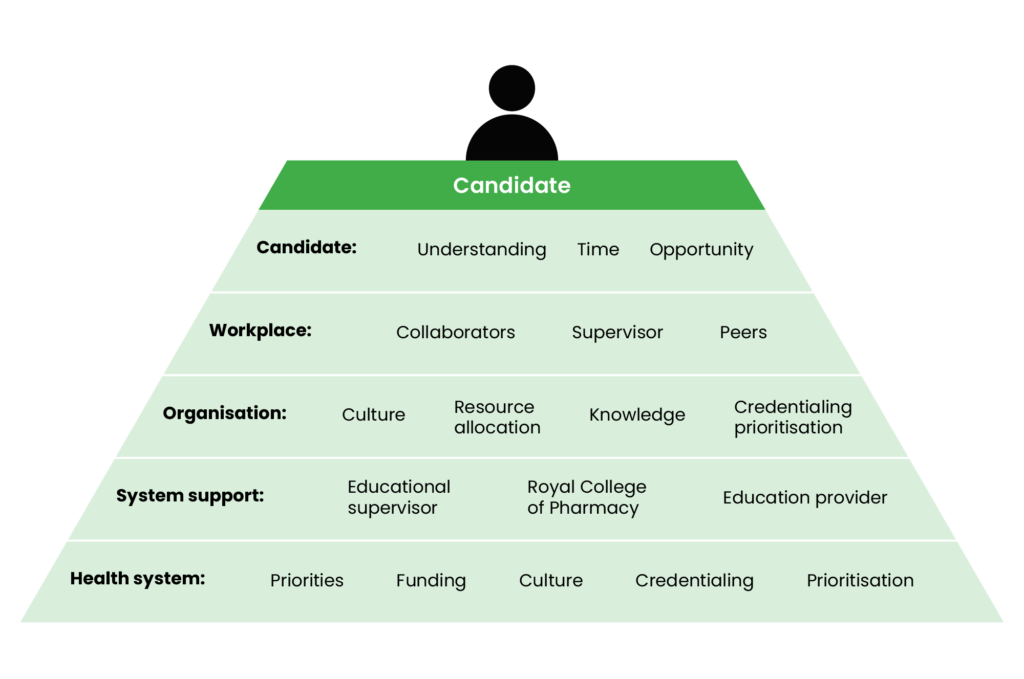
A community of learning is a supportive, enabling ecosystem that surrounds the pharmacist undertaking credentialing (i.e. the candidate). It consists of multiprofessional team members and workplace colleagues — individuals with whom the candidate will collaborate to generate assessment evidence — supported by workplace and educational supervisors who provide direct support for credentialing activity. This community is further supported by the credentialing team at RCPharm and education teams, if credentialing is being supported through an education provider. This community of learning is, moreover, influenced by broader organisation and system-level values and cultures.
Successful credentialing is the responsibility of the whole health system. Leadership needs to be simultaneously top down, with leaders creating the right culture and environment, and bottom up, with the candidate advocating for their own success by understanding credentialing processes, identifying and educating collaborators on evidence requirements and pro-actively seeking opportunities for evidence generation.
Thus, a system-wide community of learning is a nested structure of support, empowered by an understanding of the benefits of credentialing and a culture that will facilitate credentialing activity (see Figure).
Figure 1: A community of learning
Preparing for credentialing
There are practical steps that can be taken even before a credentialing journey begins.
Understand credentialing requirements
Identify learning opportunities that will generate authentic ‘does-level’ evidence against outcomes. As each candidate’s professional context is unique, so will be their learning and associated evidence, with multiple pieces of evidence collected to demonstrate outcomes over time. This may differ from candidates’ previous experiences of portfolio-based assessments (e.g. those commonly embedded in foundation training). Resources are available on the RCPharm website1, while education providers and supervisors will be able to provide further insights, as will peers who have already engaged in credentialing.
Identify and educate potential collaborators
The programmatic assessment requires evidence of real-world practice to be generated through supervised learning events (SLEs) or other professional activity, which should be corroborated by collaborators, who will provide feedback on the candidate’s performance.
Box: Supervised learning events
An supervised learning event (SLE) is a structured event where the candidate undertakes a learning activity and receives feedback from a collaborator to support their learning and development. Important features of an SLE include:
- Observation or description of practice;
- Discussion and reflection;
- Feedback and action planning.
It is essential to identify collaborators who will be able to make a valid judgment and provide useful feedback, as well as understand how to do this well in the context of a programmatic assessment strategy. Collaborators who have previous experience of the credentialing process can often provide meaningful feedback as they understand the programme and the learning outcomes you are trying to demonstrate. For collaborators without experience, it can be helpful to ensure they have a clear understanding of the learning outcomes you trying to demonstrate and focus their feedback on these.
Identify the links between outcomes and professional activity
Within each of the domains of a credentialing framework, outcomes are flagged as low, medium and high stakes, which are relative to their impact on professional risk and patient safety. Although pharmacists in all sectors are exposed to opportunities to develop evidence against all outcomes, some outcomes may be more challenging to evidence than others7,8. Additionally, some of the outcomes require direct observation of practice by collaborators9.
Undertaking the learning needs analysis within the e-portfolio and starting to map outcomes to professional activities — using the RCPharm evidence planning tool10 — will help to identify challenging outcomes but also those activities that provide evidence across multiple outcomes simultaneously. For example, undertaking a clinical audit and communicating findings to colleagues may allow several outcomes associated with collaboration, as well as leadership and management, to be demonstrated. Mapping will ensure opportunities for evidence generation are not missed.
Identify time and support and advocate for personal development
Credentialing activity will inevitably impact the workload of candidates, collaborators and workplace supervisors. Identifying time within existing work schedules or negotiating protected learning time will facilitate credentialing activity. In organisations where the benefits of credentialing are understood, protected time is often made available. If credentialing is less understood, the candidate may have to make a case for time allocation. Personal leadership is important: candidates should not expect organisations to allocate resources without justification, and they will be expected to demonstrate progression.
Generating evidence
Interpreting and understanding the outcomes is important when starting to gather evidence. Many outcomes are multi-faceted, covering multiple actions or behaviours, and all facets must be evidenced. Outcomes are orientated around high-level capabilities, with descriptors used to provide detail and context1. However, the descriptors are not a checklist of activities that must be undertaken to demonstrate an outcome. Multiple pieces of evidence will be needed to cover a single outcome, depending on the complexity and level of the outcome. Tools to support this are provided by RCPharm10.
Evidence and the assessment blueprint
Before generating evidence, it is worth spending time understanding the assessment blueprint and identifying how activities and evidence can demonstrate outcomes. The assessment blueprint provides guidance on assessment requirements11–15.
The programmatic assessment relies on multiple pieces of evidence combining to illustrate the candidate’s capability. Certain outcomes require evidence that involves direct observation of the candidate’s practice, whereas others permit a broader range of activities. Broader appropriate workplace evidence can also be used, and, for some outcomes, there is a process of accreditation of prior learning (APL)16, where formal education and training can provide evidence against a learning outcome. The approved APL list is growing.
Triad of evidence
To support the cyclical nature of the programmatic assessment strategy, evidence developed needs to demonstrate three key factors: impact or outcome, corroboration and reflection. This is known as the triad of evidence.
Impact or outcome
The evidence needs to be embedded in practice and clearly demonstrate how the candidate has achieved service or patient outcomes. Supporting evidence can be included — for example, a teaching plan or participant feedback to support an educational event developed by the candidate. Spending time planning which activities present impactful evidence will simplify evidence generation and help identify outcomes that will be challenging to cover.
Corroboration
Evidence needs to be corroborated to ensure it contains a true account and actionable feedback. Identifying collaborators who can complete evidence documentation and provide feedback for development is crucial.
Reflection
Safe and effective practitioners can reflect effectively on their own performance and identify further learning needs. Good reflection is a vital evidential component, hence why actionable feedback is required from collaborators.
When a portfolio is submitted for assessment, assessors will be focused on this triad of evidence. Understanding this concept and ensuring that it is central to evidence generation will improve assessment outcomes.
Working with collaborators and supervisors
The support and expertise of collaborators and supervisors are central to credentialing success. Proactive and regular check-ins with supervisors, along with agreeing goals and milestones, will provide external accountability to keep evidence generation on track. Supervisors are not responsible for driving the credentialing journey — personal accountability and motivation is crucial to success.
Collaborators need to provide corroborating comment and actionable feedback. However, asking a collaborator to complete evidence documentation entirely on their own will be a burden on their workload and could lead to poorer evidence. Instead, agree the broad scope of what will be captured on evidence documentation at the time of the learning event, complete that detail and then ask the collaborator to provide feedback. If feedback was provided in the moment, this should be captured by the candidate on documentation for the collaborator to agree. A timeframe for returning completed documentation should be negotiated. Ultimately, the candidate needs to facilitate evidence development and drive the process.
Mapping assessment evidence
Assessment evidence needs to be accurately mapped against outcomes. A single piece of evidence typically maps to up to ten different outcomes. It is essential to ensure that the evidence is accurate and clearly covers the outcomes claimed. The candidate should state explicitly why their evidence has demonstrated a particular learning outcome. Supervisors and education providers can help with the mapping of evidence and provide feedback on accuracy and appropriateness. Seeking such support early in the processes is recommended.
Submitting a completed portfolio
Submitting a clear and navigable portfolio for assessment will streamline the process. The candidate should include a ‘context statement’, which is an overview of the candidate and the scope of their professional role. This provides assessors with insight into the candidate’s role, workplace and collaborator roles. A good context statement allows the assessors to understand the evidence presented within the reality and limitations of the candidate’s role, allowing for contextualised assessment.
A portfolio is not complete unless there is sufficient evidence to demonstrate all outcomes. Before submitting the portfolio, undertake a critical self-assessment of evidence. Any poor or weak evidence should be archived or removed. There should be an appropriate volume of evidence that meets the triad of evidence standard. Within each domain of outcomes, provide a narrative that highlights the important pieces of evidence presented and how these demonstrate outcomes within the domain.
Assessment outcomes and receiving feedback
Each portfolio domain will be assessed as ‘domain met’ if there was sufficient assessment evidence, or ‘domain not evidenced’ if assessment evidence was unsatisfactory or insufficient. For ‘met’ domains, feedback will highlight good practice and areas for ongoing development. For a ‘domain not evidenced’ outcome, feedback will provide specific detail on which outcomes were not met and why. As feedback forms part of the learning cycle embedded in the programmatic assessment, feedback on outcomes should be viewed as a central part of ongoing development, not a criticism or statement of failure.
Receiving feedback, particularly when it is developmental and unexpected, can be challenging. Emotional responses can inhibit feedback engagement17,18. There is evidence that pharmacy learners may be emotionally adversely affected by negative assessment outcomes19 and associated feedback20, as well as may be reluctant to discuss failure with peers19,20. Allow time for emotional responses to feedback to subside before objectively discussing the outcomes with supervisors. Then you can establish a clear plan for resubmission and not be demotivated by negative assessment outcomes.
Conclusion
Curating a high-quality portfolio of evidence is essential to credentialing success at all levels of practice. A supportive community of learning can help candidates to achieve this through a thorough understanding of credentialing requirements, effective collaboration and actionable feedback. A clear grasp of each learning outcome, strategic use of evidence to demonstrate the outcome and the appropriate selection of collaborators will aid credentialing success. Candidates should take advantage of the resources available from RCPharm and educational providers, as taking time to read these can help prevent misunderstanding or duplication of work at a later stage.
- 1.Credentialing. Royal College of Pharmacy. 2026. https://www.rcpharm.org/credentialing/
- 2.Carter S, Bennett S, Hawkins J, Southam D. Programmatic assessment: a literature review of challenges, opportunities and useful tools to support student transition to the workplace. Assessment & Evaluation in Higher Education. Published online October 3, 2025:1-18. doi:10.1080/02602938.2025.2567538
- 3.van der Vleuten CPM. Revisiting ‘Assessing professional competence: from methods to programmes.’ Medical Education. 2016;50(9):885-888. doi:10.1111/medu.12632
- 4.Miller GE. The assessment of clinical skills/competence/performance. Academic Medicine. 1990;65(9):S63-7. doi:10.1097/00001888-199009000-00045
- 5.Annual Credentialing Report 2024. Royal College of Pharmacy. 2024. https://www.rcpharm.org/education/annual-credentialing-report/
- 6.Initial education and training for pharmacists. General Pharmaceutical Council. 2022. https://assets.pharmacyregulation.org/files/2024-01/Standards%20for%20the%20initial%20education%20and%20training%20of%20pharmacists%20January%202021%20final%20v1.4.pdf
- 7.McCabe M, Harrison T, Oakley J, Edwards P. Review of The Royal Pharmaceutical Society (RPS) Post Registration Foundation (PRF) Pharmacist Programme. Understanding barriers, enablers and optimal conditions for successful credentialing. National Workforce and Education Conference 2026 – Collaborate Innovate Transform: Delivering change towards improving health, social care and other public services in Scotland. Royal College of Pharmacy . 2026. –
- 8.Harrison T, McCabe M, Oakley J, Edwards P. From Collaboration to Credentialing. How Communities of Learning Facilitate Authentic Workplace Evidence. Clinical Pharmacy Congress. 2026. –
- 9.Programme of assessment. Royal College of Pharmacy. 2026. https://www.rcpharm.org/education/programme-of-assessment/
- 10.Credentialing Evidence Planning Tool. Royal College of Pharmacy. 2026. https://www.rcpharm.org/wp-content/uploads/2026/05/RPS-credentialing-evidence-planning-tool-EPT-FINAL.xlsx
- 11.Consultant Framework Detailed Assessment Blueprint. Royal College of Pharmacy. 2026. https://www.rcpharm.org/wp-content/uploads/2026/04/Assessment-blueprint.pdf
- 12.Advanced pharmacist mental health curriculum. Royal College of Pharmacy, College of Mental health Pharmacy. 2026. https://www.rcpharm.org/wp-content/uploads/2026/06/RPS-CMHP-advanced-pharmacist-mental-health-curriculum-006-june26.pdf
- 13.RPS & UKCPA Advanced Pharmacist Critical Care Curriculum. Royal College of Pharmacy, UK Clinical Pharmacist Association. 2026. https://rcpharm.org/wp-content/uploads/2026/03/RPS-UKCPA-advanced-pharmacist-critical-care-curriculum-190924-B.pdf
- 14.Core Advanced Pharmacist Curriculum. Royal College of Pharmacy. 2026. https://www.rcpharm.org/education/core-advanced-pharmacist-curriculum/
- 15.Post-registration Foundation Assessment Blueprint. Royal College of Pharmacy . 2026. https://www.rcpharm.org/wp-content/uploads/2026/05/Post-registration-foundation-assessment-blueprint-FINAL-domain-5-update.pdf
- 16.Accreditation of Prior Certified Learning. Royal College of Pharmacy. 2026. https://www.rcpharm.org/education/accreditation-of-prior-certified-learning/
- 17.Rowe AD, Fitness J, Wood LN. The role and functionality of emotions in feedback at university: a qualitative study. Aust Educ Res. 2013;41(3):283-309. doi:10.1007/s13384-013-0135-7
- 18.Nicola-Richmond K, Tai J, Dawson P. Students’ feedback literacy in workplace integrated learning: How prepared are they? Innovations in Education and Teaching International. 2021;60(2):196-206. doi:10.1080/14703297.2021.2013289
- 19.Mawdsley A, Islam S, Farooq A, Ledder R. Evaluating the Feedback Literacy Behaviors of Pharmacy Learners: A Case Study from One UK University. American Journal of Pharmaceutical Education. 2026;90(1):101911. doi:10.1016/j.ajpe.2025.101911
- 20.Mawdsley A, Willis SC. Academic resilience in UK pharmacy education – a pilot study applying love and break up letters methodology. BMC Med Educ. 2023;23(1). doi:10.1186/s12909-023-04380-4