NurPhoto SRL / Alamy Stock Photo
- Describe the statutory and operational framework underpinning pharmacy’s role within NHS emergency preparedness, resilience and response, including the legislative context;
- Explain the specific responsibilities of pharmacy teams in medicines management during chemical, biological, radiological and nuclear incidents;
- Identify common system vulnerabilities and lessons from previous incidents and national exercises, and apply these to strengthening local preparedness;
- Outline the strategic value in pharmacy leadership in proactive resilience-building, including embedding preparedness into routine practice through local simulation and contingency planning.
Introduction
Major incidents represent events that overwhelm capacity and require exceptional, controlled healthcare responses to minimise harm to patients, staff and services1. The ‘NHS Emergency Preparedness, Resilience and Response (EPRR) Framework’ defines a major incident as any event that cannot be managed within routine service arrangements1,2. These incidents are not rare. NHS England reported 217 incident declarations in 2024, of which 19 were major incidents and 198 were critical incidents3.
Such incidents place significant demands on pharmacy services across all settings. Mass-casualty incidents — such as major transport accidents, terrorist attacks or industrial disasters — can generate an immediate surge in demand for emergency medicines, analgesics and anaesthetic agents. Pandemics present as sustained major incidents and can expose vulnerabilities in medicines supply chains and workforce capacity, placing high operational burden on healthcare systems4. Chemical, biological, radiological and nuclear (CBRN) incidents present additional complexity as they often require specialist antidotes or countermeasures, some of which require approval through national channels.
The National Risk Register
The UK’s National Risk Register (NRR) 2025 lists pandemics as the most likely catastrophic-impact risk over a five-year horizon, with large-scale CBRN incidents also rated as potentially catastrophic5. The legislative framework governing NHS preparedness is outlined in the Civil Contingencies Act (CCA) 2004, which classifies London Ambulance Service (LAS), NHS trusts, NHS foundation trusts, integrated care boards (ICBs) and NHS England as Category 1 responders, subject to the full set of civil protection duties6. These duties are reinforced by the National Health Service Act 2006 and the Health and Care Act 20227,8. The risk context is further reinforced following the Joint Terrorism Analysis Centre’s decision to raise the UK national terrorism threat level from ‘substantial’ to ‘severe’ in May 20269. This emphasises the importance of pharmacy services having effective EPRR arrangements in place as part of wider organisational and system preparedness1,9.
Statutory and operational responsibilities of pharmacy within EPRR
Pharmacy professionals operating within this legislative landscape carry clinical and operational responsibilities that are central to an effective major incident response4. Providers and commissioners of NHS-funded services are required to demonstrate annual compliance against NHS core standards for EPRR. These set out the minimum requirements for emergency preparedness, resilience and response through a formal assurance process overseen by NHS England10,11. The Royal College of Pharmacy’s ‘Professional standards for hospital pharmacy services’ emphasises the need for robust, integrated pharmacy services that are resilient to disruptions12. These standards require pharmacy teams to maintain medicines supply, patient safety and clinical care during, and in response to, emergencies.
The London Ambulance Service NHS Trust pharmacy team provides specialist medicines governance for emergency preparedness and resilience capabilities, working closely with EPRR and Hazardous Area Response Team (HART) colleagues. Responsibilities include medicines procurement, storage, assurance, quality management, regulatory compliance and operational readiness to support major incident and mass casualty responses. Similar governance arrangements exist across NHS ambulance services to promote interoperability and mutual aid, ensuring medicines are available, safe and fit for purpose during exceptional operational circumstances.
Within the EPRR framework, hospital pharmacy departments have an important role in supporting organisational preparedness, including maintaining continuity of medicines services, contributing to major incident planning, and supporting the safe receipt, storage and deployment of emergency countermeasures1,4. Emergency preparedness is embedded across the General Pharmaceutical Council’s ‘Standards for chief pharmacists’ through the requirements for leadership, clear accountability, risk management, governance, standard operating procedures (SOPs), escalation and resource planning (specifically in standard 4, which focuses on identifying and responding to risks while maintaining safe services)13.
CBRN countermeasures are medicines held in central stockpiles to protect and treat individuals exposed to hazardous materials and are managed nationally through a model involving UK Health Security Agency (UKHSA) and NHS England’s regional EPRR structure14. NHS England’s guidance on requesting and receiving CBRN countermeasures specifically identifies pharmacy departments as designated delivery points for these products, highlighting the important role of pharmacy in such instances14.
The NHS core standards for EPRR details CBRN preparedness requirements, training, exercising and business continuity10. Operationally, the chief pharmacist (or equivalent) holds responsibility for overseeing medicines continuity planning in these instances. In integrated care systems, this responsibility extends to coordination with the local ICB EPRR teams14,15.
The role of pharmacy professionals during major and CBRN incidents
Medicines management: stocklist, stock visibility, stockholding and mobilisation pathways
Drawing on operational experience within the King’s College Hospital pharmacy emergency planning team, and consistent with national EPRR principles, medicines preparedness for a major incident can be considered across four interdependent elements1:
- Having a designated stocklist in line with national guidance;
- Stock visibility;
- Having sufficient stock in the right place at the right time (i.e. stockholding);
- Having a clear, tested plan for deploying stock rapidly (i.e. mobilisation).
Clinicians working in emergency departments may request CBRN countermeasures for patients presenting with exposure to any CBRN products14,16. The request pathway involves escalation to NHS England regional on-call function, which would then result in a coordinated release from the UKHSA stockpile14. It is important that all pharmacy staff, including those on-call, are aware of CBRN countermeasures that are held centrally to allow for prompt signposting if contacted by clinicians from emergency departments.
For example, in the event of a nerve agent incident — such as the Novichok poisonings in Salisbury in 2018, which placed significant demands on local NHS services — pharmacy teams would be required to rapidly receive, verify and prepare antidotes, including atropine and pralidoxime17,18. These agents must be administered promptly because some nerve agents can irreversibly bind to acetylcholinesterase within minutes of exposure, making pre-prepared pharmacy action cards and clear mobilisation pathways clinically critical18.
Hospital pharmacy departments should maintain stock levels relevant to their local risk profile and aligned to their local risk registers. There should be adequate stockholding of mass casualty drugs where appropriate and information on medicines stocked in-house, as well as those that require central coordination (e.g. CBRN countermeasures). Those that require central coordination are stocked in ‘supra-regional centres,’ of which there are eight in the UK19. Stocklists should be available on pharmacy inventory systems and, where feasible, stored in a designated location reserved for these incidents. To avoid wastage, expiry dates should be proactively monitored and stock moved into general inventory when appropriate. OneLondon Trust has a virtual stocklist on its pharmacy inventory system, CareFlow Medicines Management. In the event of an incident, medicines would be packed and sent to emergency departments.
Mobilisation pathways should be clearly documented in pharmacy major incident action plans, integrated into the trust’s overarching major incident plans and should include a pharmacy-specific action card. These should clearly detail actions for staff members, escalation channels, how to request stock centrally and how to receive countermeasure stock. Critically, these plans must be familiar to on-call pharmacy staff in the event the incident occurs outside of normal working hours.
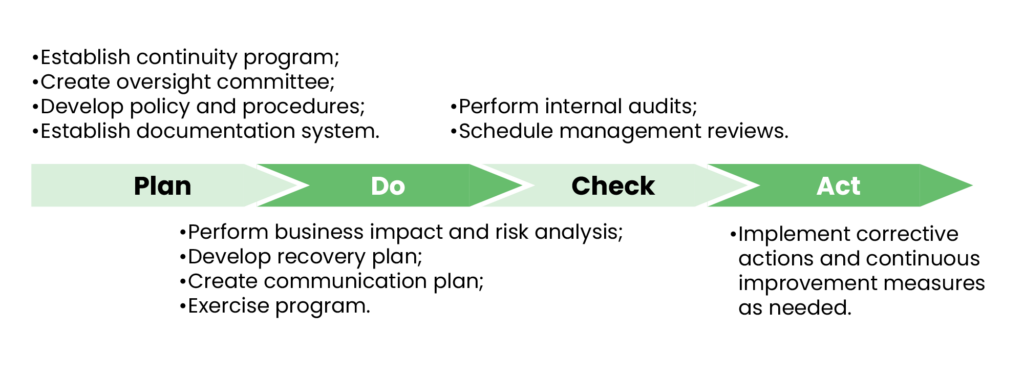
Figure: NHS EPRR Business Continuity Toolkit
Surge capacity and stock resilience
The COVID-19 pandemic revealed the vulnerabilities that exist in global medicines supply chains20. Demand for critical care medicines increased dramatically, particularly sedatives and neuromuscular blocking agents as mechanical ventilation requirements increased20. Geopolitical disruptions can rapidly expose vulnerabilities in the supply chain, and it is imperative that pharmacy departments allocate sufficient resource to manage surge increases21,22.
For mass prophylaxis events, such as those requiring large-scale antiviral distribution during a pandemic, pharmacy teams must be capable of rapidly scaling dispensing operations across population-level demand. This requires pre-agreed procedures for mass prophylaxis measures — from the point of receiving into the pharmacy department, to accurate dispensing and ensuring legal frameworks governing the supply are in place.
Governance and clinical decision-making during major incidents
Major incidents require rapid, evidence-based clinical decision-making in high-pressure situations where there are often periods of uncertainty and resource constraints. The governance framework supporting this must be established before an incident occurs, not during the incident.
NHS England’s ‘Clinical guidelines for major incidents’ provide a platform for establishing and sharing best practice in the clinical management of mass casualty events23. Pharmacists in hospitals and working in ambulance services should have clear escalation pathways to the chief pharmacist (or equivalent) and pre-agreed policies that cover the pharmacy departments response to a major incident/ mass casualty event. These critical policies should be included as part of staff inductions and regular training sessions provided to on-call pharmacists, where applicable. These policies and plans should be accessible to all staff across all sites, in paper and electronic formats, to maintain a level of resilience.
Embedding preparedness into practice: simulation and business continuity
Tested and planned preparedness are fundamentally different. Plans that exist only as documents and have never been practised under realistic conditions carry a significant risk of failure when activated under the pressure of a real incident24.
NHS England’s EPRR core standards require NHS organisations to exercise major incident and business continuity arrangements regularly, with a communications exercise at least every six months, a table-top exercise annually, and live and command-post exercises at least every three years9. These range from desktop ‘tabletop’ exercises to scripted scenarios testing decision-making and communications, through to live full-scale simulations that may involve significant movement of staff and resources10,24.
Evidence from simulation research supports the value of repeated exercising. A study of four hospital pharmacies conducting full-scale simulation exercises found that pharmacies accomplished a mean of 69% of expected actions during a first exercise, rising to 84% following the learning and protocol improvements made between exercises24. Crucially, three of the four participating pharmacies had no major incident SOPs in place prior to the study, a finding that reinforces the gap between formal governance obligations and operational readiness that can exist in practice24.
Local examples
In March 2026, the Guy’s and St Thomas’ NHS Foundation Trust (GSTT) EPRR team conducted a tabletop exercise to test the trust’s mass prophylaxis plan from initial notification through to mobilisation of the mass prophylaxis centre.
The exercise was scenario based and included facilitated discussions and provision of structured feedback during the exercise. Themes identified for pharmacy included the importance of preparedness, robust communication pathways and the rapid mobilisation of pharmaceutical countermeasures. Clear escalation processes for on-call pharmacists and the wider pharmacy team are essential to ensure mass prophylaxis can be delivered with the required timescales. Logistical preparedness for large-scale countermeasure distribution was also identified as a priority. This includes an understanding of NHS England arrangements for bulk medicine supply and the packing down requirements, in addition to exploring measures to improve readiness (e.g. maintaining stocks of pre-prepared labels, packaging materials, and other consumables to support rapid dispensing and distribution during an emergency response). For any information on this scenario exercise, contact umisha.bhuva@nhs.net.
The LAS pharmacy team contribution to EPRR includes contingency planning for medicines shortages, supply chain disruption and business continuity events. The team participates in routine assurance activities and exercises, Preparedness programmes provide opportunities to identify system vulnerabilities before incidents occur, strengthening organisational resilience and supporting continuous improvement.
Business continuity
Business continuity planning involves ensuring core pharmacy services can be maintained or rapidly restored in the event of disruption and is a statutory requirement25. Examples of pharmacy business continuity plans (BCPs) include: loss of IT systems (including electronic prescribing, pharmacy dispensing systems); supply chain failures; staff shortages or industrial action; and physical damage to, or unavailability of, the pharmacy department. BCPs should be reviewed and exercised at agreed time points (see, Table26).
Table: Major incident Action Card Template for out of hours – on-call pharmacist
System vulnerabilities and lessons learned
COVID-19 pandemic
The COVID-19 pandemic provided an unprecedented stress test of medicines supply chains revealing insufficient stockholding of critical medicines, inadequate stock visibility and exposed the under-resourced pharmacy workforce with insufficient surge capacity27. Rapid response, leadership and resilience by the pharmacy workforce nationally mitigated the worst impacts but clearly demonstrated that many trusts lacked pre-existing plans for managing sustained large-scale shortages28.
On-the-ground learning highlighted the importance of workforce wellbeing as part of resilience planning. For example, ICU/intensive trauma unit pharmacists working through the acute phases of COVID-19 benefited from structured psychological support, including regular reflective practice sessions facilitated by a clinical psychologist. This model has since been described in the literature, and demonstrates that supporting pharmacy staff emotionally and professionally is not an optional add-on but a core component of emergency preparedness and response29.
The LAS pharmacy team established medicines governance arrangements for a temporary operational facility associated with the NHS Nightingale Hospital London, including a secure medicines storage facility to support medicines availability for frontline staff and patient transfer activities. Abloy CLIQ® mechatronic access systems were utilised to provide secure, auditable access and maintain governance standards within a rapidly deployed operational environment30.
2017 Manchester Arena attack
The Manchester Arena attack in 2017 highlighted the importance of pharmacy’s integration into major incident command structure. The public inquiry into the Manchester Arena attack in 2017 highlighted failings in pre-hospital emergency care and pain31. This led directly to a programme of work within NHS England to review the clinical response to major incident pathways, including medicines management. The inquiry emphasised the need for rapid deployment of fast-acting analgesia to victims and, as such, recommended a review of regulations to enable paramedics to provide fentanyl lozenges to injured persons32.
Cyber security
Cyber security has emerged as a growing risk and the NHS EPRR internal deep dive 2024–2025 focused on IT resilience reflecting the risk that ransomware attacks could have on electronic prescribing systems and medicines supply to patients, reiterating the importance of regularly reviewing and testing downtime plans10.
For pharmacy services, practical preparedness should include mapping critical digital dependencies for all pharmacy services, developing contingency plans, maintaining tested downtime arrangements, defining recovery priorities, and regularly exercising IT downtime scenarios with digital and EPRR teams.
Practical actions for pharmacy teams to strengthen major incident and CBRN readiness locally
The practical steps shown in Box are recommended for pharmacy teams seeking to strengthen their major incident and CBRN preparedness.
Box: How pharmacy teams can improve their major incident and chemical, biological, radiological and nuclear (CBRN) readiness
- Review local community risk registers and major incident plans to ensure that pharmacy-specific actions are appropriately referenced;
- Develop and exercise a local major incident plan and mass countermeasure pathway for in-hours and out of hours:
- For mass countermeasures, establish a process for receipt, dispensing and supply of mass countermeasure stock as well as the legal framework for supply (e.g. patient group direction).
- Review and test pharmacy action cards that cover major incidents and mass countermeasure pathways with all relevant staff:
- Consider in- and out-of-hours staff;
- Consider training needs of staff and accessibility of plans (physical vs electronic) and training cycles required depending on staff group.
- Establish and maintain a major incident stocklist with appropriate quantities:
- Factor in risk profile of your organisation and measures that can be implemented to reduce likelihood of wastage;
- Consider suitable location to store major incident stock and whether it is logistically convenient in the event of a major incident, or consider a virtual stocklist built into pharmacy systems that can be packed during an emergency as an alternative option.
- Develop training material relating to CBRN incidents (due to their rarity) to enable swift clinical review by staff (or signposting to national guidance);
- Participate in annual tabletop exercises where possible with stakeholders to identify strengths and weaknesses in plans;
- Complete a structured debrief and action plan following each incident, and share with stakeholders;
- Incorporate pharmacy emergency preparedness, resilience and response (EPRR) training into local induction plans for staff and maintain records of training completed by staff (noting this will vary depending on role);
- Regularly engage with local EPRR colleagues;
- Horizon scan anticipated risks/incidents (e.g. How would an electronic downtime impact our major incident pathway?)
Strategic value of pharmacy leadership in major incident planning
Effective medicines management pathways are a central component of incident response and recovery. The COVID-19 pandemic demonstrated in real time that pharmacy leadership at system level was critical to the coherence of medicines response across all sectors.
Moving from reactive response to proactive resilience-building requires pharmacy leaders to treat EPRR as a standing professional responsibility. This means allocating protected time to EPRR activities, building medicines preparedness into pharmacy governance and audit cycles, and championing the discipline.
Best practice
- Familiarise yourself with NHS England chemical, biological, radiological and nuclear (CBRN) countermeasures resources and request pathway before an incident — not during an incident;
- Familiarise yourself with the CBRN antidotes that are stocked in designated holding centres, and have awareness of your nearest holding centre and action plans for their deployment;
- Review impact to major incident medicines when managing or developing stockholding strategies in response to drug shortages;
- Simulation exercises can significantly improve pharmacy preparedness — and mitigate risks to patients and services — consider scheduling tabletop exercises annually;
- Complete a debrief following simulations and following incidents, engaging all relevant stakeholders to capture and embed learning into practice;
- Consider support that may be required for staff exposed to incidents, as part of preparedness activities rather than as an afterthought.
- 1.NHS Emergency Preparedness, Resilience and Response Framework. NHS England. 2022. https://www.england.nhs.uk/publication/nhs-emergency-preparedness-resilience-and-response-framework/
- 2.Annual emergency preparedness, resilience and response (EPRR) assurance report 2023/24. NHS England . 2024. https://www.england.nhs.uk/long-read/annual-emergency-preparedness-resilience-and-response-eprr-assurance-report/
- 3.Annual emergency preparedness, resilience and response (EPRR) assurance report 2025. NHS England. 2025. https://www.england.nhs.uk/long-read/annual-eprr-assurance-report-march-2025/
- 4.Uppal Z, Considine A, Dalby M, Fernandes R. Hospital pharmacy emergency preparedness: Developing a strategy to respond to emergencies and major incidents. American Journal of Health-System Pharmacy. 2024;82(6):369-382. doi:10.1093/ajhp/zxae297
- 5.National Risk Register 2025. Cabinet Office. 2025. https://www.gov.uk/government/publications/national-risk-register-2025
- 6.Civil Contingencies Act 2004, c.36. UK Government . 2004. https://www.legislation.gov.uk/ukpga/2004/36/contents
- 7.National Health Service Act 2006. c.41. UK Government . 2006. https://www.legislation.gov.uk/ukpga/2006/41/contents?utm_source=chatgpt.com
- 8.Health and Care Act 2022. c.31. UK Government . 2022. https://www.legislation.gov.uk/ukpga/2022/31/contents?utm_source=chatgpt.com
- 9.Terrorism and national emergencies: terrorism threat levels. UK Government . https://www.gov.uk/terrorism-national-emergency
- 10.NHS core standards for emergency preparedness, resilience and response guidance. NHS England . 2022. https://www.england.nhs.uk/publication/emergency-preparedness-resilience-and-response-core-standards/
- 11.Emergency preparedness, resilience and response (EPRR) annual assurance process for 2024/25. NHS England . 2024. https://www.england.nhs.uk/long-read/emergency-preparedness-resilience-and-response-eprr-annual-assurance-process-for-2024-25/
- 12.Professional standards for hospital pharmacy services. The Royal College of Pharmacy . 2022. https://www.rcpharm.org/professional-standards/professional-standards-for-hospital-pharmacy-services/
- 13.Standards for chief pharmacists. General Pharmaceutical Council. 2025. https://assets.pharmacyregulation.org/files/2025-01/Standards%20for%20Chief%20Pharmacists%20January%202025.pdf
- 14.Requesting and receiving chemical, biological, radioactive or nuclear (CBRN) countermeasures. NHS England. 2026. https://www.england.nhs.uk/long-read/requesting-and-receiving-chemical-biological-radioactive-or-nuclear-cbrn-countermeasures/
- 15.Advice for health and justice healthcare teams on medicines and pharmacy services continuity during the COVID-19 outbreak. NHS England. 2020. https://www.england.nhs.uk/coronavirus/documents/advice-for-health-and-justice-healthcare-teams-on-medicines-and-pharmacy-services-continuity/
- 16.The management of self-presenters from incidents involving hazardous materials or chemical, biological, radiological and nuclear substances. NHS England. 2026. https://www.england.nhs.uk/long-read/the-management-of-self-presenters-from-incidents-involving-hazardous-materials-or-chemical-biological-radiological-nuclear-cbrn-substances/
- 17.Hughes of Ombersley L. The Dawn Sturgess Inquiry: report into the death of Dawn Sturgess. UK Government . 2025. https://www.gov.uk/government/publications/dawn-sturgess-inquiry-report
- 18.Schaffer D, Hayoun M. Nerve Agents. StatPearls Publishing; 2025. https://www.ncbi.nlm.nih.gov/books/NBK493158/
- 19.Regional holding centres for Category C antidotes – Version 3b. The Royal College of Emergency Medicine. 2023. https://rcem.ac.uk/wp-content/uploads/2024/09/Regional_Holding_Centres_for_Category_C_Antidotes_v1.pdf
- 20.Ways to safeguard UK drug supplies during COVID-19 and beyond. The Pharmaceutical Journal. Published online 2020. doi:10.1211/pj.2020.20207897
- 21.McMillan A. Strait of Hormuz: how some UK medication could be cut off. Procurement Magazine . 2026. https://procurementmag.com/news/strait-of-hormuz-closure-uk-medical-supply-chain
- 22.Managing a robust and resilient supply of medicines. Department of Health & Social Care . 2025. https://www.gov.uk/government/publications/managing-a-robust-and-resilient-supply-of-medicines/managing-a-robust-and-resilient-supply-of-medicines
- 23.Clinical guidelines for use in a major incident: Version 2. NHS England. 2020. https://www.england.nhs.uk/wp-content/uploads/2018/12/B0128-clinical-guidelines-for-use-in-a-major-incident-v2-2020.pdf
- 24.Schumacher L, Senhaji S, Gartner BA, et al. Full-scale simulations to improve disaster preparedness in hospital pharmacies. BMC Health Serv Res. 2022;22(1). doi:10.1186/s12913-022-08230-9
- 25.NHS England business continuity management toolkit: Version 2. NHS England. 2023. https://www.england.nhs.uk/publication/nhs-england-business-continuity-management-toolkit/
- 26.Major incident standard operating procedure: extract [unpublished internal document]. King’s College Hospital NHS Foundation Trust, Pharmacy Emergency Planning Team. 2026. –
- 27.COVID-19 Inquiry must consider pharmacy resilience in case of future pandemics, says RPS. Pharmaceutical Journal. Published online 2024. doi:10.1211/pj.2024.1.329988
- 28.Leonardi Vinci D, Polidori P, Miljković N, et al. Lessons learnt from the COVID-19 pandemic: results of EAHP survey on the future crisis preparedness of hospital pharmacies. Eur J Hosp Pharm. 2021;29(5):242-247. doi:10.1136/ejhpharm-2021-002944
- 29.Fowlis N, Barnett N, Banks S, Jubraj B. A qualitative evaluation of weekly reflective practice sessions for the intensive care unit pharmacy team during the COVID-19 pandemic. Eur J Hosp Pharm. 2022;31(1):57-62. doi:10.1136/ejhpharm-2021-003164
- 30.James RH, Doyle CP, Cooper DJ. Descriptive record of the activity of military critical care transfer teams deployed to London in April 2020 to undertake transfer of patients with COVID-19. BMJ Mil Health. 2020;169(e1):e74-e77. doi:10.1136/bmjmilitary-2020-001619
- 31.Manchester Arena attack: key failings of emergency response. BBC News. 2022. https://www.bbc.co.uk/news/uk-england-manchester-63472531
- 32.Manchester Arena Inquiry report. Volume 2: emergency response. Manchester Arena Inquiry. 2022. https://www.gov.uk/government/publications/manchester-arena-inquiry-volume-2-emergency-response