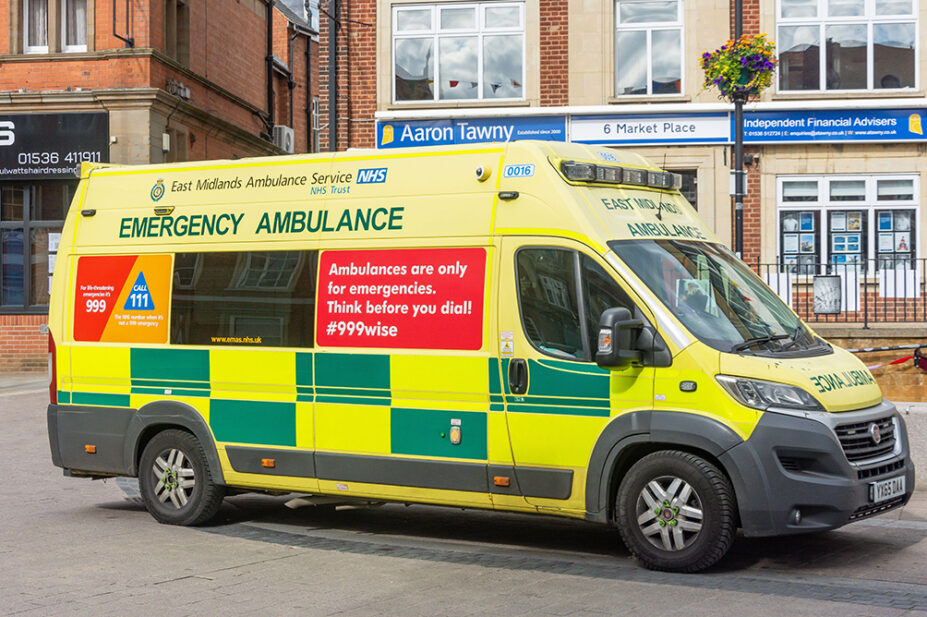
Greg Balfour Evans/ Alamy Stock Photo
A coroner has warned that the triage algorithm used by emergency call handlers should take into account the quantity of drugs a person has taken, as well as the type of drug, following the death of patient.
Anne Pember, senior coroner for Northamptonshire, raised the concern in a ‘Prevention of future deaths’ report, published on 19 October 2026, following the death of Samuel Hand, who died from an overdose on 22 March 2025 aged 32 years.
The coroner said she heard evidence that Hand had told emergency services that he had taken a significant overdose but was not prioritised for ambulance support as the drug he had taken was not on the pathway’s “high risk” list.
Hand reported his suicidal intent to a mental health hub at 3:48am, which then made a call to the ambulance service, the coroner wrote. She added that at 4:36am, the patient then made a 999 call, reporting that he had taken a significant number of tablets in overdose.
The call was designated as category 3 and was not upgraded to category 2 until 7:17am. A double-crewed ambulance was then allocated at 7:47am and arrived at Hand’s address at 8:01am, where a paramedic confirmed Hand deceased at 08:40am.
“It is clear that no consideration was given to the number of tablets taken when deciding the relevant category for disposition. Concentration appears to be entirely on the type of drugs used,” the coroner noted.
The drugs taken were redacted from the coroner’s report.
A spokesperson for the Association of Ambulance Chief Executives told The Pharmaceutical Journal on 20 October 2026 that where patients have taken an overdose, a clinician should be involved to decide if the category is correct — depending on what the patient has taken — but that there is variation in exactly how this takes place in each trust.
In response to the coroner’s report, sent on 6 October 2026, East Midlands Ambulance Service said: “NHS Pathways is a nationally governed, symptom-based triage system designed to identify immediately life-threatening features, including reduced consciousness, breathing difficulty, seizures, shock and certain recognised high-risk substances. It is not a toxicology calculator and does not assess the clinical significance of every reported dose for every medicine.”
It added that the trust was “increasing frontline capacity to support more timely emergency care, including for patients reporting an overdose or other high-risk presentations”, but acknowledged that “these measures do not alter the national triage algorithm”.
NHS Pathways is owned by the Department for Health and Social Care and delivered by the Transformation Directorate of NHS England.
Both were sent a copy of the coroner’s report.
You may also be interested in

Pharmacy regulator and royal college call on NICE to state propranolol is not recommended for anxiety
MHRA reviewing risks and safeguards for propranolol use in anxiety