ALK
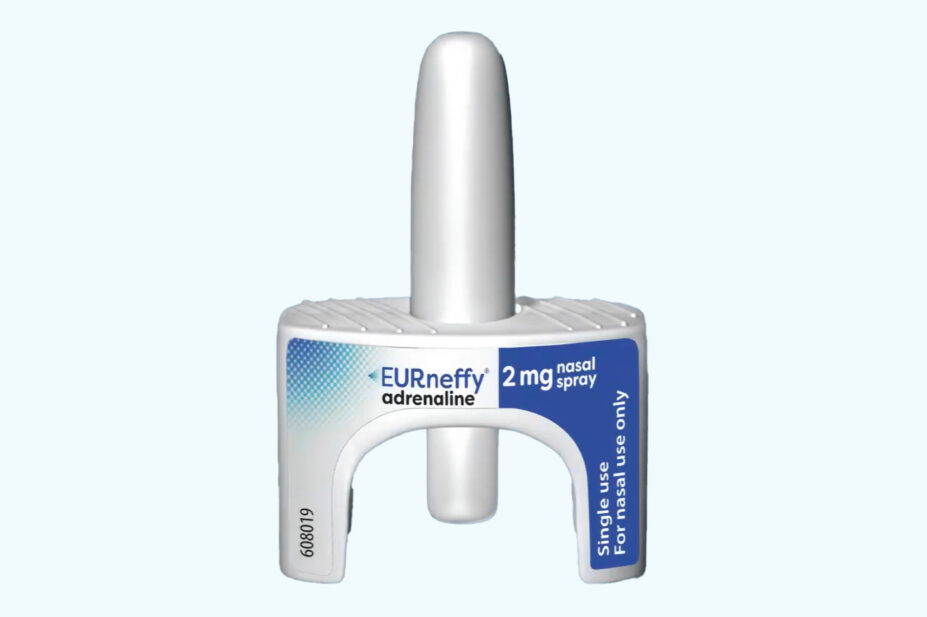
The All Wales Medicines Strategy Group (AWMSG) has recommended EURneffy, a 2mg nasal adrenaline spray, for the emergency treatment of anaphylaxis in NHS Wales.
The recommendation applies to adults and children weighing 30kg or more, covering anaphylaxis caused by insect stings or bites, foods, medicines or other allergens, as well as idiopathic and exercise-induced anaphylaxis.
And since the licence for EURneffy was extended to include the 1mg nasal spray for children aged 4 years and over weighing 15 kg to less than 30 kg in July 2026, health boards in Wales should also make this product available for prescribing in accordance with the AWMSG policy statement on paediatric licence extensions, it said.
EURneffy, marketed by ALK-Abelló, is a ready-to-use, single-dose nasal spray delivering adrenaline as an alternative to adrenaline auto-injectors.
Its use in Wales follows a recommendation from the Licensed One Wales Medicines Assessment Group (LOWMAG), a sub-group of the AWMSG, which met on 1 July 2026.
In its evidence summary, the All Wales Therapeutics and Toxicology Centre (AWTTC), which supports AWMSG and its sub-groups, noted the “bulky” size and short expiry dates of auto-injectors, and that a needle-free alternative would be “welcomed” by some people, including young people and teenagers. It highlighted advantages of the nasal spray for people with needle phobia, neurodivergence or those with additional learning needs, and ALK’s submission that simpler administration may reduce hesitancy among parents, carers and school staff who may need to give emergency adrenaline.
The product was approved by the Medicines and Healthcare products Regulatory Agency (MHRA) in July 2025, when it became the first needle-free adrenaline treatment for anaphylaxis licensed in the UK.
As adrenaline is already an established and widely adopted medicine for the treatment of severe allergic reactions, including anaphylaxis, ALK said it did not plan to submit EURneffy for evaluation by the National Institute of Health and Care Excellence (NICE) or the Scottish Medicines Consortium. Instead, local or regional decisions would be made on formulary inclusion in England and Wales.
However, Emil Stage Olsen, ALK general manager for UK and the Republic of Ireland, said the decision in Wales may help support access in Northern Ireland, “where medicines guidance is often adopted from other UK nations”.
He raised concerns about “significant barriers” to patients accessing the product in England.
“More than a year after the 2mg dose became available in the UK, many ICBs [integrated care boards] have yet to review the medicine, which can limit NHS access for eligible patients. ALK hopes that growing awareness of the unmet need, together with positive developments in Wales, will help support broader and more equitable access across the NHS,” Stage Olsen told The Pharmaceutical Journal on 16 September 2026.
Responding to the recommendation in Wales, Amena Warner, head of clinical services at Allergy UK, said: “Many people and their families live with the knowledge that a severe allergic reaction can happen without warning, making it essential to always carry emergency medication and be prepared to act quickly.
“We welcome the availability of a needle-free adrenaline option in Wales, which provides people with greater choice in how they prepare for, and manage, an allergic emergency.”
The AWTTC evidence summary notes that the British Society for Allergy & Clinical Immunology (BSACI) considers EURneffy a “suitable means of giving rescue adrenaline to treat anaphylaxis”, and recommends “shared decision-making when counselling patients” about using it in place of injectable adrenaline.
However, BSACI said evidence has not shown it to be as effective as intramuscular adrenaline for people who have previously needed more than one dose, or who have had severe anaphylaxis with hypotension — “something which is more common in those with allergy to insect venom”.
For those two groups, the BSACI does not recommend EURneffy as the “sole rescue therapy” and says they should retain access to auto-injectors.
Tanya Ednan-Laperouse, founder of food allergy charity Natasha’s Foundation, said: “We welcome the news that Neffy has now been recommended by the All Wales Medicines Strategy Group (AWMSG). This should mean that Neffy will be a properly funded and routinely prescribed NHS treatment in Wales.
“A needle-free adrenaline nasal spray provides an alternative way to administer adrenaline quickly to treat anaphylaxis — a severe and potentially life-threatening allergic reaction.
“For people with food allergies at risk of anaphylaxis, who have anxieties around needles, it could be a game-changer — giving them greater confidence to quickly administer vital medication an emergency.
“We are also pleased to learn that Neffy looks set to be accessible to children aged 4 [years] and over in Wales (weighing between 15 to 30kg) at risk of anaphylaxis. This is great news as we know these children in particular can find needles scary.”
The manufacturer’s budget impact model, summarised by AWTTC, estimates 20,320 eligible patients in Wales in the first year, with an uptake of 5% rising to 25% by year five. The AWTTC broadly agreed with the estimate, though it noted that some clinical experts in Wales believe up to 7,500 patients may switch to the needle-free alternative.
On cost, the AWTTC added that if calculations are based on the whole shelf life of each product, two EURneffy devices cost £72.84 per patient per year, compared with £60.69 for two auto-injectors — an increase of £12.15 per patient.
The company’s case for savings rests instead on functional shelf life at the point of dispensing, drawn from “real world evidence” it collected from 50 community pharmacies in England, which it said gives an average of 22 months for EURneffy against 11 months for auto-injectors.