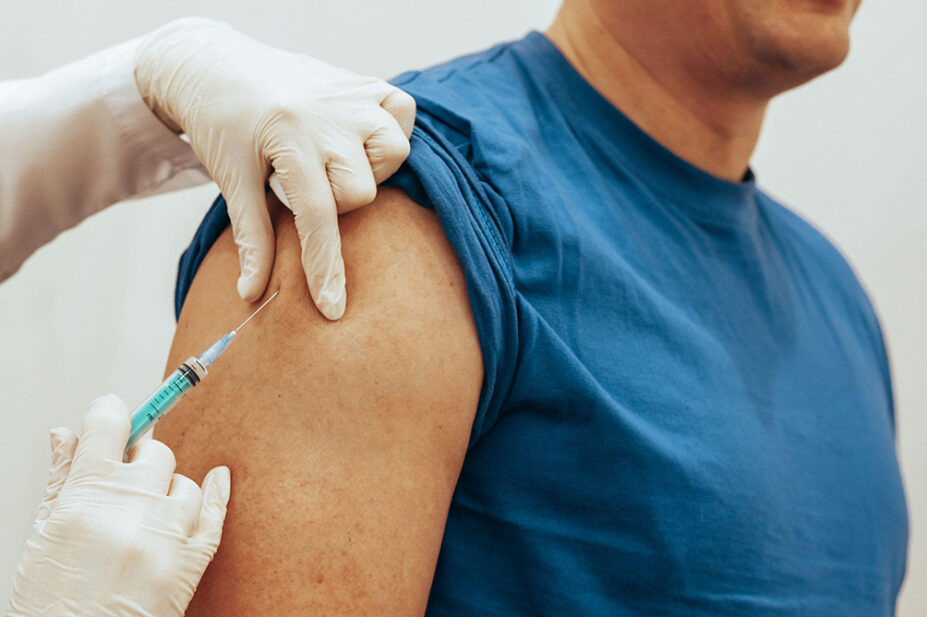
Natalia Khimich/ Alamy Stock Photo
Adding a personalised messenger RNA (mRNA) cancer vaccine to pembrolizumab — an immunotherapy drug — after surgery for high-risk melanoma reduced the risk of recurrence or death by 42%, phase III trial results have shown.
During the trial — the results of which were presented at the European Society for Medical Oncology (ESMO) Congress, held in Madrid on 23–27 October 2026 — researchers analysed data from 1,137 adults who had surgery for stage IIB-IV cutaneous melanoma who were randomly assigned to pembrolizumab with either the intismeran autogene vaccine or placebo.
The data come from an abstract accepted for presentation at the ESMO Congress.
Each vaccine is made from the patient’s own tumour. The tumour is sequenced to find neoantigens, which are abnormal proteins specific to that cancer. Up to 34 neoantigens are encoded in mRNA to help the immune system recognise and attack any remaining cancer cells.
After a median follow-up of 24.6 months, the combination reduced the risk of recurrence or death, the study results revealed.
The study results also highlighted that at two years, 82% of patients on the combination were alive without recurrence, compared with 70% on pembrolizumab alone. The risk of distant metastasis or death also fell by 38%, while the benefits were similar in lower and higher risk groups, the study results showed.
According to a press release on the study, published on 24 October 2026, overall survival data are immature at this stage of interim analysis, while there was no “statically significant difference between the groups”.
Commenting on the study, Alice Tew, consultant pharmacist in oncology and co-chair of the British Oncology Pharmacy Association immunotherapy cancer advisory group, said the results represent an “exciting development” in cancer treatment.
She added: “From an oncology pharmacy perspective, this represents an important step towards increasingly personalised cancer treatment.
“As these innovative therapies move closer to clinical practice, oncology pharmacists will have a key role in supporting their safe and effective implementation, including treatment pathway development, medicines governance, toxicity management and patient education.
“The individualised nature of this treatment also presents new challenges around manufacturing, supply chains, treatment scheduling and equitable patient access. Ensuring that NHS services have the infrastructure, workforce and expertise to deliver these therapies will be essential.”
In the press release, James Larkin, scientific co-chair of the ESMO Congress 2026, who was not involved in the study, said that the reduction in the relapse risk was “clinically significant” and the combination was “very well tolerated”.
Lennard Lee, associate professor of AI and cancer vaccine research at the University of Oxford, commented: “This is a major breakthrough for cancer vaccine research. Although we await the full publication, the findings reported so far provide strong evidence that the vaccine can reduce cancer recurrence.
“Melanoma is less common than many other cancers, yet it can be devastating when it spreads.
“Rather than giving everyone the same medicine, this trial demonstrates the potential of designing cancer vaccines around the unique genetic fingerprint of an individual patient’s tumour.”
“We may be witnessing the beginning of an entirely new way of treating cancer.”