

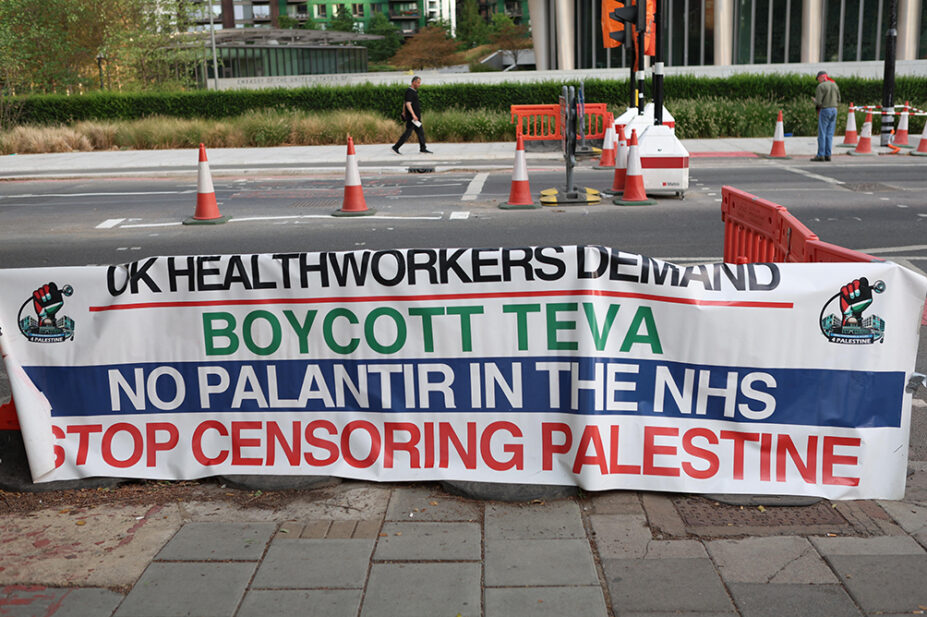
S-Akram / Shutterstock.com
The Royal College of Pharmacy (RCPharm) has decided to end Teva UK’s sponsorship and exhibition presence at its upcoming annual conference, to be held in London on 6 November 2026.
Teva Pharmaceuticals is a global manufacturer of generics and biosimilars, with headquarters in Israel. Teva UK is the UK arm of the company.
In a statement issued to The Pharmaceutical Journal on 9 October 2026, the College said: “The Royal College of Pharmacy has decided to end Teva UK’s current sponsorship and exhibition presence for our forthcoming annual conference with immediate effect.
“This follows a further due diligence review which has brought to our attention the possibility of certain Teva Pharmaceuticals activities which do not align with our values.”
Teva UK, as well as other pharmaceutical companies, has sponsored College events previously, and these were considered on an event-by-event basis in line with the College’s policies and requirements at the time, RCPharm said.
The sponsorship deal with Teva UK was worth £15,000 for exhibitor presence across four College events.
Its decision comes after the Royal College of Nursing (RCN) ended its commercial partnership with the pharmaceutical company on 2 October 2026 over “a number of Teva Pharmaceuticals’ operations, which have been the subject of legal sanction and public scrutiny”.
The RCN acted after an open letter from Nurses for Palestine and UK Health Petitions to the Royal Colleges, which called for “the RCN to disengage with Teva”, received 773 signatures.
A subsequent letter from the same groups called on RCPharm “to end Teva’s sponsorship and exhibition at its 2026 annual conference, alongside demands to end all ties with Teva UK” and received 1,270 signatures.
RCPharm said that after it became a charity in April 2026, the College reviewed all its policies as part of a “comprehensive due diligence process” to ensure the policies aligned with its values and responsibilities.
Future relationships with Teva UK and other parties will be considered in light of internal policies, which are being updated as part of its new responsibilities as a charity, the College said.
A spokesperson from Teva told The Pharmaceutical Journal: “We are disappointed by the Royal College of Pharmacy’s decision, and firmly believe healthcare is at its best when it remains focused on patients rather than being politicised. While we respectfully disagree with this decision, we will continue to act with integrity and remain focused on what matters most: helping patients access the medicines they need.
“We are humbled by the opportunity to serve more than 150 million patients every day around the world and remain steadfast in our dedication to positively impact those we serve, guided by international laws, local regulations, and our shared values.”
14 comments
You must be logged in to post a comment.



Very disappointed with this disgusting decision.
Geoffrey P Jacobs,Ph.D., MRCP
Dr Geoffrey P Jacobs Associates
Consultants to the Pharmaceutical &
Medical Device Industries
POB 3304, Jerusalem 9103301, Israel
Phone 972 2 6422227 Mobile 052 5509207 Fax: 972 2 6432372
i am ashamed of, and disgusted with, the Society I joined 58 years ago. Blatant political actions such as this have no place in the Pharmaceutical Society I joined on graduation in 1968. I would like who made this disgraceful decision which reflects very badly on all the reasonable members. Am Yisroal Chai.
dr.g.p.jacobs@gmail.com
Absolutely disgusted and extremely disappointed with this decision. David Kent and Geoffrey Jacobs are quite right in their condemnation of our Society's, College's, foolish decision. Unhelpful political decisions do not align with our values as Pharmacists. I would like to know, in the interests of transparency who were responsible for coming to this erroneous decision, and to what does ' the possibility of certain activities which do not align with our values' refer.
Bernard E Black 62803 bernardeblack@aol.com
Will all pharmacists who agree with the views of those posted above please contact me. my email is mps63207@gmail.com
The Royal College of Pharmacy welcomes the views of members on this subject, or any other of its activities, via CEO@rcpharm.org
Michael Dowdall - Head of editorial, The Pharmaceutical Journal
RCPharm is not refusing to use Teva medicines or suggesting that pharmacists should discriminate against an Israeli pharmaceutical company. It is deciding whose money and branding it is prepared to associate with the professional leadership body for pharmacy. Given Teva Pharmaceuticals' documented history of major regulatory sanctions, the concerns identified through the College's own due-diligence process, and the relatively small £15,000 commercial benefit involved, it is reasonable for the College to conclude that accepting the sponsorship presents greater ethical and reputational risk than declining it. The same ethical sponsorship standards should, however, be applied consistently to every pharmaceutical company, regardless of nationality.
Matthew Clarke states that the reasons for not accepting sponsorship areTeva Pharmaceuticals' documented history of major regulatory sanctions as a reason for not accepting sponsorship and the risks it poses to the RCP.
On this basis there are many Pharma and allied companies who have a history of major regulatory sanctions but the RCP is still happy to grab their money for sponsorship.
This decision is purely anti semitic and should be called out for what it is.
The RCP are a disgrace to the Pharmacy profession!
They should be ashamed of themselves,
Former Vice President & Treasurer of PSGB
Mathew Clarke has fallen into the trap set by Moslem Brotherhood,Jihadists ,Hamas and other antisemitic ,anti Israel terrorist organisations. Is he aware that two of the exhibitors at the conference last week have had court cases against them. Aspire Pharma, court cases July 2022,February 2024, March 2024 and May 2019. Haleon- court cases 2023, in USA 2024, and2022[ regarding Zantac} and June 2025.
Had there been,here, due diligence process? Have similar standards been applied to all Pharmaceutical companies in an open and transparent way? I think not.
As a professional body the College should model the principles of fairness,proportionality,due process and evidence based decision making. Substance of concerns must be disclosed and the companies concerned duly informed of the substance of concern and given a reasonable opportunity to respond. Further, if the college posseses credible evidence of misconduct, it should openly identify which standards are engaged and set out the process by which the evidence was assessed. If the College does not possess such evidence , or cannot produce it or will not produce it the decision risks appearing arbitrary and highly prejudicial.
A mere possibility of unspecified conduct, is not a sound or transparent basis for taking a decision that may cause significant reputational and professional harm. Use of the term ' possibility' ,appears to indicate uncertanty ,rather than established fact.
My concern is also with the external pressure from the Royal College of Nursing, and associated campaign groups. They seem to have influenced our College into making this erroneous decision. Independent judgement should be exercised and avoid creating the perception that policy decisions are being driven by pressure from outside organisations, rather than objective assessment.
Bernard e Black 62803
bernardeblack@aol.com 9th November 2026
Thank you for the responses.
I agree on one important point: if the College applies ethical criteria to commercial sponsorship, those criteria should be transparent, proportionate and applied consistently to every potential sponsor. That was also the final point of my original comment.
However, inconsistency, if demonstrated, would support scrutiny and reform of the College's sponsorship policy. It would not, by itself, establish that the decision concerning Teva was antisemitic. That is a serious allegation and requires supporting evidence rather than an inference based solely on Teva's Israeli identity.
The scope of the reported decision is also relevant. The Pharmaceutical Journal reports that it concerned Teva UK's sponsorship and exhibition presence, worth £15,000 across four College events. The article does not report any proposal that pharmacists should stop using Teva medicines.
The College said that a further due-diligence review had identified the“possibility” of activities that did not align with its values. It also said that future relationships with Teva UK and other parties would be considered under internal policies being updated following the College's transition to charitable status
There are nevertheless documented matters that a due-diligence process could reasonably consider. In 2023, Teva USA entered a deferred prosecution agreement concerning criminal antitrust charges, accepted responsibility for conduct set out in an agreed statement of facts and agreed to pay a $225m criminal penalty.
In 2024, Teva USA and Teva Neuroscience agreed to pay a further $450m to settle two civil matters. This comprised $425m resolving allegations concerning Copaxone co-payment assistance and $25m resolving allegations relating to generic-drug price fixing and market allocation. These were settlements of allegations, and the $425m agreement expressly states that it was not an admission of liability by Teva.
Bernard Black is therefore right to ask whether comparable scrutiny has been applied to Aspire, Haleon and other sponsors. However, the existence of court cases alone would not necessarily make those companies equivalent to Teva. The nature, outcome, seriousness and relevance of each matter would need to be assessed against the same published criteria.
I would welcome greater transparency from the College about the specific concerns considered, the evidence assessed, whether Teva was given an opportunity to respond, and how the same criteria will be applied to other commercial partners. That would allow members to judge whether the decision was fair, proportionate and consistent.
The proper response to possible inconsistency is consistent scrutiny, not the abandonment of scrutiny. Scrutiny of an Israeli company is not, by itself, evidence of antisemitism. The same standards should apply to Teva, Aspire, Haleon and every other potential sponsor, irrespective of which country they are based.
Matthew Clarke’s response is very measured. Unfortunately, the Royal College of pharmacy and it’s leadership team are basically copying the RPSGB and being non-transparent in their dealings with the membership.
Scrutiny of all Pharma companies sponsoring events should be equal and this is clearly not the case.
Because of pressure from other bodies such as the Royal College of nursing and the NHS, we are succumbing to the belief of the statements coming from these bodies which are based on purely antisemitic tropes?
As a profession I was led to understand that we are evidence based, but clearly when it comes to the Middle East we seem to lose any evidence whatsoever.
Karen Clark as CEO needs to get a grip on this organisation before it starts to fall into the trap of being used as a mouthpiece by these terrorist organisations.
By the way, with no disrespect to Matthew Clarke.. do you work for the journal or are you a mouthpiece for the RCP?
Not quite sure of your status in this audit Trail
Matthew Clarke’s response is very measured. Unfortunately, the Royal College of pharmacy and it’s leadership team are basically copying the RPSGB and being non-transparent in their dealings with the membership.
Scrutiny of all Pharma companies sponsoring events should be equal and this is clearly not the case.
Because of pressure from other bodies such as the Royal College of nursing and the NHS, we are succumbing to the belief of the statements coming from these bodies which are based on purely antisemitic tropes?
As a profession I was led to understand that we are evidence based, but clearly when it comes to the Middle East we seem to lose any evidence whatsoever.
Karen Clark as CEO needs to get a grip on this organisation before it starts to fall into the trap of being used as a mouthpiece by these terrorist organisations.
By the way, with no disrespect to Matthew Clarke.. do you work for the journal or are you a mouthpiece for the RCP?
Not quite sure of your status in this comment trail.
seems to be a glitch with a post comment button🤣🤣