UK COVID-19 Inquiry
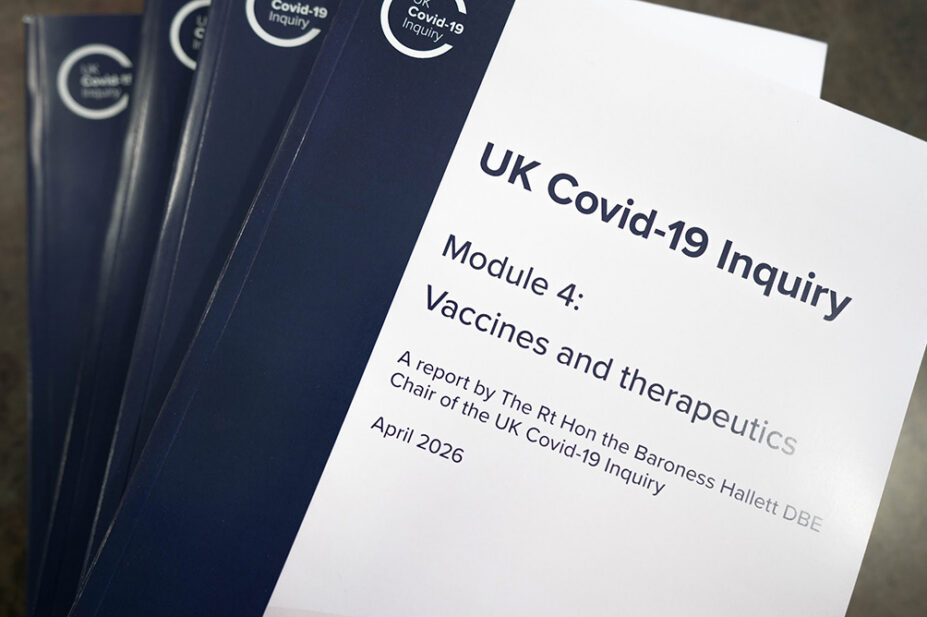
Community pharmacies should be used at an earlier stage in future pandemics, unless there are clear barriers to doing so, the latest report from the COVID-19 inquiry has said.
In the report on vaccines and therapeutics, published on 16 April 2026, Baroness Hallett noted that pharmacies were “underutilised” in the early stages of the vaccine rollout, owing to constraints from the delivery and storage requirements of vaccines.
“The inquiry understands the concern that pharmacies were underutilised at the start of the [COVID-19] pandemic. Pharmacies were a useful way of reaching people in a convenient and familiar way within their local community and proved to be integral to the delivery programme,” it said.
“However, the delivery and storage requirements of the vaccines acted as a constraint in the first few months of vaccine rollout. The desire to avoid waste and initially to restrict their use was reasonable.”
The report noted that only the largest pharmacies were involved in the rollout initially, as NHS England’s position was that the average pharmacy injected about 260 flu vaccines per year, and that pharmacies were likely to be less efficient at delivering high volumes of vaccinations compared with larger sites.
However, by the end of 2021, 1,500 community pharmacy-led vaccination sites had been established in England and were responsible for 20% of all COVID-19 vaccinations during the first year of rollout, the report said.
“In a future pandemic, vaccine deployment planners should use community pharmacies at an earlier stage, unless there are clear logistical or operational barriers to doing so,” it added.
“This will be especially effective in areas likely to have lower vaccine uptake and where travel may be a barrier to vaccine access, including, for example, areas of high deprivation.”
The report also covered vaccine hesitancy and addressing misinformation, noting that lower vaccine uptake among ethnic-minority groups and areas of higher deprivation.
Hesitancy among a small part of the population was driven by both complacency about the need for vaccines and a lack of confidence in the safety of COVID-19 vaccinations, the report said.
It also recommended that local communities across the UK should develop “targeted myth busting”.
“In order to combat misinformation and disinformation, it is essential to engage with communities who may be more vulnerable to it. Targeted ‘myth busting’ at a local level is likely to enhance understanding within these communities and be the most effective way of countering disinformation and misinformation,” the report said.
“Educational initiatives on misinformation, such as ‘pre-bunking’ particularly prevalent false narratives, would also help to reduce public susceptibility to misinformation.”
In addition, it urged the government to combat vaccine hesitancy as soon as possible.
“The process of building trust with communities and reducing vaccine hesitancy will take time and it is not known when the next pandemic will hit. If governments delay the formation of a more effective strategy to address vaccine hesitancy, it may come too late to be effective for a future vaccination programme,” the report continued.
It said that the government should establish a standing pharmaceutical expert advisory panel to oversee the UK’s preparedness to develop, procure and manufacture pharmaceuticals in the event of a pandemic or health emergency.
The report has also recommended that the UK government reform the ‘Vaccine damage payment scheme‘ “as soon as possible”.
This must include increasing the £120,000 payment — at least in line with inflation to date — annual increases in line with inflation, multiple levels of payment, which is commensurate with the degree of injury suffered, and any transitional arrangements necessary to provide for fairness between applicants to the existing scheme and applicants to the revised scheme, the report said.
Regarding vaccine preparedness, the report praised the partnership between government, academia and the pharmaceutical industry as “a crucial part of the UK’s approach to tackling COVID-19”.
However, it cited recent announcements of life sciences pausing or withdrawing investments in the UK, adding that “we will not be as well prepared to face the next pandemic if industry has deserted the UK”.
The report also noted the need to make research a part of everyday clinical activity — in order to improve trial recruitment — and ongoing funding for clinical trial infrastructure.
Commenting on the report, Henry Gregg, chief executive of the National Pharmacy Association, said: “This report suggests that many more people – particularly in deprived areas – could have been helped if the government had turned to the pharmacy network earlier.
“The government could help tackle a wave of vaccine hesitancy that has surged after the pandemic by allowing pharmacies to roll out more vaccination services to patients, particularly in areas where uptake is lower.”
In the inquiry’s previous report on the impact of the COVID-19 pandemic on healthcare systems, published in March 2026, Baroness Hallett said community pharmacies must be funded for any future medicine delivery programmes caused by health crises.
You may also be interested in

Community pharmacists can prescribe outside of existing Pharmacy First age limits, NHS England confirms

Negotiator says there is ‘very little evidence’ of pharmacy involvement in neighbourhood health plans