Mohd Izzuan Roslan/ Alamy Stock Photo
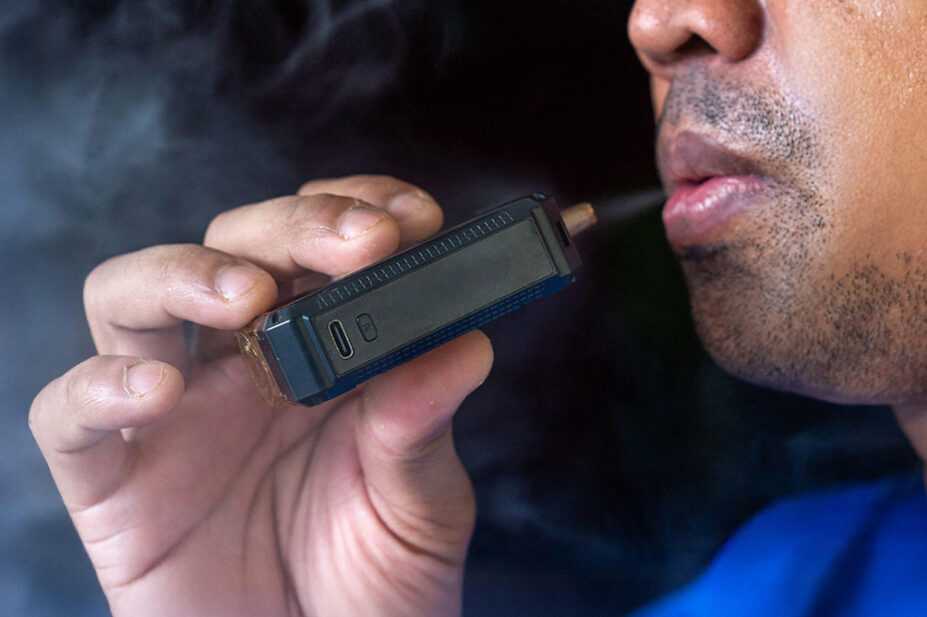
An updated Cochrane review has concluded that nicotine e-cigarettes, or vapes, are more effective in helping people quit smoking than nicotine patches and gums or quitting either with, or without, behavioural support.
Publishing the findings of the review, entitled ‘Electronic cigarettes for smoking cessation‘, in the Cochrane Database of Systematic Reviews on 26 August 2026, the authors examined 80 randomised controlled trials involving 29,861 participants, nine of which were new to this update.
The analysis is part of an ongoing living systematic review that is updated as new evidence becomes available.
The authors found high-certainty evidence that nicotine e-cigarettes led to higher quit rates than nicotine replacement therapy (NRT), such as patches and gum, resulting in approximately four more quitters per 100 people.
Nicotine e-cigarettes also outperformed non-nicotine cigarettes, resulting in around two more quitters per 100 people, the authors noted.
They also revealed that compared to those participants who received no support or behavioural support, such as individual counselling and group programmes, quit rates were still higher when people were also provided with e-cigarettes — although this evidence was less certain owing to risk of bias in the study design.
There was no evidence of increased serious harm from using e-cigarettes to quit, although the authors said that longer-term studies were needed. They added that the findings also applied specifically to regulated, nicotine-containing e-cigarettes.
Lead author Nicola Lindson, associate professor at the Nuffield department of primary care health sciences at the University of Oxford, said: “Quitting smoking is hard and a lot of people who smoke will have tried many times to quit smoking and been unsuccessful. For that reason, it is important that there are a number of different options available to help somebody quit, which could encourage them to keep trying.
“Although nicotine vapes are unlikely to be completely risk free, they are less harmful than smoking and that is the most important comparison to make for people who are still smoking tobacco.”
Senior author Jamie Hartmann-Boyce, assistant professor of health policy and management at the University of Massachusetts Amherst, said there was “very strong evidence” that regulated nicotine e-cigarettes were substantially less harmful than smoking.
“Based on the consistency of the findings here, it’s clear that they are a proven and viable option for people wishing to quit traditional cigarettes. This update includes nine new trials, and our main conclusions haven’t changed,” she added.
Caroline Cerny, deputy chief executive at Action on Smoking and Health (ASH), said: “Around two in three people who smoke long term will die from a tobacco-related illness, so it’s vital we support people to stop smoking. This review confirms that vapes are not only a highly effective quit aid, but that they are also far less harmful than smoking and are a key part of reducing the harm from tobacco.
“Despite this clear evidence, there are still widespread misperceptions that vaping is no less harmful than smoking, which can discourage people who smoke from switching. While vaping is not risk free, and more needs to be done to reduce youth vaping, it is significantly less harmful than smoking and has an important role to play in helping people to quit.”
The results of an ASH survey, published in July 2026, revealed that more than half (54%) of adults in 2026 believed vaping to be as harmful to, or more harmful than, cigarettes.
Andrew McCracken, director of external affairs at Asthma + Lung UK, commented: “This review shows how effective vapes can be in helping people quit, but they are not risk free, so if you don’t smoke, don’t vape. There needs to be a focus on ensuring non-smokers — especially children — don’t take up vaping and on helping people to also eventually quit vaping. We ultimately want to see a world where the only thing entering people’s lungs is clean air.
“More research is needed to understand the long-term impacts of vaping, and as our understanding develops, policymakers need to be ready to adapt and put in place measures to protect people’s lungs. As rates of vaping soar among young people, urgent action is needed to target child-friendly packaging and flavours of vapes, making it less attractive to children while preserving its legitimate role in helping adult smokers quit.”
Ravijyot Saggu, lead pharmacist in medicine and respiratory at Chelsea and Westminster Hospital in London, noted that vapes “aren’t properly regulated, and this poses a problem, especially making them appealing to children and never smokers”.
Hartmann-Boyce also noted that the review only considered regulated e-cigarettes containing nicotine.
“Unlicensed e-cigarettes are potentially dangerous, with issues including unstable batteries and harmful chemicals. Anyone looking to use e-cigarettes to quit smoking should only purchase devices that have been tested and approved by their country’s regulatory body,” she said.
Darush Attar-Zadeh, a clinical fellow respiratory pharmacist with NHS West and North London integrated care board and executive chair of the Primary Care Respiratory Society (PCRS), told The Pharmaceutical Journal on 26 August 2026: “The findings are consistent with the wider evidence considered by NICE [National Institute for Health and Care Excellence], which indicates that nicotine vapes, combination NRT, cytisine and varenicline are all among the more effective cessation options. The PCRS recommends offering people the most effective and least harmful approaches, tailored to their preferences and circumstances.”
But since varied regimens were included in the review, “the results do not establish that vaping is superior to optimised combination NRT, a long-acting product, such as a patch, together with a faster-acting product provided alongside behavioural support”, he said.
Hartmann-Boyce said Cochrane was currently working on a review of interventions to help people quit vaping, which “could be the next step along for people looking to transition to a lower-harm product before quitting nicotine altogether”.