National recommendations suggest around six whole-time equivalent (WTE) staff for an emergency department (ED) the size of the Royal London Hospital’s1. However, the current funded establishment remains below this level, reflecting wider workforce pressures across the NHS.
Since beginning to act on that gap in January 2026, our view is that trusts in the same position should not wait for fully funded staff to arrive. Instead, we need to review how the pharmacy workforce is structured and deployed, ensuring that critical points in the patient pathway are prioritised and that resource is directed to areas with the greatest potential impact on quality of care. A structured reallocation of existing pharmacy resource into an ED can deliver measurable improvements in patient safety, medicines reconciliation, governance and operational efficiency. It also strengthens, rather than weakens, the case for proper funding where the data generated from the reallocated service becomes the empirical evidence the funding case has often lacked.
Our evidence base is just under six months. In this time, we have noticed a positive effect on medical wards that is positively reflected in the key performance indicators. This includes consistently meeting our target of completing more than 90% of drug histories within 24 hours of admission. Operational improvements include improving medicines management in ED and the roll out of quality improvement (QI) projects focusing on controlled drug (CD) management and time-critical medicines.
The model
Our service has three layers. In the first, a medicines management assistant (MMA) and medicines management pharmacy technician (MMPT) are physically present in the ED, Monday to Friday, 09:00 to 17:00. The MMA focuses on stock: top-ups, transfers, expiry checking and returns of unwanted medicines to pharmacy stock. The MMPT focuses on patients: drug histories at admission, identification of patients on time-critical medicines and escalation of concerns to the duty pharmacist.
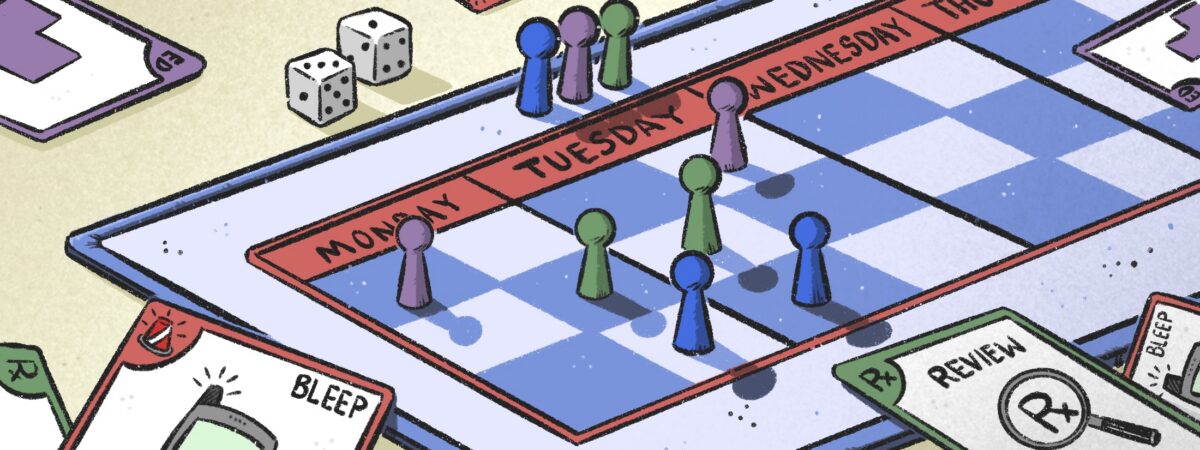
The second layer comprises a band 7 or 8a pharmacist providing bleep cover across the same hours. The duty pharmacist responds to MMPT and MMA escalations, supports prescribing decisions and handles complex queries. Communication runs through a trust mobile phone, which is a small change that has improved reliability over the previous bleep system, allowing uninterrupted communication between the pharmacist and multidisciplinary team.
The third layer is a dedicated pharmacist prescriber attending ED for two afternoons each week, focusing specifically on clerked medical patients awaiting admission. This addresses what is recognised as one of the highest-risk windows for prescribing error: the period between ED clerking and ward transfer2.
Around the team sit several embedded processes: a weekly CD walk around led by a pharmacist; an annual review of the ED ward stocklist with the matron and consultant team; antidote-cupboard management with a documented checking process; and a drug shortages workflow that lets ED clinicians flag issues to pharmacy early rather than wait for them to escalate.
None of the components are unusual — the point is that they work together.
Early evidence
The most striking finding has been in medicines reconciliation3. Before MMPTs went live in ED, drug histories were taken on the receiving ward after admission, by which point prescribing decisions had already been made. In the first months since MMPT deployment, around 800 patients have had a medicines history completed in ED prior to ward transfer. The shift from zero coverage to substantial coverage in a transition window known for prescribing error is significant.
The clinical intervention log helps monitor prescribing issues and spot trends in practice. In a single month, MMPTs logged 22 interventions where a prescribing issue, omission or supply problem was identified and escalated for resolution.
In one example, a patient on regular Humalog (Insulin lispro; Eli Lilly) was mistakenly prescribed Humalog Mix 50. The MMPT picked up the discrepancy during a reconciliation, while the pharmacist amended the prescription before administration, preventing a potential insulin overdose.
Statistical process control charts demonstrate a sustained reduction in nurse time spent on stock top-ups following MMA deployment, releasing capacity into direct patient care
In another example, a patient due to start clobazam was prescribed clonazepam, a medicine with very different pharmacology. The pharmacist identified this and the prescription was corrected before the first dose, averting benzodiazepine toxicity.
Further examples include a patient with epilepsy, admitted without their regular anti-epileptic drugs prescribed. This was flagged by the MMPT and the pharmacist prescribed in time for the next due dose. In addition, two patients with HIV were identified on admission as having no antiretroviral supply. The team arranged supply before transfer, avoiding an omitted dose.
These are the kinds of errors that — without an MMPT physically present in ED — would not surface until the patient reached the ward, by which point the wrong dose may already have been given, the anti-epileptic drug may already have been missed or the antiretroviral may already be a day overdue.
The operational and financial impact has been substantial. In a typical month, around 200 medication orders are now redistributed between ED and other clinical areas, ensuring the medicine is transferred with the patient. When unused stock is returned to pharmacy, it has saved around £3,000. Statistical process control charts demonstrate a sustained reduction in nurse time spent on stock top-ups following MMA deployment, releasing capacity into direct patient care.
We have two years of CD and medicines management audit data from before we implemented this intervention and, overall, there is a positive trend with improving results. In the most recent annual quarter, three out of six of our ED zones achieved more than 90% compliance in CD management. When compared with the rest of the data, this is demonstrable evidence of meaningful improvement.
What we take from this
There are three lessons from this. First, the MMPT role is underutilised in ED. Most discussion of ED pharmacy resource defaults to pharmacist numbers, while the bulk of the patient safety benefits we have seen come from MMPT-led reconciliation, with pharmacists deployed where their clinical judgement adds most value. National workforce planning should be more explicit about the mix of roles, not just the total WTE for ED.
Trusts that reallocate resources without using the resulting evidence to make the case for funding are preventing change
Second, partial coverage can deliver disproportionate value. Our service runs for around 30% of the hours in a week and the impact is substantial. The data we have obtained over the past six months supports a compelling argument, which is a benefit that a substantive ED pharmacist and MMPT could deliver.
Third, reallocation is a stopgap not a substitute. The data we generate strengthens our funding case for proper establishment — it does not replace it. Trusts that reallocate resources without using the resulting evidence to make the case for funding are preventing change.
Honest limitations
Our service does not cover evenings, nights, weekends or bank holidays — a significant gap given ED attendance is 24 hours. The intervention log has been in use for one month and further data is required to capture more interventions. The model depends on goodwill from a pharmacy team with other commitments and is structurally more fragile than a funded service. In addition, not every ED zone has improved at the same rate — some remain a focus.
What other trusts should consider
The components of our service can be easily reproduced without new funded posts: embedded MMAs and MMPTs, a pharmacist bleep service, a dedicated prescriber for a few afternoons a week, structured CD and stock processes and a reliable communications setup. However, it also requires reallocation, governance sign-off, working relationships with ED nursing and medical leadership, and a willingness to start before everything is in place.
Waiting for the workforce gap to be funded risks accepting the safety and operational consequences of under-provision
Waiting for the workforce gap to be funded risks accepting the safety and operational consequences of under-provision. Acting now, with what is available, demonstrates value, generates data and strengthens the case for the resource the national recommendation always intended.
- 1.Joint Position Statement between UK Clinical Pharmacy Association and the Royal College of Emergency Medicine regarding Pharmacists & Pharmacy Services in Emergency Departments. United Kingdom Clinical Pharmacy Association. https://rcem.ac.uk/wp-content/uploads/2023/12/RCEM_UKCPA_Joint_Position_Statement_Pharmacists.pdf
- 2.Medicines optimisation: the safe and effective use of medicines to enable the best possible outcomes – NICE guideline NG5. The National Institute for Health and Care Excellence . 2015. https://www.nice.org.uk/guidance/ng5
- 3.Redmond P, Grimes TC, McDonnell R, Boland F, Hughes C, Fahey T. Impact of medication reconciliation for improving transitions of care. Cochrane Database of Systematic Reviews. 2018;2018(8). doi:10.1002/14651858.cd010791.pub2