Annette Chisom Okeke
A few years ago, it might have seemed unlikely that standing beside anatomical models, making Play-Doh po, and talking openly about self-checking and bowel habits would become a highlight of pharmacy education. Yet this experience sits at the heart of what has made ‘Be aware, be empowered’ so transformative for students, partners and the public.
As pharmacy educators, we talk a great deal about preparing students for real-world practice, but translating that ambition into meaningful, authentic learning isn’t always straightforward. Our ‘Be aware, be empowered’ cancer-awareness, service-learning initiative grew from a desire to bridge that gap, connecting professional skills teaching with a genuine public health need, and doing so in partnership with those who bring their lived experience to the table.
Why we created ‘Be aware, be empowered’
Cancer awareness remains a public health priority, with early detection playing a vital role in improving outcomes, yet awareness of signs, symptoms and self-checking — particularly for testicular and bowel cancer — is still variable. Conversations about cancer can be uncomfortable or avoided altogether.
Pharmacy students often report feeling underprepared for having sensitive, emotionally charged conversations with patients and the public. They learn the clinical facts well, but confidence, empathy and adaptability only really develop through practice.
‘Be aware, be empowered’ was developed to address these challenges. Embedded as a mandatory, credit-bearing, service-learning activity within year two of the MPharm programme, the initiative is aimed to equip students to have confident, compassionate and empowering conversations with patients about cancer awareness, while delivering tangible benefit beyond the university.
Crucially, it was designed collaboratively with our partners at the Greater Manchester Cancer Alliance (GMCA) and Cancer Voices volunteers, ensuring the activity was grounded in lived experience from the outset.
What does the initiative involve?
The activity unfolds in two connected stages. First, students undertake a full‑day ‘educate and advocate’ training programme, building on knowledge gained in the programme. This is not a traditional lecture format. Instead, it uses interactive, playful learning to help students explore how to explain self‑checks, use accessible language, adapt messages for different audiences, and respond to uncertainty or discomfort. Sessions co‑delivered with GM Cancer Voices volunteers allow students to hear first-hand what people living with and beyond cancer wish they had known earlier, and how healthcare conversations can either empower or alienate patients.
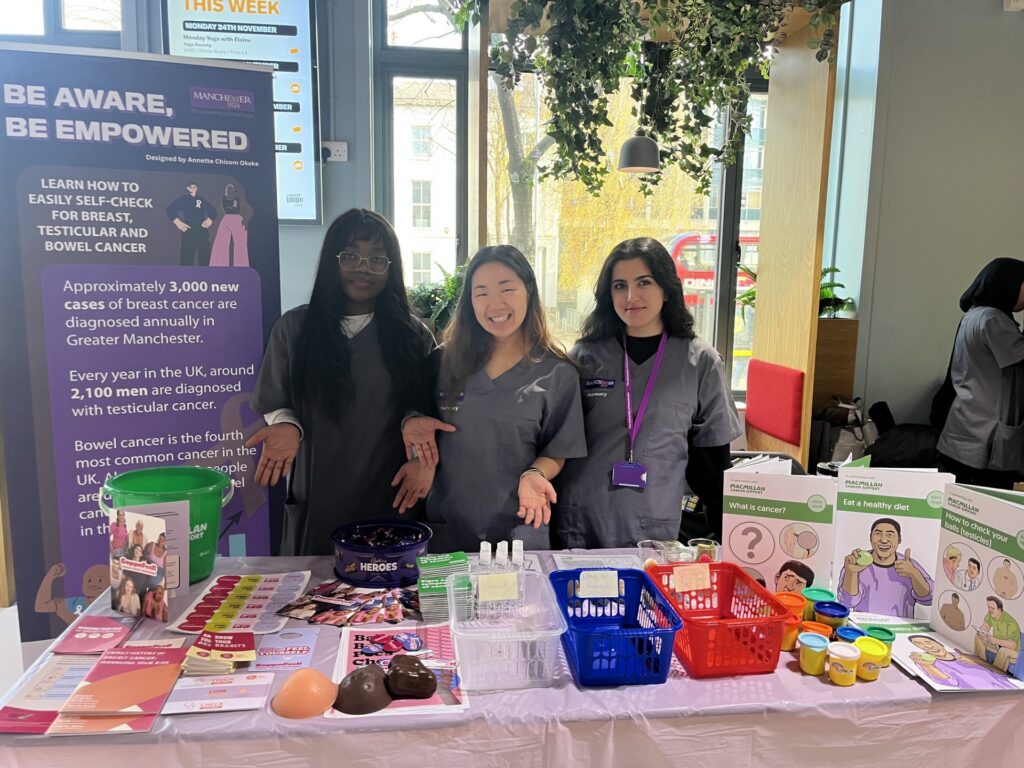
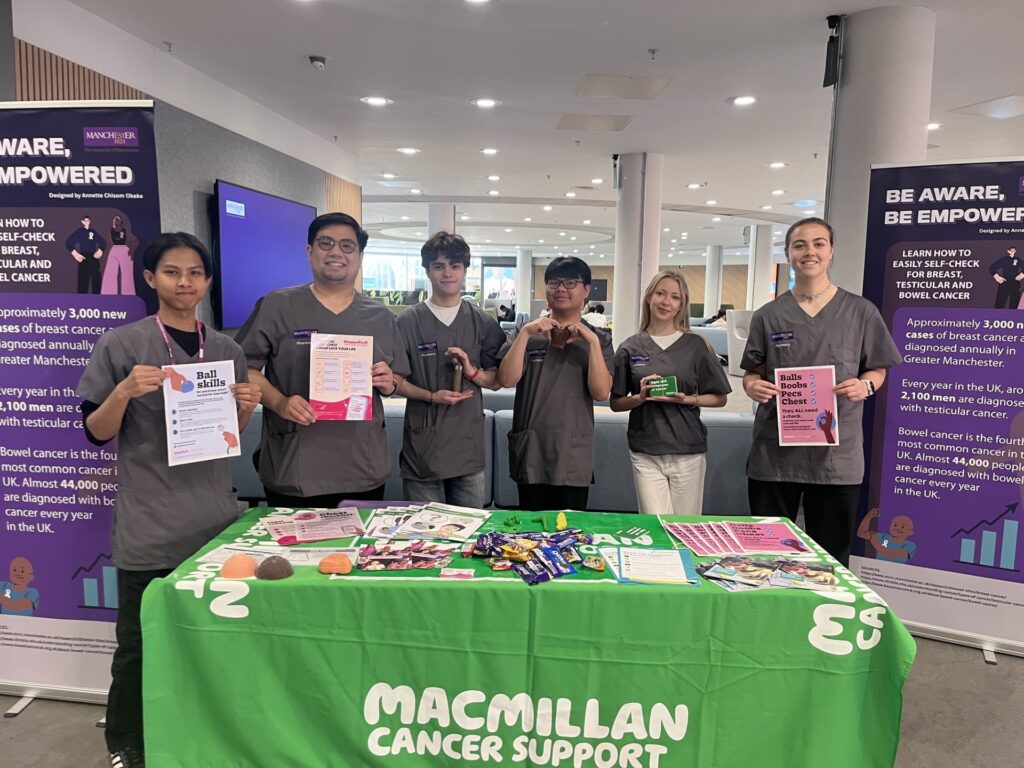
Students then take what they have learned into practice by delivering ‘Be aware, be empowered’ cancer awareness events at pop-up stalls across campus. At these events, students engage members of the public in supportive conversations, share signs and symptoms of breast, testicular and bowel cancer, demonstrate self‑checking using anatomical models and signpost to trusted sources of information. Tutors assess students in real time via direct observations of practice, focusing on consultation skills, professionalism, teamwork and leadership.
Sarah Knighton
What do students gain?
Feedback consistently highlights how different and impactful this learning feels compared with classroom-based teaching. Many participants describe initial nerves about talking to ‘real people’, particularly when addressing sensitive topics. For most, this anxiety quickly gives way to confidence as conversations unfold.
Growing comfortable with polite rejection is a vital skill when initiating public-facing health conversations in real-world practice
An important, if sometimes uncomfortable, professional lesson also emerges: not everyone wants to stop or engage. Growing comfortable with polite rejection is a vital skill when initiating public-facing health conversations in real-world practice.
Reflections also point to improved communication skills, greater empathy, and a deeper understanding of the future pharmacist’s role in prevention and early detection — not just treatment. Hearing lived experiences consistently reframes perceptions of cancer pathways, shifting the focus from abstract timelines to real human stories grounded in hope and compassion.
One recurring reflection is surprise at how low awareness among the public can be. Realising that a simple, well-timed conversation could make a meaningful difference is often a powerful motivator and a reminder of the advocacy role pharmacy professionals are uniquely positioned to play.
What does the public gain?
From the public perspective, the events create informal, welcoming spaces for conversations that might otherwise feel difficult to initiate. Feedback suggests the demonstrations and open discussions help improve understanding and increase confidence to seek help if something doesn’t feel right.
Volunteers have spoken about the importance of sharing what they wish they had known earlier, and how students’ curiosity and care helped them feel that their stories could help others
Importantly, these are not one-way interactions. People ask questions, share personal experiences and shape the dialogue, giving students insight into how health messages land in the real world.
Our GMCA Cancer Voices partners consistently describe the experience as meaningful and affirming. Volunteers have spoken about the importance of sharing what they wish they had known earlier, and how students’ curiosity and care helped them feel that their stories could help others.
From an educational perspective, this partner-enabled approach brings authenticity that cannot be replicated through case studies alone. It models ethical, reciprocal engagement, where community partners contribute to learning design, delivery and reflection, rather than being treated as an add-on.
Sarah Knighton
Looking ahead
‘Be aware, be empowered’ has reinforced how powerful, co-created, service-learning approaches can be in preparing students for professional practice. Students develop knowledge, confidence, empathy, adaptability and advocacy skills — essential for modern pharmacy practice.
Watching our students grow into confident, compassionate advocates — while contributing to cancer awareness across our community — has been one of the most rewarding aspects of this work
Partnerships with organisations and charities, such as GMCA, enable socially responsible, impactful and sustainable learning. These remind us that education does not happen in isolation and that our greatest learning opportunities lie beyond the walls of the lecture theatre.
Watching our students grow into confident, compassionate advocates — while contributing to cancer awareness across our community — has been one of the most rewarding aspects of this work. It’s a reminder that when we truly connect learning with lived experience, everyone stands to benefit.
You may also be interested in
Can simulation help foundation trainee pharmacists prepare for prescribing?

Royal College of Pharmacy launches national standard and credential for newly qualified pharmacist prescribers