Charlotte Gurr
I could see her hesitation before speaking, as if weighing whether honesty was worth the risk. In a meeting with colleagues, a pharmacy manager shared how exhausted she felt — not just from the workload, but from the constant effort of trying not to let her true self show. As a senior staff member who was neurodivergent and deeply conscientious, she described the daily tension between authenticity and acceptability; the fear of being perceived as harsh or chaotic. The pressure to mask was taking a quiet toll on her work, her relationships at home and her sense of self.
It wasn’t just her vulnerability that stood out, but the realisation that this exhaustion was not an individual failing. It felt like an unspoken leadership tax. Is this the reason we are quietly losing some of our most compassionate leaders before they ever reach the top?
Neurodivergence in leadership
Many of us start our careers in healthcare sharing similar frustrations as junior staff: inflexible working patterns, limited protected development time and systems that struggle to accommodate individual needs. As we progress through training, those frustrations don’t disappear; they simply change shape. Leadership is often treated as a natural extension of technical expertise rather than a distinct skillset that needs support, reflection and development. We promote people for what they know, then expect them to lead without really teaching them how.
Leadership can appear designed for neurotypical minds, where conformity is rewarded and difference must be carefully managed
For neurodivergent staff, this transition can feel like a narrowing funnel. As senior roles demand greater emotional regulation, decisiveness and composure under pressure, the need to consciously suppress natural communication styles or behaviours, often described as masking, becomes more pronounced. Some have spoken about deliberately holding back from further progression; not owing to a lack of ambition, but as an act of self-preservation. Leadership can appear designed for neurotypical minds, where conformity is rewarded and difference must be carefully managed. The more senior the role, the higher the perceived cost of authenticity and the greater the pressure to mask.
This rigidity in how we define leadership has consequences beyond neurodiversity alone. Some of the most compassionate, effective leaders I have worked with were not pharmacists, but pharmacy technicians. Their leadership fundamentally changed how I worked and how I experienced my role, because of how they listened, supported others and created psychologically safe environments. Yet senior leadership roles in healthcare are often tightly bound to rigid essential criteria such as requiring a specific professional registration. These criteria are not always about leadership capability; they are often about tradition. When leadership pathways are narrowly constricted, we limit who is allowed to lead before conversations about inclusion even begin. This rigidity filters out talent early and reinforces the idea that leadership becomes something that must look a certain way to be considered legitimate.
For neurodivergent staff, this compounds the problem. Not only must they navigate masking to fit leadership norms, but they must do so within systems that already restrict who can step into senior roles. The result is a leadership pipeline that quietly filters out difference.
The isolation of masking
Senior leadership is often described as lonely. People come to you with problems, concerns and emotional weight, while you are expected to project calm and certainty. Chief pharmacists and senior managers frequently speak about burnout, isolation and the challenge of balancing service demands with personal and family commitments. For neurodivergent leaders, this isolation can be intensified by the added layer of masking and the sense that even vulnerability must be moderated to remain acceptable.
For many, long online meetings can be even more cognitively draining, intensifying fatigue rather than reducing it
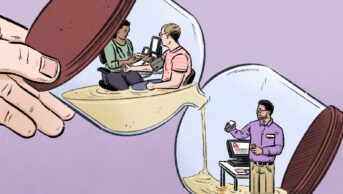
For some neurodivergent leaders, including those with autism or ADHD, this cost shows up in very practical ways. Chairing or attending back-to-back senior meetings requires intense focus, rapid processing, emotional regulation and constant self-monitoring. For some, this means needing short breaks between meetings to reset, time afterwards to process decisions or adjustments to how meetings are run. The shift to virtual platforms has not always made this easier; for many, long online meetings can be even more cognitively draining, intensifying fatigue rather than reducing it. These are not signs of incapacity, but of leadership being structured around a narrow cognitive norm.
Is it any surprise then that some of our most effective leaders step back before they ever step up?
In 2025, Charlotte Bell, a deputy chief pharmacist at Lewisham and Greenwich NHS Trust, created pPANDa, a peer-support network for neurodivergent pharmacy staff working in England (see below). It provides a safe space to connect, share lived experience and collectively influence change in how our workplaces are designed and led. Through this network, neurodivergent staff have contributed their expertise to shaping future practical resources as part of the London EDI Champions, Neurodiversity Task and Finish group, which I help co-lead with Charlotte. This includes an inclusive language charter and a flexible working framework tailored to neurodivergent needs. This work reflects a simple but powerful principle: inclusion is not about forcing adaption to exhausting systems but redesigning systems so individuals can thrive.
Invisible disabilities and neurodiversity must also be part of how we understand inclusive leadership
Conversations around inclusion often focus on what is visible — gender, ethnicity, representation. These are essential conversations; however, invisible disabilities and neurodiversity must also be part of how we understand inclusive leadership. When they are overlooked, the cost is rarely dramatic or immediate. It often presents as burnout, disengagement, talented people stepping back or leaving altogether.
The principles that support neurodivergent staff — such as flexibility, psychological safety, kindness and trust — benefit everyone. The same principles apply to staff returning from maternity or paternity leave, those with caring responsibilities or anyone navigating change. Inclusive leadership is not a niche interest; it is simply good leadership.
Perhaps the question we need to ask is not whether neurodivergent staff are suited to leadership, but whether leadership, as it is currently constructed, is suited to the diversity of minds within our workforce.
If masking is the price of progression, we should not be surprised when people choose to step away. If we can build cultures where authenticity is not taxed, we may find that the leaders we have been losing were here all along, waiting for systems that support them to stay.
Further information
If you are interested in joining pPANDa, a peer-support network for neurodivergent pharmacy staff working in England, please contact suzanne.al-rawi1@nhs.net