

Dave Phillips / Andy Catterall / The Pharmaceutical Journal
Today, on 15 April 2026, the Royal College of Pharmacy (RCPharm) was born.
Following a special resolution vote in March 2025, in which 71% of voting members supported the idea of the Royal Pharmaceutical Society (RPS) becoming a royal college, the Society has been hard at work planning for this transition.
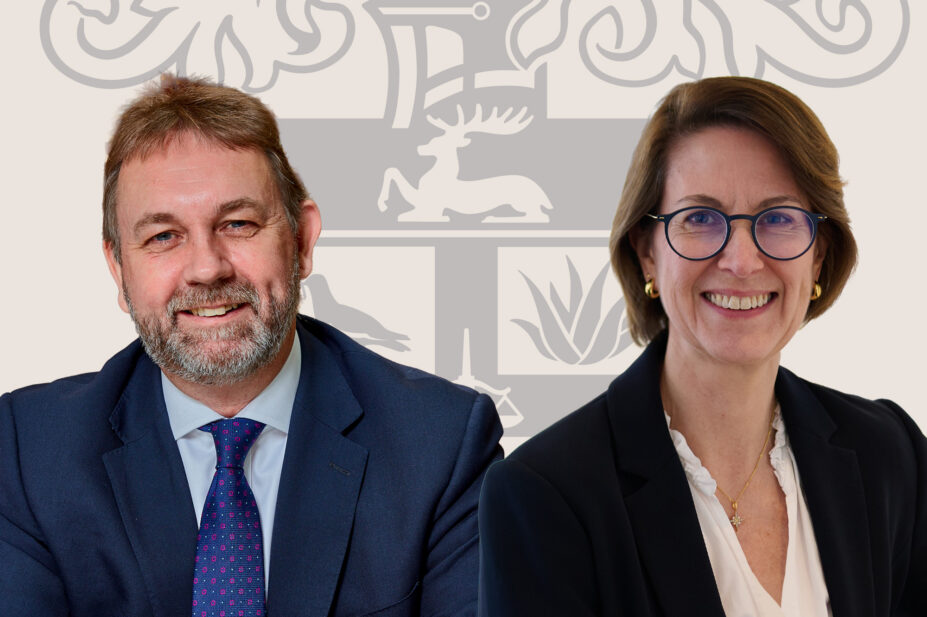
Paul Bennett, chief executive of the RPS, is stepping down from his role and Karen Baxter, formerly deputy chief executive of the RPS, will become interim chief executive of RCPharm.
The Pharmaceutical Journal spoke to Paul and Karen, separately, to ask for their reflections on the build up to this historic moment. We also invited Paul to reflect more widely on his tenure as chief executive, while Karen shared her thoughts on establishing the fledgeling college.
You can listen to the full interviews in this special episode of The PJ Pod.
Were you surprised by the result of the special resolution vote, or did you already have a sense of how it was going to go?
Paul Bennett (PB): I wasn’t surprised by the outcome. I thought we would — and was hopeful that we would — secure a positive endorsement from those who were eligible to vote for change to do just that.
I was really pleased with the turnout. It was over 31%, I think, from memory, and while that might seem not to be a very high figure, this is all relative to numbers that generally participate in votes of this nature.
I was particularly pleased with how positive the vote for change was. We secured a very strong mandate from the special resolution vote to proceed, and that helped create the momentum. It’s now 12 months since we held that special resolution vote. It’s been a hard 12 months, but that’s carried us through. So, I’m delighted by it and it’s taken us to where we are now.
Karen Baxter (KB): We were very confident that there was a lot of positive feedback, but we were also aware it’s quite hard to reach everyone in the profession, and so there’s always that feeling of unknown and not knowing who was out there that we hadn’t reached.
There were a lot of unknowns, but we felt very confident that we’d had quite a lot of positive feedback on the journey and through the road shows
Karen Baxter, interim chief executive of the Royal College of Pharmacy
There were a lot of unknowns, but we felt very confident that we’d had quite a lot of positive feedback on the journey and through the road shows, and there was definitely a sense of: ‘Yes, just get this done, and then what’s next?’ So, I think we felt relatively positive, but never say never. There was always that nervous moment when we were awaiting the results.
While most people supported the proposals, a minority did not. What would your message be to those members?
PB: My plea would be to please work with us, work with the future royal college to make it a success, on behalf of the members, on behalf of patients and the public that the royal college will work to support. It’s in all of our interests for this transition from a really proud RPS and everything that the Society has done, to the new beginning of a future Royal College of Pharmacy.
KB: We got from some that there were reservations and a lack of clarity of what we were going to do, so hopefully over the course of the past year, we’ve really started to address that, as we’ve been out and about and communicated more.
And further to that, I’d say — please don’t cease to engage with us. We understand that not everybody is going to be behind a change, but it’s important that we hear both positive and negative views because those negative views sometimes illustrate a point we might have overlooked, or more work that we need to do to address a wider population’s either lack of understanding or lack of agreement with the proposal.
It’s really important that we hear all viewpoints and all opinions as we go through this change.
What have the past couple of years been like, since the proposals were first mooted?
PB: We’ve recruited the inaugural chair of the board of trustees. We’re in the process of recruiting the independent members of that board. The rest will be populated from those who come from the Senate, as a consequence of the recent elections that have been taking place to the Pharmacy Advisory Councils for Scotland, England and Wales.
Setting up the subsidiary for Pharmaceutical Press — our publishing business — to make sure that that is appropriately structured. Navigating all of what needed to be navigated to secure Privy Council support for the amendment to the charter. Securing — and we hope to soon have notification of — registration for the college with regard to the Charity Commission and Office of the Scottish Charity Regulator, the equivalent regulatory body in Scotland.
Making sure all of our financial systems are appropriately set up, our people are in the right places in terms of organisational design, that we’ve got the right resources focused on the right things. It’s probably all very boring for everybody who’s not actually involved in undertaking the activity and so it should be. To them, this should be seamless. It’s all about what the royal college actually delivers in the future that really matters.
KB: We’d never get anywhere without our teams. There’s the publishing team, getting really fantastic evidence-based information into the hands of pharmacists. The profits that they create will continue to come back to the college.
Then the team that have been delivering the constitutional governance change within the future college: our people team, our legal team, our finance team. Whilst this is a transitional change, a lot of it is quite in-detail legal and financial work in the background. Those teams have worked heroically.
There are those teams whose work celebrates, supports and promotes the profession, they have continued to deliver, whilst many of us have had a focus on this constitution and governance change, and I think this is now their time. I hope they get their moment in the spotlight for all of the really hard work that they do.
As a royal college and a charity, there’ll be a greater emphasis on the responsibility to the public good. How will that look in practice?
KB: I think this underplays the work that the RPS has already done in this sphere. We already have patients and the public at the heart of what we do. I’m thinking about our work on medicine shortages and then the really good work team Scotland has been doing recently on end-of-life care. Ultimately, of course, that’s about supporting patients through the profession.
What changes when we are a charity? I think we need deeper and wider engagements with patients and the public, and the UK Pharmacy Professional Leadership Advisory Board (UKPPLAB) has kicked off some really great work with that. [It has] convened a group of patients and the public that are helping us work through how that might show up in the royal college.
15 April 2026 isn’t the end of this story, it’s just the foundation stone. And so, we’ll continue that engagement work over the course of the year.
What will be the impact for members and the wider pharmacy profession?
KB: I’m going to go straight in on member fees, because it’s one of the things that I hear most commonly in the feedback. This transition is not altering member fees. I’d really like to get that out there up front.
We’re trying to get a louder, stronger voice for pharmacy
Karen Baxter
But in terms of the transition that we’re undertaking, what we’re trying to do is get a louder, stronger voice for pharmacy. So really emphasise the impact of the work we do. There’s a real element of status with the royal college, and there’s a real element of understanding now — both in the media and by patients — of what a royal college represents.
And so, it gives both the members of the profession and the profession itself status, puts professionalism at the forefront of what we do, and, ultimately, will allow us to have a deeper impact on things that really matter to the profession.
What’s the in-tray looking like post-transition? What priorities will the college have?
KB: There’s a huge amount of dialogue about workforce wellbeing, and that’s already part of the work of the RPS. But we really need to have a keen eye on thinking about our role as a royal college in developing excellence and promoting the profession and allowing it really to operate at the top of the scope of its licence. I think that’s a key piece of work for us to do to understand how we can do that alongside the pressures that pharmacists on the frontline feel.
We continue to advocate for protected learning time, but then also look at how the educational content that we deliver and the activities that we undertake to support the profession can be delivered in different ways: bite-sized, easier accessibility, to really support them to achieve that excellence alongside those pressures.
It’s not a role for us alone. I think there are a lot of partnerships we need to capitalise on here. We already partner with Pharmacist Support in this area of workforce wellbeing, and the Association of Pharmacy Technicians UK.
The college is working on now is developing the new strategy. How is that going?
KB: We are assembling our trustee board at the moment. The recent elections have given us four members of the trustee board alongside Jo Irvin. So, they’ll be responsible for taking that transitional strategy forward. But, as we engaged [in 2025], what we heard loudly and strongly from the sector is a real desire for us to engage more. I think it’s really important that we take the opportunity across the course of this year to do a lot more listening and a lot more engagement of the kind that we did when we were out on the roadshows.
There’s obviously other work ongoing in the ecosystem that will inform our strategy as well. So UKPPLAB, which the RPS was a part, have made some strong statements about the direction for the future of the royal college, and there’s a huge amount of work there to pick up and build on, working with the other specialist pharmacy groups and professional leadership bodies in the sector to see how we can collaborate ultimately to the benefit of the profession, so that we can help patients more through the work that we do.
What would your message for people reading this?
KB: There’s been a huge amount of expectation on what 15 April will bring, and 15 April will bring the right framework for us to do the work that we need to in the future. But everything won’t change at once. So, I’d say — Please, continue to join with us on this journey. Please, continue to give your feedback and engage with us — because only by hearing from our members in the profession can we truly understand how we deliver to the best of our abilities.
But also watch what we do and watch how we deliver and see the change in what we’re doing. I think there’s a huge cultural piece that we have to address, as we become a charity, and I think we’ve heard so strongly over the course of the past year how much people want to see us out and about and talking to them and hearing their concerns.
So, I’d say: judge us on our actions, not on exactly what happens on 15 April.
I have been so impressed with just how talented the people are who work within the RPS and impressed by the people who give freely of their time to support the work that we do
Paul Bennett
PB: I have been so impressed with just how talented the people are who work within the RPS, and impressed by the people who give freely of their time to support the work that we do: whether that’s those who become elected members and part of our governance structure, those who work and give freely of their time in the expert advisory groups, or sit on our committees or our sub-committees. They do that because they passionately want to see pharmacy develop and grow as a profession.
I take away from all of my time here a really nice warm feeling inside about how positive the future is for pharmacy while great people like that are around.
1 comment
You must be logged in to post a comment.


Will we see investment in creating a searchable online archive of the PJ?
And what's happened to the old RPSGB and RPS website and pages?
These should be part of National Archives - why are they being hidden ?