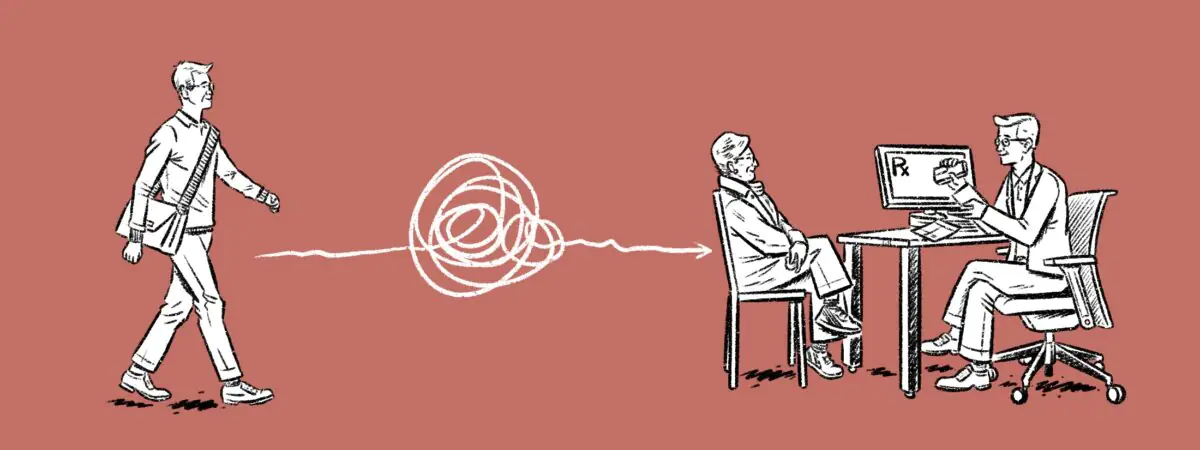
Pharmacy First has shifted the way patients can access care for common conditions — the next expansion is even more ambitious. From autumn 2026, patients in England can access pharmacy treatment for five additional conditions: migraine, seasonal allergic rhinitis in children, acute otitis externa, mild-to-moderate acne, and mild skin and soft-tissue infections and scabies. Pharmacist prescribers can then prescribe within the relevant Pharmacy First pathways1.
It’s an important step towards making community pharmacy a genuine first point of contact for routine clinical care. But as the list of conditions grows, I find myself asking a different question: How do we ensure patients are ready to trust this expanding role and that the pharmacists of tomorrow are ready to deliver it?
I ask this as a pharmacist who has worked across both community pharmacy and general practice, and now teaches pharmacy students. Across these settings, I’ve increasingly encountered the same questions: Why has the patient been sent here? When should they see their GP instead? How much clinical assessment can reasonably happen in a busy pharmacy? Perhaps most importantly, do our students and trainees feel prepared to make those decisions?
Beyond ‘Pharmacy First’
For Pharmacy First to succeed, patients must understand what the service means.
There’s a difference between telling the public to “go to your pharmacy first” and genuinely establishing community pharmacy as a trusted clinical setting. There’s encouraging evidence that public awareness and trust can change. Following a national Pharmacy First promotional campaign, awareness that pharmacies could treat Pharmacy First conditions increased from 71% to 79%, while reported trust in pharmacy advice increased from 61% to 70%2.
That’s promising. However, trust cannot be created through advertising alone. It’s built consultation by consultation.
A patient presenting with a sore throat, ear infection or acne must feel they’ve received a proper clinical assessment rather than simply being redirected from general practice. They need to understand why the pharmacist has recommended treatment, why they may not need to see their GP and what should happen if they don’t improve. This becomes particularly important as pathways move into areas that patients may traditionally associate with medical diagnosis and treatment.
Acne is a good example. A young person may arrive expecting to collect a prescription from their GP. Instead, they may now be assessed and treated in a community pharmacy. That is, potentially, a fantastic opportunity but only if the patient leaves understanding that the pharmacist has not simply become another place to collect medicines. They have accessed a clinician.
What happens when the pathway doesn’t fit?
The success of Pharmacy First shouldn’t be measured only by how many consultations are completed. A good pharmacist knows when not to treat. The ability to recognise red flags, identify diagnostic uncertainty and refer appropriately is arguably just as important as knowing which medicine to supply.
This is where the relationship between community pharmacy and general practice becomes critical. If a pharmacist refers a patient to a GP, the patient should not feel they’ve been passed around. Equally, a GP should be able to trust that a Pharmacy First consultation has been clinically assessed and appropriately documented.
Pharmacy First should not mean “pharmacy instead of general practice” — it should mean pharmacy as part of primary care
We therefore need pathways that work in both directions.
Pharmacy First should not mean “pharmacy instead of general practice”. It should mean pharmacy as part of primary care. That requires clear referral routes, appropriate access to information, communication between professionals and an understanding across sectors of what each service can and cannot provide.
The NHS has recognised the importance of clinical governance, with the Pharmacy Quality Scheme supporting clinical audit and peer review for Pharmacy First delivery1. The challenge is ensuring that governance becomes part of everyday clinical culture rather than an additional exercise completed around the service.
What about the pharmacists we are training?
Pharmacy students and foundation trainee pharmacists are increasingly asked to become clinicians who can assess symptoms, identify red flags, make treatment decisions, prescribe where appropriate and know when to escalate.
Yet there is a risk that we teach the pathway but not the thinking behind it. A trainee may tell you the treatment for acute otitis externa. That doesn’t necessarily mean they can confidently assess a patient presenting with ear pain and determine whether that pathway is appropriate.
We should give students opportunities to practise the messy, uncertain consultations that happen in real life, not just recall the correct medicine from a set protocol
Similarly, knowing the treatment options for acne is different from being able to take a structured history, recognise severity, identify differential diagnoses, discuss patient expectations and know when referral is required.
This is where education must change. We should give students opportunities to practise the messy, uncertain consultations that happen in real life, not just recall the correct medicine from a set protocol.
Case-based learning, simulated consultations, clinical examination skills and structured safety-netting should become increasingly central to undergraduate and foundation training.
The expansion of Pharmacy First is happening alongside the move towards independent prescribing for newly qualified pharmacists. A 2026 scoping review highlighted structured support, experiential learning and prescribing immediately after qualifying as important considerations in preparing pharmacists to prescribe at scale3. The direction of travel is clear. Pharmacists’ education must catch up with it.
We shouldn’t train pharmacists to fear the service
When trainees or newly qualified pharmacist prescribers encounter a new service, their instinct can sometimes be: “I don’t want to do that.”
I understand why. A new clinical pathway can feel like another responsibility added to an already busy day. Pharmacists may worry about making the wrong decision, managing complex patients or being expected to diagnose conditions outside their comfort zone.
While undergraduate degrees lay the foundations of consultation and clinical skills, the next step is ensuring these skills are directly connected to the services they’ll deliver in practice
If we allow this to become the dominant narrative, we risk training a workforce that sees expanded clinical services as something to avoid rather than an opportunity to develop. The answer isn’t to tell them simply to be more confident. Instead, education must keep pace with practice by providing the knowledge, supervision, clinical exposure and psychological safety to become confident.
While undergraduate degrees lay the foundations of consultation and clinical skills, the next step is ensuring these skills are directly connected to the services they’ll deliver in practice.
All students should therefore encounter pathways, such as Pharmacy First and its specific conditions, during their education, with foundation training providing a chance to develop and apply this knowledge in practice. They should practise consultations, make mistakes in simulation and discuss uncertainty. They should observe experienced pharmacists and learn what a good referral looks like.
Equally, they should understand that being a good pharmacist doesn’t mean treating every patient. Sometimes the best clinical decision is to refer, when appropriate.
Taking patients with us
Pharmacy First has the potential to fundamentally change how patients experience primary care. However, expanding the list of conditions is only one part of that transformation.
We must build trust between pharmacists, patients and other healthcare professionals, and ensure that pharmacists have the training and tools to deliver these services safely. We need to prepare the next generation of pharmacists for a profession in which clinical assessment and prescribing are no longer peripheral skills but core parts of practice.
If we want patients to think “pharmacy first”, we must ensure that, when they walk through the pharmacy door, they experience something worthy of that trust
The question is no longer whether pharmacists can do more — they clearly can. It’s whether our systems, education and public understanding are ready for what pharmacists are increasingly being asked to do.
If we want patients to think “pharmacy first”, we must ensure that, when they walk through the pharmacy door, they experience something worthy of that trust. That starts long before pharmacists qualify.
- 1.Patients to get quicker treatment for migraines, acne and 3 other everyday conditions at pharmacies. NHS England . 2026. https://www.england.nhs.uk/2026/09/patients-to-get-quicker-treatment-for-migraines-acne-and-3-other-everyday-conditions-at-pharmacies/
- 2.Pharmacy First campaign boosted public awareness and trust in pharmacy advice, says minister. Pharmaceutical Journal. Published online 2026. doi:10.1211/pj.2026.1.399040
- 3.Pharmacy leaders call for vocational MPharm degree to prepare students for prescribing. Pharmaceutical Journal. Published online 2026. doi:10.1211/pj.2026.1.412391