Paul Stuart
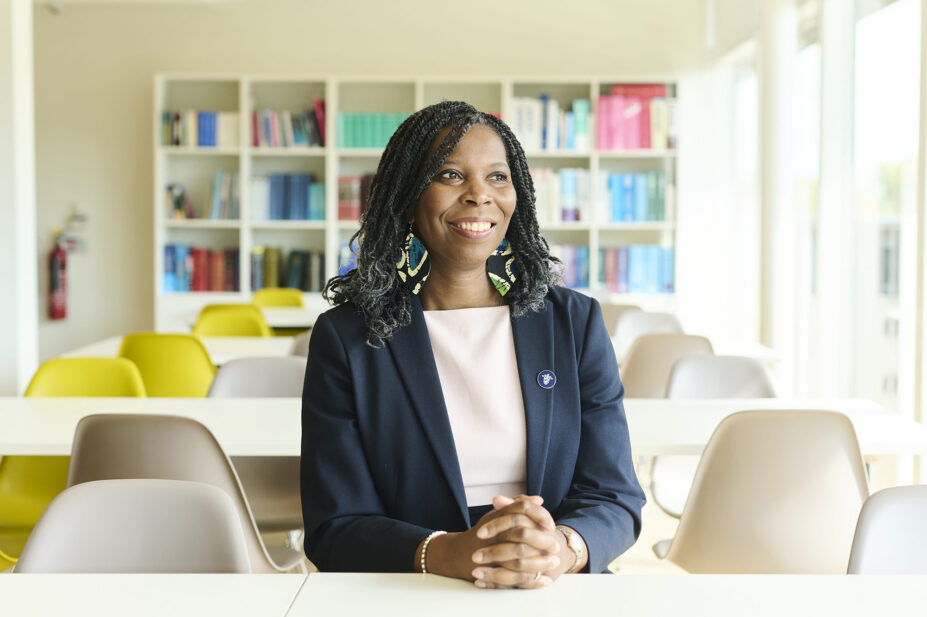
Tase Oputu is the first president of the new Royal College of Pharmacy (RCPharm). A hospital pharmacist for most of her career, she has spent the past three years in an integrated care board in Kent — working on medicines commissioning and high-cost drug — and previously chaired the then Royal Pharmaceutical Society’s English Pharmacy Board. She is also a passionate advocate for inclusion and diversity. In this interview, she describes leading the College as “very emotional”, explains why differential attainment is “a system problem”, calls for “fair, long-term, sustainable funding” for community pharmacy and urges members to “come and talk to us”.
How does it feel being the first president of RCPharm?
It’s the greatest honour of my career to be the first president of the new RCPharm. It has been very emotional. People have been very happy and excited to see the progression that we’re making in the royal college.
And I would also say that even as I was chair of the previous English Pharmacy Board, and having those connections to our wider stakeholders in regulation and policymakers, that there is a tangible difference to the reception and the reaction that they have to us now being a royal college. There is a real recognition of the significance. The potential for greater influence and what that means across all of the wider aspects of our profession — a real encouragement and excitement and anticipation of what we can achieve as a royal college.
I’m quite enthusiastic and impatient to get things done. There’s an aspect of: ‘Okay, why can’t we achieve all of this right now?’ But there’s a recognition from myself, and from everybody involved in the governance of the organisation, that we are taking things very carefully, and we are looking at what we are doing in a very focused way.
Why is the College’s recently launched ‘enhanced curriculum and credentialing for pharmacist prescribers’ important?
We are really focused on strengthening our education, credentialing and professional support for our pharmacists because it’s key for us to be able to — as a royal college — provide our pharmacists with the skills, knowledge and the confidence that they need throughout their careers.
We’re at a pivotal point with our new cohort of pharmacists who have just registered, in that they have come through as independent prescribers, and we cannot ignore the fact that they need a focus and support to get them started correctly in their careers. But we also recognise that we have pharmacists at every stage of their career, and we are also putting in plans to support all of them.
We have a programme, ‘From qualified to confident’, to support our newly qualified pharmacists, helping them to build their confidence, capability and judgment. We also have our RCPharm Learn component as well, taking the aspects of what is happening in community pharmacy, where we see Pharmacy First, and the skills and knowledge that is needed to support delivering that. We have our credentialing frameworks, which support our pharmacists post-registration through their education and training, and enables them to demonstrate their advances in knowledge, skills and behaviours against national standards.
Our credentialing frameworks are really important because they give that assurance for patients, providers, and commissioners of the quality and safety of care that all of our pharmacists are delivering when they choose to follow these credentialing frameworks.
How is the College addressing the ongoing awarding gap in the MPharm degree?
The gap has been wide, and it’s been there for a long time. We have been doing work over the past few years to address it. It’s going to take meaningful and sustained action across all of education and training to narrow this.
I have to be very clear that it’s not a product of the individual’s capability and ability. It’s a system problem that we need to address, and it’s complex. It’s a mix of so many factors within the education and training field, within organisational cultures. Bias within all of those spheres that I’ve talked about, access to positive role models, networks, tutor training, that transition for students when they go from university into their foundation training.
We have — within the College — task and finish groups, which are looking in depth at all of those different layers to try to move that forward into sustained action to address those gaps. We will not let that go until we start to see sustained change. A dip or a rise one year does not mean success or failure. It’s important for me that that people don’t see it as an external problem: ‘That’s something for the universities to deal with, or that’s something just for the employers to deal with.’ It’s for everybody in every part of wherever we are interfacing with our trainees, with students.
What are the issues surrounding AI that people want to know about, that they want support in?
I hear that pharmacists do recognise how AI can support in terms of the administrative burden of the work that they do, and how it can also support learning and professional development. There is a recognition that AI can save time, and the benefit of that is that it helps our pharmacists, it releases to our pharmacists the time to focus on patients and their clinical role. It can help with supporting clinical decision-making, and it can help with improving the way that services are delivered.
But it has to be used safely and appropriately. We’ve got issues to do with false or misleading information. We know that AI can generate hallucinations, for example. So where does the responsibility lie when those errors occur?
We have to think about bias, what’s feeding the AI systems, patient confidentiality, governance. As pharmacists, we always have to be aware of our limitations and where our professional judgment kicks in. And if there is an error, does the accountability lie with us? Probably not. Through the roundtable hosted by the College, it has been voiced that there has to be a recognition that there is accountability for the systems that create the AI.
There is something about making sure that we as professionals use our professional judgment when we’re making decisions based on the work of AI. We also need to make sure that we as professionals have the education, the training, the guidance, and the time to be able to use AI safely and confidently. Patient safety is the key thing here.

Paul Stuart
You’ve touched on something interesting there around training: we’ve heard that people often feel like they don’t have time in their working day for this.
I think for anything that we are asking people to do differently and to take responsibility for, where we’re asking people to use their professional judgment to be able to understand these things, then there is an element of ensuring that we are also supporting through protected learning time. That’s been a call that we’ve put forward for many things, because there are many asks of us as pharmacists in the working sphere. Protected learning time is crucial for us to be able to do the learning and ensure that we are practicing safely.
The ongoing issue of workforce wellbeing and pharmacy closures is something that the College has been talking about for a while.
Pharmacists are being asked to take on greater responsibility all the time. That has an impact on our workforce — they’re all under significant pressure. Pharmacy closures are significant because it affects our patients access to their medicines.
Our wellbeing surveys show significant levels of burnout and risk of burnout. It’s really important that we do call for — especially for community pharmacists who are under significant financial strain — fair, long-term, sustainable funding that’s able to realistically close the gap between the cost of providing the services and the resources available.
Pharmacists have such an important role in making sure that medicines are used safely and effectively. The government and NHS need to reflect that in workforce planning, funding and service design.
There are pressures for our colleagues in secondary care. There are workforce pressures for our colleagues in academia who are feeling — and myself included personally — restructures and cuts to services, headcount cuts that directly affect the care and the delivery of pharmaceutical care for patients. That is very worrying for the short term, the medium term and the long term, as we are being asked to do more and more.
What are the College’s priorities over the next 12 months?
We’re here now. We’ve created the royal college. But there’s a lot of work to be done — we need to really build our college now, in conjunction with our members.
It’s going to take time. Over the next few months, we will be launching our transition strategy. That is the articulation of what we’re going to be doing in the next 12 to 18 months or so. Our ambitions for how we’re going to work together with people to create that bigger, fuller strategy, which will take us over the next five years.
We’re looking to transform in a collaborative way the landscape of pharmacy professional leadership in in the UK.
And underlying all of that, we still have all the work that we will be doing to support our pharmacists in providing excellence in patient care across all spheres of pharmacy. We have excellent work that’s coming through from the councils and policy work at the devolved-country levels. All of that almost feels like the bread and butter of what we do and layered upon that is trying to ensure that we create this inclusive, collaborative home for pharmacy.
Is there any other message that you’d like to get out there?
My plea at the moment is that we have a lot of work to do. When we come out as the College to do engagement work with our members on our longer-term strategy, on what it means in terms of changing our membership for pharmacy technicians, I really hope that people really rally round, our members and our wider non-members, and see the possibility of pharmacy and what we can achieve as a unified profession.
Pharmacy technicians, pharmacists, all the different sectors of pharmacy, all of our specialist groups: there is so much that we can do together, and I hope that people come with their hopes and their aspirations and their recommendations and their suggestions. Come and talk to us about it. If you don’t agree with things, come and talk to us as well. Be part of the conversation: nobody’s opinions are invalid. We need to hear the positives, and we need to hear the negatives.

Paul Stuart
You may also be interested in

‘We’re in our early days’: the Royal College of Pharmacy’s first national advisory council chairs on their priorities

Alex Williams: ‘There’s a risk to the resilience of the supply chain if government doesn’t invest’