In June 2026, analytics company Clarivate and publishing company Elsevier released the ‘Journal Citation Reports 2026‘ and Scopus CiteScore metrics, respectively. The reports show that the three research journals owned by the Royal College of Pharmacy (RCPharm), and published in partnership with Oxford University Press, achieved broad increases in their impact metrics.
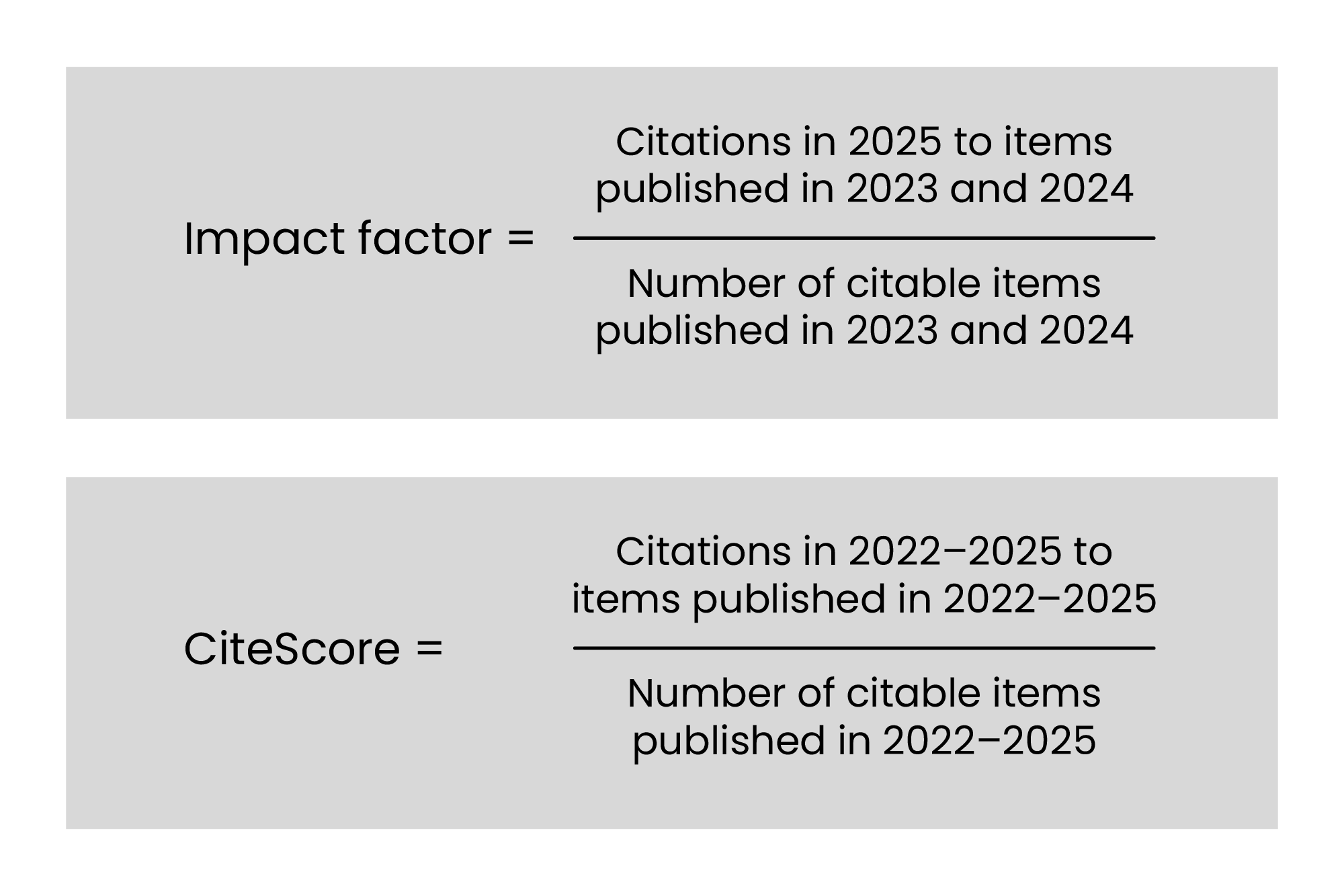
Impact metrics, such as Journal Impact Factor and CiteScore, are a quantitative measure of the immediate relevance and importance of the research published in the journals to the communities they serve (see Box 1).
Box 1: How impact factors and CiteScores are calculated
So far in 2026, the impact factors (IFs) of our journals have significantly increased, which is summarised in the Table below, alongside additional metrics illustrating the journals’ volume, reach and trust in the community.
A journal’s IF often influences researchers’ decisions about where to publish. This is because research and researchers are frequently evaluated by universities and funders based on the IF of the journals in which their research gets published. Therefore, we are pleased that an increased IF encourages a wider range of authors to publish with us, and provides more visibility and influence to the pharmacy research field.
While an increase in IF is cause for celebration, it should be noted that journal-level, citation-based impact metrics are not a proxy for the quality of the research or the peer-review processes of the journals. The scores must be used responsibly alongside other qualitative and quantitative metrics.
Oxford University Press — alongside 27,322 individuals and organisations in 175 countries — is a signatory of the San Francisco Declaration of Research Assessment (DORA), which advocates against the use of IF as a sole measure of research quality and calls for journal publishers to reduce emphasis on the IF as a promotional tool.
We would argue that the role and influence of the research published in the RCPharm journals is much broader than what those metrics can measure
This stems from the fact that the IF is a flawed metric that can be manipulated by journal editorial policies. For example, if journals increase the number of reviews they publish, this can increase their IF, as reviews are generally cited more than primary research articles. Journals may also require authors and editorial board members to cite papers from the journal as a condition of publication or membership.
While we do publish review articles of relevance and value — particularly secondary pieces of research such as systematic and scoping reviews — as well as produce special issues to highlight emerging research areas of interest, we do not deploy these at scale as editorial tactics solely to chase citation metrics.
Citations and related metrics, particularly of individual articles, are a useful way to measure the impact of research(see Box 2). However, the role and influence of the research published in the RCPharm journals are much broader than what those metrics can measure.
A case in point is how evidence from a scoping review article on pharmaceutical industry promotional activities on social media published in the Journal of Pharmaceutical Health Services Research in October 2024 influenced the US Food and Drug Administration policy to crackdown on deceptive direct-to-consumer pharmaceutical advertisements.
Similarly, International Journal of Pharmacy Practice supports the role of pharmacy in contributing to the sustainability goals in the NHS ten-year health plan for England, published in 2025, by bringing together the latest research on the topic in a themed collection: ‘The climate, nature, and pollution crises — how more sustainable medicines use can make a difference‘.
Box 2: Top cited papers that contributed to the journals’ current impact factors
- ‘Gender and ethnicity bias in generative artificial intelligence text-to-image depiction of pharmacists‘; International Journal of Pharmacy Practice;
- ‘Pharmaceutical industry promotional activities on social media: a scoping review‘; Journal of Pharmaceutical Health Services Research;
- ‘Production of mRNA lipid nanoparticles using advanced crossflow micromixing‘; Journal of Pharmacy and Pharmacology).
Future impact
We continue to uphold the rigorous peer-review standards of the journals, as well as expand their reach to underrepresented geographic regions and communities. We aim to promote the journals’ research to relevant audiences for citation, and inform healthcare policy, pharmacy practice and drug development in line with the RCPharm’s mission to advance the safe and effective use of medicines.
We thank the pharmacy community for its support for the RCPharm journals over the past year. We will continue to publish the rigorous, robust and high-quality research to advance the science and practice of pharmacy.
Have you undertaken research related to pharmacy practice, pharmaceutical health services, pharmaceutics, pharmacology or drugs from natural products?
If so, submit your work to the Journal of Pharmacy and Pharmacology, International Journal of Pharmacy Practice, Journal of Pharmaceutical Health Services Research or Pharmaceutics and Pharmacology.
As part of their membership benefits, all Royal College of Pharmacy members can access the research journals for free and receive a 20% discount on any article processing fees required to publish open access articles.