imageBROKER.com/Alamy.com
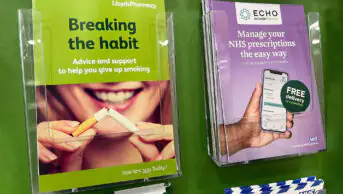
A nationally commissioned community pharmacy stop-smoking service could significantly expand access in deprived areas and support more than 225,000 quit attempts each year, according to a Company Chemists’ Association (CCA) report.
In the report, published on 5 February 2026, the CCA said that current stop-smoking services “vary across the country” and fewer than half of local authorities commission services from community pharmacies, while some also restrict access by age or other patient characteristics, including for pregnant women.
In Solihull, West Midlands, only 1% of pharmacies are commissioned to provide stop-smoking support, the report said. In contrast, the report noted that Blackburn with Darwen, Lancashire, has the highest recorded activity, with 356 people per 100,000 population supported to set a quit date.
The report also highlighted that, currently, patients who start a quit attempt in hospital can continue their programme at a local pharmacy after discharge, with consultations lasting up to 12 weeks.
The service reviews prescribed nicotine replacement therapy, adjusts treatment as needed and aims to promote healthy behaviours, it added.
However, the report revealed that fewer than 5% of pharmacies receive referrals from this service, adding that between April 2024 and March 2025, 11,728 consultations were recorded.
It added that local authority commissioned services are slightly more accessible, but provision varies widely, with NHS data showing that there were 11,451 consultations recorded in 2024/2025.
The CCA urged that a national walk-in pharmacy service would create a single, consistent route for patients.
Based on the data from Blackburn with Darwen and data from Scotland — where pharmacy stop-smoking services accounted for more than two-thirds of quit attempts in 2023/2024, with more than 21,000 people setting a quit date — the report said that such a model could support more than 225,000 quit attempts annually in England.
The proposals mirror wider calls to expand pharmacy-led smoking cessation services. In a report published in January 2026, AstraZeneca called for a national pharmacy stop-smoking service funded by a tobacco levy.
The AstraZeneca report also highlighted that pharmacies already deliver large-scale preventive care — including the ‘Community pharmacy hypertension case-finding service’ — which screened more than 2.8 million people and detected 225,000 cases of high blood pressure in 2023/2024.
Malcolm Harrison, chief executive of the CCA, said: “A national smoking cessation service commissioned through community pharmacies would end the postcode lottery and help stub out the impact that smoking has on the nation’s health and economy once and for all.”
Ravijyot Saggu, a lead pharmacist in medicine and respiratory in London, commented: “Availability of cessation services greatly varies across the country; unavailability disadvantages individuals, contributing to widening health inequalities.
“A national cessation service is welcomed and provides an opportunity to improve access and support patients to stop smoking, thereby improving health and wellbeing for themselves and their household and reduce health system burden. Community pharmacy are well placed to support people with this journey and help improve equity of care.”
Ijeoma Udeagbala-Okumah, lead respiratory pharmacist at Frimley Health NHS Foundation Trust, said: “Community pharmacies are critical partners in this effort. They are well embedded in communities most affected by smoking‑related disease and health inequality.
“Many of the patients I support — those living with chronic breathlessness, frequent exacerbations, or complex multimorbidity — struggle to access traditional GP‑based cessation services due to time, mobility and appointment pressures. Community pharmacy teams offer what these patients need most: timely, local and flexible support, with no appointment barriers.”
Sarah Sleet, chair of the Taskforce for Lung Health and chief executive of Asthma + Lung UK, said: “Smoking is a primary driver of lung disease, but it is difficult for people to quit without the right support, which is why we have been calling for a community pharmacy cessation service across England for some time.
“A walk-in service like this would ensure a seamless transition for patients into primary care after a hospital discharge. The fact that people would be able to access this support close to home, without a referral, could bring us closer to achieving a smoke-free society and could eliminate some of the regional disparities that currently exist.”
Hazel Cheeseman, chief executive of Action on Smoking and Health, said that community pharmacies “can play an important role” in extending the reach of smoking cessation, particularly in deprived areas, adding that pharmacy support alone is not enough.
“Pharmacy provision should complement, not replace, specialist services – particularly if we are to reach smokers with the highest levels of addiction and need,” she said.
Andy McEwen, chief executive of the National Centre for Smoking Cessation and Training, said: “Any attempt to increase the ‘reach’ of stop smoking support needs to be accompanied by a focus on the quality of the support being offered. This is especially true for community pharmacies, where quit rates tend to be significantly lower than in other settings.
“Training, quality standards, support and supervision are all required to ensure that value is added to quit attempts by the community pharmacy team.”