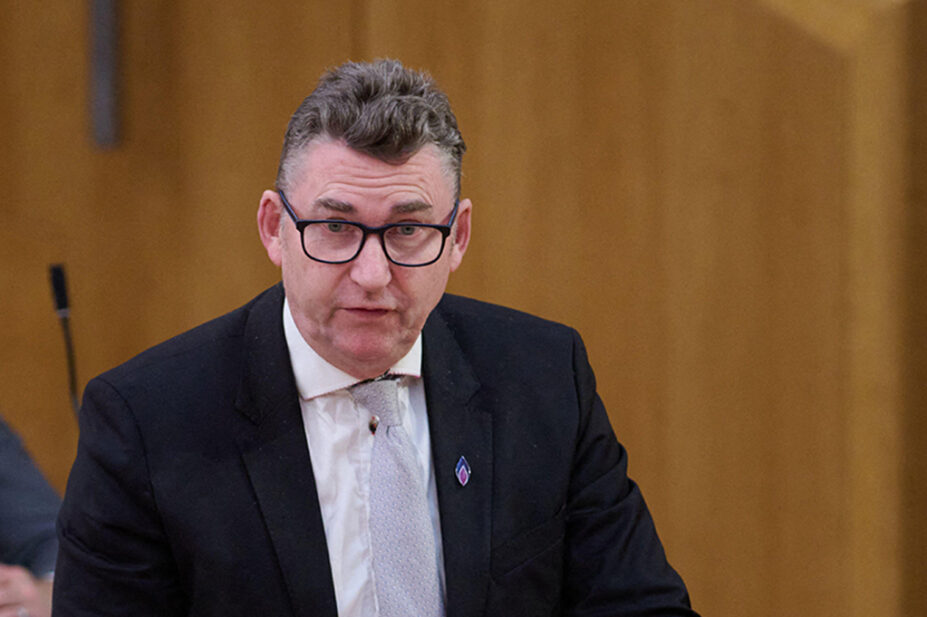
SST / Alamy Stock Photo
Concerns over the removal of protections for pharmacists and other healthcare professionals were central to the Scottish Parliament’s final debate on the Assisted Dying for Terminally Ill Adults (Scotland) Bill, ahead of a vote that saw the bill defeated.
Several members of the Scottish Parliament (MSPs) cited the lack of safeguards for healthcare professionals who did not wish to participate in assisted dying as a key reason for opposing the bill, after protections that had been secured at an earlier stage of the legislative process were removed in the days before the final vote.
In the debate, Brian Whittle, Scottish Conservative MSP for South Scotland, said he remained “concerned about the exclusion of pharmacists from the healthcare framework, despite their expertise in the supply, handling and effects of medicines and other drugs, and the lack of safeguards for other healthcare professionals”.
He also raised concerns about the doctor–patient relationship, warning that “a doctor proposing assisted dying to a patient as an option could compromise that trust and risk the patient feeling pressurised towards a choice that they may not otherwise make”.
Whittle had previously tabled an amendment at stage two of the bill in November 2025, on behalf of the Royal Pharmaceutical Society (RPS), which would have clarified the pharmacist’s role in supplying the substance used in assisted dying and allowed pharmacists to conscientiously object to participating.
Both provisions were subsequently removed before the final vote.
Whittle voted against the bill, saying in the stage three debate: “I have come to the conclusion that there is no right answer here … I do not think that the bill, in the current social climate, meets the high bar that is required to pass assisted dying legislation.”
Speaking to The Pharmaceutical Journal after the vote, in which the bill was rejected by 69 votes to 57, Whittle said: “I was clear from early in the bill’s process that the importance and role of pharmacists in assisted dying should be acknowledged and their expertise integrated into the process.
“Despite some constructive discussion with Liam McArthur about my amendments, and support from the RPS, I was unable to get those amendments through.”
McArthur, MSP for Orkney Islands, sponsored the bill, introducing it to Scottish Parliament in March 2024.
Douglas Ross, Scottish Conservative MSP for the Highlands and Islands, also cited the RPS’s decision to oppose the bill as a reason for voting against it.
“[The RPS] said that, because the bill did not contain vital protections for pharmacists and other healthcare professionals with conscientious objections, it could no longer remain neutral on the bill and urged members to vote against it,” he said.
While the RPS remains neutral on the principle of assisted dying, it opposed the final draft of the bill after what it described as “vital protections” were removed in the days before the vote, including section 18, which had been referred to as a “conscience clause” and would have provided statutory protections for pharmacists and other clinicians who chose not to participate.
Following the bill’s defeat, Laura Wilson, RPS director for Scotland, said: “While the RPS takes a neutral position on the principle of assisted dying, we had raised concerns that the final version of the Bill did not include important safeguards for pharmacists or clarity around their role.
“If this issue is revisited in future, we stand ready to work with policymakers to ensure any legislation properly recognises pharmacists’ professional role and rights, including conscientious objection.”
A survey conducted by The Pharmaceutical Journal in September 2025 found that just over half of pharmacists (54%, n=408) supported assisted dying in principle.