Science Photo Library/Alamy.com
Concerns have been raised around legislative technicalities that could leave healthcare professionals in Scotland unable to opt-out of the assisted dying process.
Currently, only the UK government has the power to legislate on the regulation of healthcare professionals, as this is outside the remit of Scotland’s devolved powers.
The ‘conscience clause’, which would enable pharmacists to opt-out of involvement in the process, will need to be removed from the Scottish Bill before it can be passed, in time for parliamentary recess in April 2026.
If the UK Bill is then passed without an “opt-out” model equivalent to the current Scottish Bill, then Scottish pharmacists could face weaker protections than currently proposed, since the legislation decided in Parliament could be applied to the whole of the UK.
In addition, if the Assisted Dying (Terminally Ill Adults) Bill fails in Parliament, there will be no provisions in the Scotland Bill relating to conscientious objection by healthcare professionals.
However, it is possible for a Section 104 Order — under the Scotland Act 1998 — to be implemented at a later stage that would allow the Scottish government to make its own provisions around the “conscience clause”.
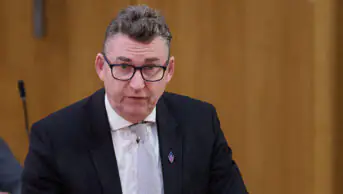
During a Scottish Parliament Health, Social Care and Sport Committee meeting, held on 20 January 2026, Scottish shadow health secretary Sandesh Gulhane asked Scottish health secretary Neil Gray for reassurance that a section 104 Order would be implemented, regardless of what happens to the UK assisted dying Bill.
“My understanding is that a section 104 Order would [be required] to proceed regardless of whether there was similar legislation contained currently in the House of Commons or the House of Lords or not, and indeed whether that particular legislation passes or not that this is a separate process based on the Scottish Parliament’s processes,” Gray responded.
Gulhane, who is also a practising NHS GP, also asked: “Have they [UK government] indicated a guaranteed assurance they will do this if we were to pass [the Bill]?”
“Negotiations on that … and discussions are still ongoing as to the terms of what that looks like,” Gray replied.
A spokesperson for the Scottish government, who confirmed this to The Pharmaceutical Journal, said: “Our discussions with the UK government to agree the provisions that could be dealt with by section 104 Order (including those relating to employment protections) are ongoing.
“Such an order would be laid in the UK Parliament after royal assent, if the Bill passes. However, provisions to be dealt with by section 104 Order must first be removed from the Bill to ensure that the Bill itself is within competence when the stage three vote is taken.”
Stage three is the final debate and vote on the Bill, which is expected to take place in March 2026, before Parliament dissolves ahead of elections.
Maurice Hickey, head of policy at the Pharmacists’ Defence Association (PDA) Scotland, told The Pharmaceutical Journal: “The PDA is conscious of the time pressure in both parliaments and is worried that if the safeguards in relation to the conscience clause are diluted in either house this could have profound implications for individual pharmacists.”
However, he said the PDA and other pharmacy stakeholders would support the introduction of an opt-in model as is currently being debated in the House of Lords.
The UK government’s Scotland office was approached for comment.
The results of a survey, conducted by The Pharmaceutical Journal in September 2025, found that just over half (54%) of pharmacists supported assisted dying.