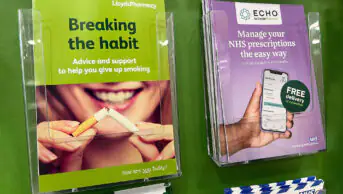
Olga Yastremska/ Alamy Stock Photo
Fewer than 2% of community pharmacies carried out a consultation under the NHS community pharmacy smoking cessation service between January 2026 and June 2026, even though half (50%) have signed up to provide it, a report has found.
In a report, published on 28 October 2026, the Company Chemists’ Association (CCA) said that England was “unlikely” to meet its 2030 smokefree ambition based on current trajectories, which is a target of 5% or less smoking prevalence in adults.
The report highlighted that the figure was 10.4% in 2024, with around 4.4 million adults still smoking.
Referral rates from the NHS community pharmacy smoking cessation service are “extremely low” because it takes referrals from hospitals only, even though many pharmacies have trained staff and governance arrangements, the report noted.
In the report, the CCA called for the current service to be opened up to accept “walk-ins, self-referrals and referrals from the wider healthcare system”, as well as funded in line with other national clinical services.
The CCA also proposed a three-tier model for smoking cessation services: pharmacies would act “as a universal front door” identifying people who smoke, giving very brief advice and referring them; a national framework would cover supplying nicotine replacement therapy and prescription-only medicines; and a nationally specified ‘stop smoking’ community pharmacy service would be delivered locally.
“A more coherent and nationally consistent approach is required,” the report stated.
“A tiered approach, with appropriate funding, will support this. A base tier available in every pharmacy will promote universal access.”
The NHS community pharmacy smoking cessation service began in March 2022, with more than 2,000 community pharmacies signing up to the service in the first two months of its launch.
However, The Pharmaceutical Journal reported in March 2025 that just 4% (203) of the 4,721 pharmacies registered to provide the service claimed payment for a consultation between July 2024 and September 2024.
The CCA report described the current provision of community pharmacy smoking cessation help as “disjointed and confused”, resulting in a “postcode lottery” of service provision, while local services differ on who can use them, treatment options, training and pay.
Malcolm Harrison, chief executive of the CCA, commented: “Community pharmacies are ideally placed to help more people quit smoking, particularly in deprived areas where smoking rates are often the highest. Yet the current system is making it unnecessarily difficult for pharmacies to deliver the support people who smoke need.
“It cannot be right that around half of pharmacies have signed up to the national NHS service, but less than 2% are receiving referrals for patient consultations. This is a missed opportunity to help more people quit smoking.
“If the government is serious about achieving its smokefree ambitions and tackling health inequalities, it must remove the barriers preventing community pharmacy from playing its full part.”
Alastair Buxton, director of NHS services at Community Pharmacy England (CPE), said: “Pharmacy teams have always been a key part of smoking cessation support for the population, offering easily accessible support, but variability in local public health commissioning and a national service with very limited scope means many patients are missing out.
“CPE’s ambitions for an open-access smoking cessation service for all smokers and users of vapes, providing not just advice but the supply of effective medicines to quit, align well with this report’s recommendations. We have long been an advocate for a bigger role for pharmacy in this area, [in 2025] calling to broaden the current service’s eligibility in a joint action plan with the Taskforce for Lung Health.
“Government should be harnessing the sector’s potential to help deliver key public health targets, such as those on smoking cessation, although any expansion of pharmacy services must be fairly funded with additional funding over and above the current global sum.”
Hazel Cheeseman, chief executive of campaigning group Action on Smoking and Health, said: “The 2030 smokefree ambition is now very likely to be missed. Years of inaction after the target was set cost us valuable time, although more recent investment and legislation have put us back on the right track.
“Community pharmacies have an important role to play in accelerating progress, particularly by reaching more smokers with advice, support and effective quitting aids. But no single service can deliver a smokefree future. We need joined-up local plans that make the most of specialist stop smoking services, pharmacies, primary care and hospitals, ensuring people can access the support that works best for them.”
In January 2026, manufacturer AstraZeneca proposed paying for a walk-in national community pharmacy ‘stop smoking’ service through a tobacco levy.
Read more: ‘A pharmacy guide for smoking cessation consultations‘