
BRUKINSA (zanubrutinib), a Bruton’s tyrosine kinase inhibitor (BTKi) licensed for adults with chronic lymphocytic leukaemia (CLL) or small lymphocytic lymphoma (SLL), Waldenström’s macroglobulinemia, and, following prior therapy, mantle cell lymphoma (MCL), marginal zone lymphoma (MZL) or follicular lymphoma (FL) (the latter in combination with obinutuzumab), is undergoing a change in formulation.1,2
Since October 2026, the existing 80mg capsule has been replaced by a 160mg tablet on a permanent basis.
While the recommended total daily dose remains unchanged at 320mg, the transition raises practical questions for pharmacy teams around dispensing, patient counselling and managing the switchover from existing capsule stock.
Why is the BRUKINSA formulation changing?
The 160mg tablet formulation has been developed to replace BRUKINSA 80mg capsules and offer prescribers and patients the same clinical flexibility with an improved patient experience.1–3
The change is also part of manufacturer BeOne Medicines’ commitment to sustainable business practices.
What are the patient benefits of the BRUKINSA tablets?
With BRUKINSA 160mg tablets, the daily tablet intake is halved compared to the 80mg capsules, from 4 capsules to 2 tablets.1,2
As an added benefit, at only 16mm long, the BRUKINSA film-coated tablets are almost one-third smaller in length than the capsules, which may make them easier to swallow.1,3
BRUKINSA tablets are also scored for splitting if dose reduction is clinically indicated.1
Will BRUKINSA capsules still be available?
Following the availability of BRUKINSA tablets in the UK, supplies of BRUKINSA capsules through the usual suppliers have been depleted. BRUKINSA tablets are now the standard formulation and capsules should only be prescribed where there is existing local stock to be used.
Patients currently taking BRUKINSA capsules should transition to tablets when they finish their existing supply of capsules. This approach will help minimise wastage and environmental impact, and provide a clear transition that supports patient safety.
What are the visual changes between BRUKINSA tablets and capsules?
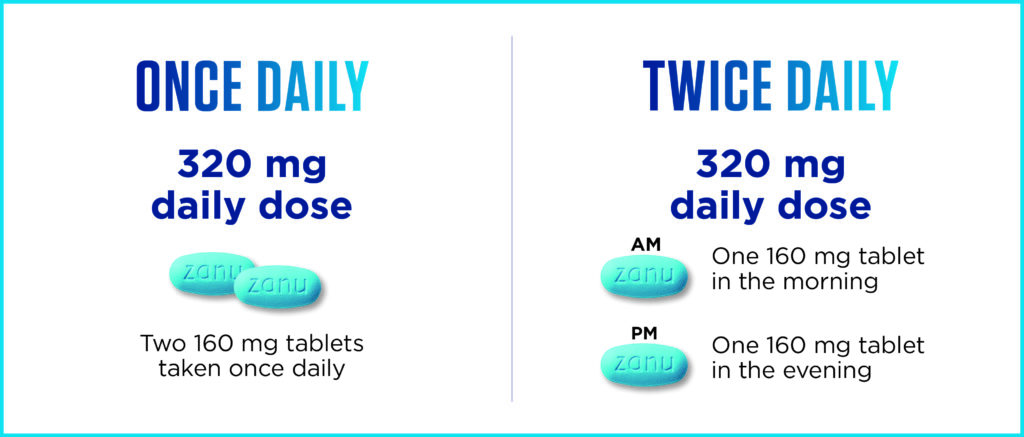
BRUKINSA tablets are blue in colour to differentiate them from the capsules, which are white.1,2
The tablet bottle is ~70% smaller than the capsule bottle.
What are the changes to the BRUKINSA dosing schedule?
BRUKINSA is still the only BTKi to offer the flexibility of once- or twice-daily dosing, with the ability to tailor the schedule to match patients’ requirements.1,4–6
Since one blue tablet contains double the dose of a capsule, this means patients will take half as many.1,2
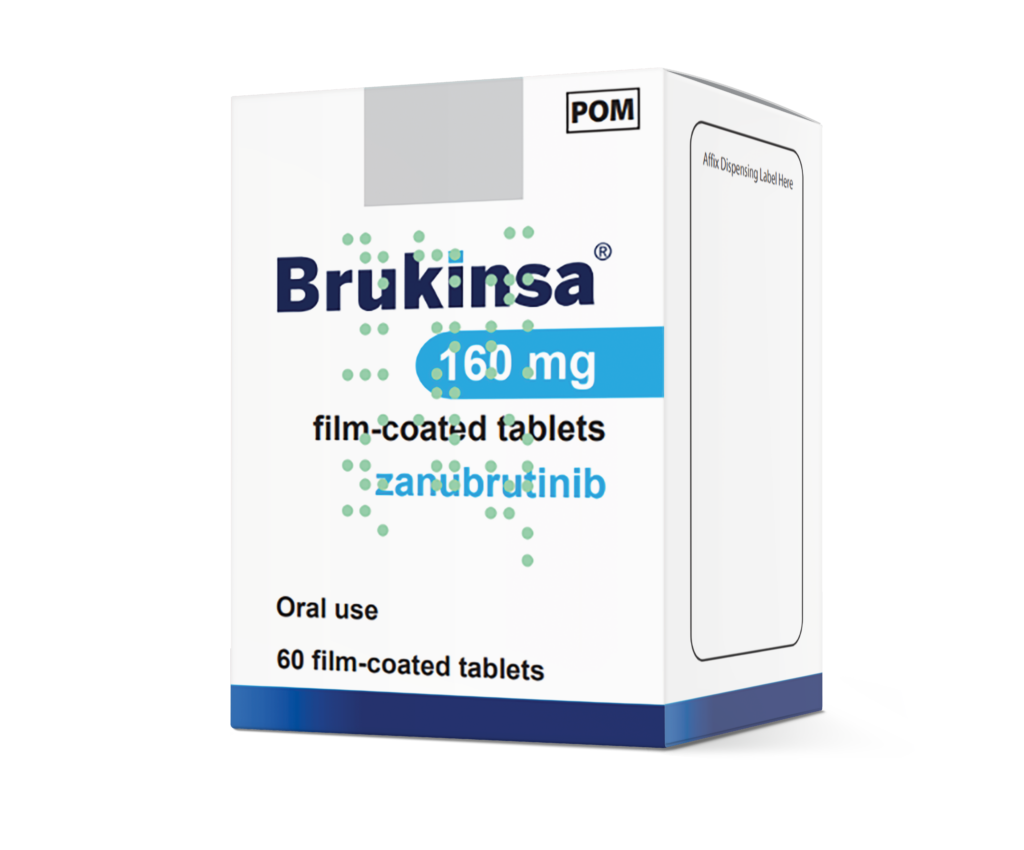
As the recommended total daily dose of BRUKINSA remains at 320mg, this can be taken as either two 160mg tablets once daily, or one 160mg twice daily (one 160mg tablet in the morning; one 160mg tablet in the evening).1
ONCE DAILY (QD)
320mg daily dose – 2 tablets taken once daily
This is a useful choice for patients with compliance concerns or those who prefer taking their medication once a day.
TWICE DAILY (BID)
320mg daily dose – 1 tablet in the morning, 1 tablet in the evening
This is ideal for patients who take other twice-daily medications to maintain a consistent drug-dosing schedule.
Are the efficacy and safety of BRUKINSA tablets the same as the capsule formulation?
Pharmacists and their teams can be reassured that BRUKINSA tablets continue to offer the same expected efficacy and safety as the capsules, based on the results of studies in healthy adults to establish bioequivalence.1,7
Supporting patients in the pharmacy
The move from capsule to tablet does not change the licensed indications, recommended dose or established safety and efficacy profile of BRUKINSA, but it does change what pharmacists will need to discuss with patients over the coming months.
For pharmacists and their teams, this reformulation is an opportunity to revisit conversations with patients currently taking BRUKINSA, to make sure they understand that:
- The total recommended daily dose of BRUKINSA is 320mg (2 tablets);1,2
- One blue tablet is double the strength of one capsule;
- BRUKINSA can be taken once daily or twice daily. Patients should talk to their doctor to agree which daily tablet routine suits them best;1,8
- This transition to tablet form is not related to a product recall or safety concern;
- Patients should continue taking capsules at their usual dose until they switch to the tablet formulation;
- There is no need for patients to return remaining capsules when they are prescribed tablets.
How should BRUKINSA tablets be taken?
- BRUKINSA tablets should be swallowed whole with water and should not be chewed or crushed;1,8
- Half-tablets used for dose reductions should be taken in the same way as whole tablets;1
- BRUKINSA tablets can be taken with or without food, including high-fat meals;1
- If a dose is missed, the next dose should be taken according to the normal schedule. A double dose should not be taken to make up for a missed dose;1
- Patients should be advised to consume grapefruit or Seville oranges (bitter oranges, including marmalade) with caution around the time they take BRUKINSA.8
As new prescriptions are required for patients moving to BRUKINSA 160mg tablets, pharmacists can reassure patients that the pharmacy will contact their prescriber when the new tablet script is needed.
Support for a smooth transition
Clear, proactive communication, explaining that the switch is a formulation change rather than a safety-related recall, and confirming when and how individual patients will transition, will be central to a smooth handover as capsule stock is used up and tablets become available through the usual suppliers.
For more information about BRUKINSA tablets, patients can be directed to the patient frequently asked questions leaflet and BRUKINSA patient booklets.
For the latest information about the BRUKINSA tablet formulation for healthcare professionals, visit BRUKINSA.co.uk or view the BRUKINSA information leaflet.
Click here for BRUKINSA prescribing information.
▼ This medicine is subject to additional monitoring. This will allow quick identification of new safety information. Report any suspected adverse reactions.
Adverse events should be reported. United Kingdom: Healthcare professionals are asked to report any suspected adverse reactions via the Yellow Card Scheme found at: www.mhra.gov.uk/yellowcard. Adverse events should also be reported to BeOne Medicines at: https://beonemedicines.co.uk/report-adverse-event/
0926-BRU-PRC-278 | October 2026
- 1.BRUKINSA (160 Mg Tablets). United Kingdom Summary of Product Characteristics. BeOne Medicines UK, Ltd; 2026.
- 2.BRUKINSA (80 Mg Capsules). United Kingdom Summary of Product Characteristics. BeOne Medicines UK, Ltd; 2025.
- 3.Seedat J, Zayannakis A. Pill-swallowing – a bitter experience for some despite the ease of the swallow. South Afr J Pub Health. 2020;4(2):41-46.
- 4.IMBRUVICA. Summary of Product Characteristics. Pharmacyclics LLC, Janssen-Cilag Ltd; 2026.
- 5.Calquence. Summary of Product Characteristics. AstraZeneca Pharmaceuticals LP; 2026.
- 6.Jaypirca. Summary of Product Characteristics. Eli Lilly and Company Limited; 2026.
- 7.Tariq B, Lin C, Mundra V, Gao Y, Zhang D, Ou YC. Relative Bioavailability, Food Effect, and Bioequivalence Studies to Assess a New Zanubrutinib 160‐mg Tablet: Results From 2 Phase 1 Studies in Healthy Volunteers. Clinical Pharm in Drug Dev. 2025;15(1). doi:10.1002/cpdd.1584
- 8.BRUKINSA. United Kingdom Patient Information Leaflet. BeOne Medicines UK, Ltd.; 2026.
BRUKINSA and BeOne Medicines are trademarks owned by BeOne Medicines I GmbH or its affiliates. © BeOne Medicines I GmbH, 2026 All Rights Reserved.