Turning Point Scotland and South Lanarkshire Alcohol and Drug Partnership
The Pharmaceutical Journal’s comprehensive look at the danger of nitazenes, published in February 2024, heard warnings that potent synthetic opioids could drive up deaths as they spread through the UK illicit drugs supply. Two years on, those predictions seem to have become a reality in Scotland, where drug use deaths have risen by 11% compared with 2024, according to figures published by the National Records of Scotland in September 2026.
In total, 1,133 people in Scotland died from illegal drug use in 2025, with nitazenes implicated in more than one in five deaths — 247 in total, which is more than three times the number of deaths in 2024.
Public Health Scotland (PHS) issued its first alert about nitazenes in January 2023, while between 2022 and 2023, they were detected in 25 deaths, which is around one-tenth of last year’s figure.
Duncan Hill, a specialist pharmacist in substance use management at NHS Lanarkshire, told The Pharmaceutical Journal that these figures show “rapid changes in the illicit drug market” and “significant new risks” from new synthetic opioids.
“Some of them are 500 times more potent than heroin,” he adds. “It’s frightening.”
A form of synthetic opioid, 2-benzyl benzimidazole — or nitazene — opioids were first developed in the 1950s as analgesics but were found to be so potent they were never approved or marketed as medicines.
Like morphine and heroin, nitazenes also suppress the respiratory system, which can result in death, but the effects of nitazenes are seen at much lower doses.
The emergence of synthetic opioids has only heightened the need to tackle Scotland’s drug death problem. A drugs death taskforce was set up and improvements to psychological and social support were introduced through the Medication Assisted Treatment (MAT) standards in 2021. The taskforce’s final report was published in 2022. These improvements include same-day access to treatment for drug addiction and being able to make an informed choice on what treatment medication to use: methadone, oral buprenorphine or long-acting injectable buprenorphine. However, implementation of these standards varies across the country, according to PHS.
Hill says implementing these standards has “made a difference” but adds that local health boards and charities, such as Turning Point Scotland and Phoenix Futures, have become crucial as they offer residential services and advice seven days per week, unlike many NHS services.
“But they don’t have the ability to start prescribing,” notes Hill, so recovery support alongside clinical treatment through initiatives including safer drug consumption rooms, such as The Thistle — the first in the UK — and Glasgow’s drug-checking facility, which opened on 9 November 2026, are critical to fixing Scotland’s drugs crisis.
Extending the naloxone supply
Equally significant to tackling drug deaths is the distribution of naloxone — a medicine that temporarily reverses the effects of an opioid overdose. Naloxone was added to the community pharmacy public health service in Scotland in October 2023 through an emergency supply service, with funding for two kits per pharmacy1.
Access has also been extended beyond health settings, with Police Scotland trained to use and carry intranasal naloxone in 20222. The latest PHS quarterly report, published in September 2026, highlighted that almost 89% of people at risk of an opioid overdose have been supplied with a naloxone kit3. In March 2026, the Scottish government committed to widening distribution in pharmacies and community venues in its ten-year alcohol and drugs plan.
As the drugs market evolves, national policy and service specifications must be kept under review to ensure pharmacy teams have the resources required to respond effectively
Sarah Staddon, policy and public relations pharmacist at Community Pharmacy Scotland
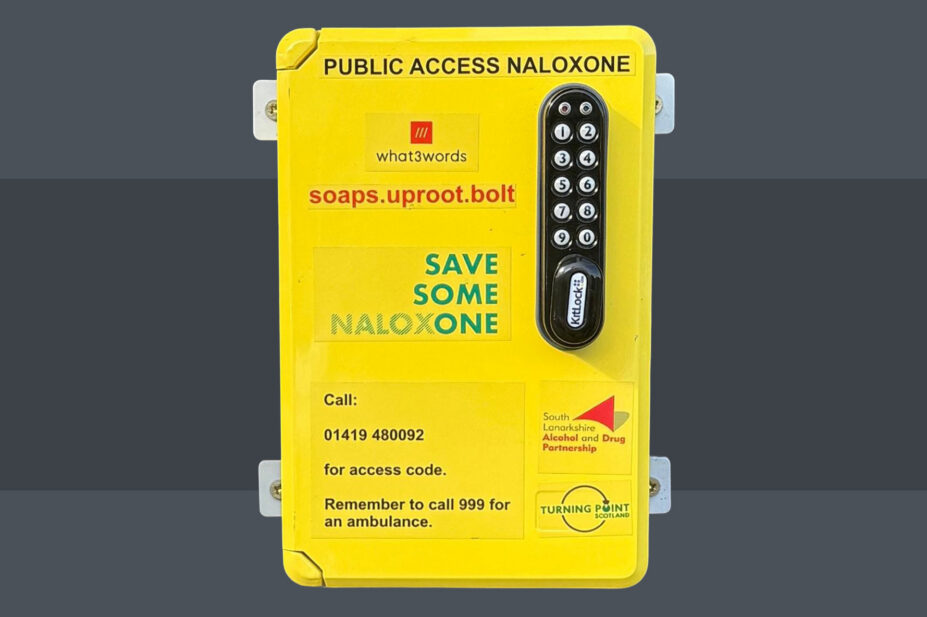
Scotland’s first public naloxone lock box appeared in October 20254, with three more following across North Lanarkshire in January 2026 and one in East Ayrshire in September 2026 — one of the areas that saw the largest increases in drug use deaths in 2024/20255.
The boxes are modelled on defibrillator cabinets and can be opened by calling a number for a code. Patricia Tracey, head of alcohol and other drugs at Turning Point Scotland, which helps maintain the Lanarkshire cabinets, told The Pharmaceutical Journal that the cabinets had not yet been used in an emergency, but that they “help reduce stigma”.
Sarah Staddon, policy and public relations pharmacist at Community Pharmacy Scotland, told The Pharmaceutical Journal that community pharmacies also play a “vital role” in harm reduction, treatment support and naloxone supply, particularly as Scotland’s early drugs warning system — Rapid Action Drug Alerts and Response (RADAR) — cites polysubstance use, which involves using more than one substance at a time, as causing the majority of drug-related harms6.
“As the drugs market evolves, national policy and service specifications must be kept under review to ensure pharmacy teams have the resources required to respond effectively,” she says.
In April 2026, research published in Anesthesiology warned that a single dose of naloxone was “unlikely to serve as an adequate countermeasure” against high-dose or high-affinity opioids. Hill explains that naloxone is safe to use regardless but adds that “you will need much more — maybe… three or four or more doses”, compared with opioids such as heroin.
“It is a holding measure. It’s there to save the life… while the emergency services are coming,” she continues.
Treating why people use
While naloxone reverses the overdose, it does not address what people are taking or why. Many of the estimated 43,400 people in Scotland with opioid dependence use substances to cope with mental health problems rooted in trauma and adverse childhood experiences7,8.
We have a long-standing history of benzodiazepine use in Scotland, and it wasn’t really being treated appropriately
Catriona Matheson, professor of substance use at the University of Stirling
One clinical trial, In-BOAT, is aimed at addressing those underlying reasons for people whose drug of concern is not an opioid at all: benzodiazepines, sedatives usually prescribed for short-term relief from anxiety and sleep problems but widely used alongside opioids, including synthetics such as nitazenes, among people who use street drugs9.
“We have a long-standing history of benzodiazepine use in Scotland, and it wasn’t really being treated appropriately,” says Catriona Matheson, professor of substance use at the University of Stirling and a former chair of the Scottish drugs death taskforce, who leads the In-BOAT trial.
“The clinical guidance just said put people on a reducing dose,” but “[we’re] not getting any… background motivations addressed”.
The UK-wide randomised controlled trial, whose investigators include two other pharmacists, Hill and Jenny Scott, senior lecturer at the University of Bristol, will test a maintenance dose of diazepam 16–30mg alongside psychosocial support to address why people use, against standard care of a tapering dose over six months. The psychosocial element is supported by the maintenance dose as a “package of care”, says Matheson.
Harm reduction messaging is also built in. Participants get fortnightly appointments of up to an hour each, ideally face-to-face. Matheson notes that in current practice, an appointment is “at best” half an hour per month by phone — a “fairly minimal… almost transactional intervention”.
What pharmacy can do
Community pharmacy teams come into regular contact with people with substance use issues, and Hill believes the accessibility of community pharmacies in areas where drug deaths are highest can help to “remove any stigma” around drug use.
A consistent national approach would ensure community pharmacy teams across Scotland are equipped to deliver the interventions, support and care needed to help reduce harm and save lives
Sarah Staddon, policy and public relations pharmacist at Community Pharmacy Scotland
“Have that time with a patient, just acknowledge them and say how are you doing? Make connections with the addiction services… and stay up to date with what might be getting used in the communities you’re working in… [and] get that information out,” he says.
Staddon adds: “A consistent national approach would ensure community pharmacy teams across Scotland are equipped to deliver the interventions, support and care needed to help reduce harm and save lives, particularly in our most vulnerable communities.”
Speaking to The Pharmaceutical Journal, Maree Todd, pharmacist and Scottish minister for mental wellbeing, public health, sport, alcohol and drugs says: “We are working hard to respond to the threat. My previous role and pharmacy knowledge has been helpful in understanding the challenges we face. Pharmacists have a vital role to play in reducing drug deaths and harms, including providing naloxone kits, and I thank them for all their hard work.”
Read more: Everything you need to know about nitazenes
- 1.Emergency Supply Naloxone: Emergency Naloxone Holding Service. NHS Fife . https://www.communitypharmacy.scot.nhs.uk/nhs-fife/pages/addiction-services/naloxone/emergency-supply-naloxone/
- 2.Carriage of Naloxone by Police Scotland officers. Police Scotland. https://www.scotland.police.uk/about-us/how-we-do-it/carriage-of-naloxone-by-police-scotland-officers/
- 3.National naloxone programme Scotland – Quarterly monitoring bulletin: Quarterly monitoring bulletin January to March (Q4) 2025/26. Public Health Scotland. 2026. https://www.publichealthscotland.scot/publications/national-naloxone-programme-scotland-quarterly-monitoring-bulletin/national-naloxone-programme-scotland-quarterly-monitoring-bulletin-january-to-march-q4-202526/
- 4.Turning Point Scotland Launch Naboxone In Scotland. Turn Point Scotland. 2025. https://turningpointscotland.com/turning-point-scotland-launch-naboxone-in-scotland/
- 5.Drug-related deaths in Scotland, 2025. National Records of Scotland. 2026. https://www.nrscotland.gov.uk/publications/drug-related-deaths-in-scotland-2025/
- 6.Rapid Action Drug Alerts and Response (RADAR) quarterly report. Public Health Scotland. 2026. https://www.publichealthscotland.scot/publications/rapid-action-drug-alerts-and-response-radar-quarterly-report/rapid-action-drug-alerts-and-response-radar-quarterly-report-july-2026/main-points/
- 7.Estimated prevalence of opioid dependence in Scotland: 2014/15 to 2022/23. Public Health Scotland. 2025. https://publichealthscotland.scot/publications/estimated-prevalence-of-opioid-dependence-in-scotland/estimated-prevalence-of-opioid-dependence-in-scotland-201415-to-202223/
- 8.Evaluation of the National Mission on Drug Deaths Lived experience survey. Public Health Scotland. 2025. https://publichealthscotland.scot/media/35390/evaluation-of-the-national-mission-on-drug-deaths-lived-experience-survey-final-150725.pdf