DR Moura / Shutterstock.com / The PJ
When, in 2020, the NHS in England first committed to reaching net zero, it estimated that around 3% of all of its carbon emissions came from the gases used to propel standard pressurised metered dose inhalers (pMDIs), which are used to treat asthma and chronic obstructive pulmonary disease (COPD).
Six years on, emissions from inhalers are falling across England, Scotland and Wales. But each nation has set its own targets for cutting them, with some targets missed.
In July 2026, the Medicines and Healthcare products Regulatory Agency (MHRA) announced what it called a “world first” in asthma management: the approval of new versions of Chiesi’s Clenil Modulite preventer inhalers, powered by a “next generation” lower-carbon propellant.
Clenil Modulite has always been a pMDI, but the new versions use the propellant HFA-152a that Chiesi says could reduce the carbon footprint of pMDIs by up to 90%.
The approval was the latest in a series of moves to reduce the environmental impact of these essential medical devices. With an update on NHS Scotland’s progress expected in the coming weeks, The Pharmaceutical Journal examines where each nation stands in relation to its goals and whether the drive for greener inhalers is aligned with the clinical needs of patients.
Why inhaler type matters for emissions
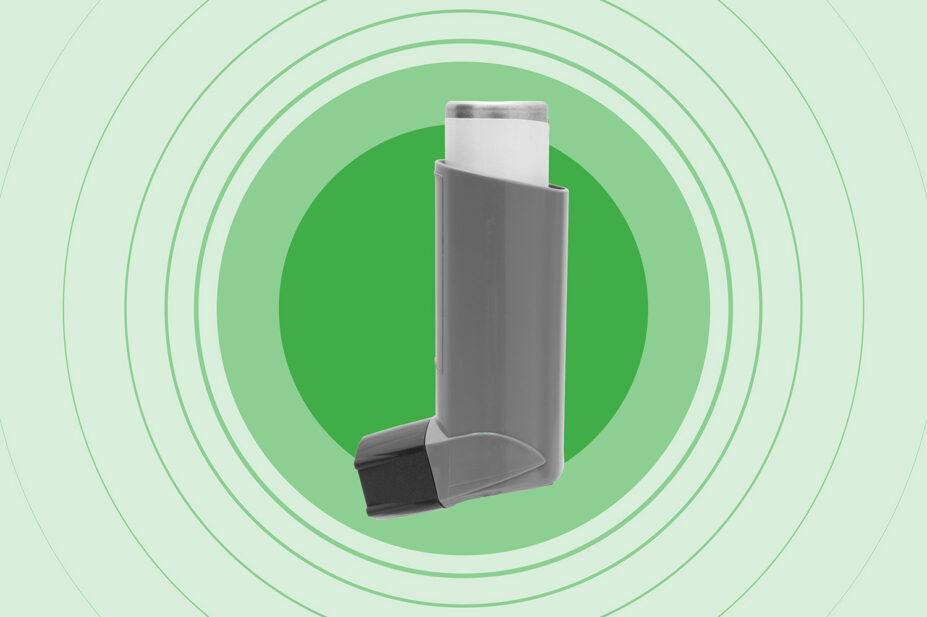
pMDIs use a pressurised propellant gas to push out a measured dose of medicine as a spray. In addition, most pMDIs use propellants that have a global warming potential (GWP) 1,300 to 3,300 times that of carbon dioxide, and their impact is measured in tonnes of carbon dioxide equivalent (tCO2e).
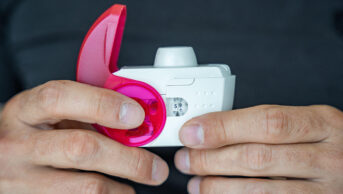
Dry powder inhalers (DPIs) and soft mist inhalers (SMIs) are alternatives to pMDIs that do not use propellant, so they have a much lower carbon footprint. DPIs release the medicine as a powder when the patient breathes in, while SMIs use a spring to produce a slow-moving mist. However, DPIs need a strong, fast in-breath, which many young children and some people with severe lung disease cannot manage. Next-generation MDIs (ngMDIs) work in the same way as pMDIs but use propellants with a much lower GWP, such as Chiesi’s HFA-152a. NHS Wales counts DPIs, SMIs and ngMDIs together as ‘low-GWP’ inhalers.
The type of treatment prescribed also affects emissions. Reliever inhalers containing a short-acting beta-2 agonist (SABA), such as salbutamol, are mostly pMDIs and account for around 70% of pMDI emissions in Scotland. However, the joint UK asthma guideline, published in November 2024, moves away from treating asthma with a SABA alone. Instead, it recommends a single inhaler combining an inhaled corticosteroid (ICS) and formoterol, a long-acting bronchodilator (LABA). This can be used only when symptoms occur, known as anti-inflammatory reliever (AIR) therapy, or every day, as well as when symptoms occur, known as maintenance and reliever therapy (MART).
Box: National targets for inhaler emissions at a glance
Each nation has set its own goals for reducing emissions from inhalers and measures progress in its own way.
Scotland: In 2022, NHS Scotland introduced a target of a 70% reduction in emissions from inhaler propellant by 2028. Its respiratory prescribing guidance splits this into interim goals of a 25% reduction by the end of 2024 and a 50% reduction by 2026.
Wales: The NHS Wales decarbonisation strategic delivery plan, published in 2021, set a target to increase the use of low-GWP inhalers to 80% of the total inhalers issued by 2025, which it estimated would cut the annual carbon footprint of inhalers in primary care from 65,000 tCO2e to 20,000 tCO2e.
England: NHS England aims to cut the health service’s greenhouse gas emissions by 4% by 2040 through greener inhaler prescribing — equivalent to 403 kilotonnes of CO2e (ktCO2e) annually, according to the NHS Business Services Authority (NHSBSA).
Progress so far
Scotland
NHS Scotland missed its interim goal of a 25% cut in inhaler emissions by the end of 2024.
According to NHS Scotland’s latest annual sustainability report, in 2024/2025, total annual emissions from pMDI propellant were 74,000 tCO2e. This is an 18% reduction on its total emissions in the year the targets were set, which the 2025 report says amounted to 90,000 tCO2e. The report adds that the reduction “has been driven by a switch from inhalers with a higher volume of propellant gas to ones which deliver the same dosage of medicine using a lower volume of propellant”.
The last annual report demonstrated sustained progress in reducing emissions from inhalers
A spokesperson for the Scottish government
Despite missing its target, Public Health Scotland figures, published in April 2026, show that prescribing is changing in line with the asthma guideline. The figures show that the use of AIR and/or MART inhalers has increased. As a proportion of all ICS and ICS/LABA inhalers, AIR and/or MART inhaler prescribing was 43% in October 2025 to December 2025, up from 32% in October 2023 to December 2023. “[This] suggests improved compliance from prescribers with the asthma guidelines,” the PHS said.
Darush Attar-Zadeh, a respiratory pharmacist based in north-west London, says: “In asthma, AIR and MART approaches deliver ICS when symptoms occur, addressing underlying inflammation rather than simply relieving bronchoconstriction with a SABA.”
A spokesperson for the Scottish government added: “The last annual report demonstrated sustained progress in reducing emissions from inhalers. A further update will be published in the coming weeks.”
Wales
Wales also missed its target for 80% of inhalers to be low GWP by 2025. Data from the All Wales Therapeutics and Toxicology Centre (AWTTC) show that low-GWP inhalers (i.e. DPIs, SMIs and ngMDIs) made up just 52% of all inhalers prescribed in primary care in August 2026, up from 44% in January 2025.
Monthly data from the AWTTC also show that in August 2026 inhalers issued in primary care had an indicative carbon footprint of 2,539 tCO2e, down from 5,389 tCO2e in January 2021. Over the 12 months to August 2026, the footprint was 34,907 tCO2e, against the target of 20,000 tCO2e per year.
Since April 2022, there has been a near 60% increase in the use of low GWP inhalers in Wales
A spokesperson for the Welsh government
The AWTTC data also show greater compliance with new prescribing guidelines. AIR or MART inhalers now make up 44% of all ICS and ICS/LABA inhalers, up from 33% in January 2025.
A spokesperson for the Welsh government says: “Since April 2022, there has been a near 60% increase in the use of low GWP inhalers in Wales. Low global warming potential inhalers now account for more than half of all prescriptions for inhalers, with a 40% reduction in the indicative annual carbon footprint associated with their prescribing as a result.”
The spokesperson also notes that an analysis published in npj Primary Care Respiratory Medicine in February 2025 reported that Wales saw a simultaneous reduction in high-GWP inhalers and an increase in low-GWP inhalers between 2018 and 2024. The authors credited a national respiratory toolkit — rolled out to every GP practice in Wales from autumn 2021 — that showed the carbon footprint of each inhaler alongside prescribing guidance.
England
In a 2025 report — entitled ‘Five years of a greener NHS: progress and forward look’ — NHS England noted that emissions from inhalers have fallen by over 340 ktCO2e since 2019/2020, which it says is a 33% reduction. That is equivalent to 84% of the 403 ktCO2e annual reduction set out as the initial long-term plan commitment in NHS England’s net zero plan.
NHSBSA data show that DPIs and SMIs made up, on average, 57% of all preventer inhaler prescribing as of August 2026. That is up from 48% two years ago, in September 2024. As DPIs and SMIs do not contain propellant, a higher share means fewer pMDIs are being prescribed for preventer treatment, reducing emissions.
According to NHSBSA data, NHS Greater Manchester Integrated Care Board (ICB) has the highest rate of low-carbon inhaler prescribing as a proportion of all preventer inhalers, at 92% in September 2026. The lowest rate is in NHS Essex ICB, at 39%, the data revealed.
“There has been an increase in the proportion of lower carbon inhalers being prescribed to patients across Essex, but we recognise there is more work to do to improve this,” says Paula Wilkinson, director of pharmacy, medicines and clinical policies at NHS Essex.
“Our local asthma and COPD guidance supports dry powder inhalers where clinically appropriate, and our formulary provides a range of lower-carbon metered dose Inhaler options.
“Our respiratory work also focuses on reducing reliance on SABA relievers in asthma through the implementation of AIR and MART approaches, and we are seeing an overall reduction in SABA inhaler prescribing.”
The ICB added in a statement that during 2026/2027, its medicines optimisation local enhanced service is supporting primary care networks and practices with clinically-led respiratory optimisation reviews. This includes reviewing preventer therapy, addressing SABA overuse and considering lower-carbon inhaler options where appropriate.
Murugesan Raja, clinical lead in respiratory medicine at the NHS Greater Manchester ICB, says that sustainability had been a priority for respiratory care in the patch since 2021, when the Greater Manchester Medicines Management Group’s COPD guidelines introduced a clear greener pathway, recommending DPIs — then the environmentally preferable option — as first-line treatment. At the time, no next-generation pMDIs had been approved in the UK.
“General practices are supported through Beyond Core Contract Review, using searches to identify people at high risk with COPD or asthma and invite them for long-term condition reviews, enabling clinicians to optimise treatment in line with the published guidelines,” he notes.
Clinical impact
Concerns have previously been raised about how some patients have been switched. In 2022, respiratory experts told The Pharmaceutical Journal that some patients in England were having their inhalers switched to ‘greener’ devices without consultation. More recently, a report by Asthma + Lung UK, published in January 2026, found that around one in three patients whose inhaler had been switched — for any reason — said their condition was less well controlled afterwards.
Ultimately, sustainable respiratory prescribing should not be about chasing carbon targets through blanket switching
A respiratory pharmacist based in north-west London
Matt Swallow, clinical lead at Asthma + Lung UK, says it was “encouraging” to see progress in the uptake of lower-carbon inhalers.
He adds: “While environmental considerations are important, they should never come at the expense of achieving the best possible clinical outcomes for someone with a lung condition.
“Understandably, some people may have concerns about switching inhalers, particularly if they are stable on their current treatment. The good news is there are a range of effective treatment options available, and many people switch to a lower-carbon inhaler successfully.”
Attar-Zadeh says: “Ultimately, sustainable respiratory prescribing should not be about chasing carbon targets through blanket switching.”
“It should focus on optimising disease control, minimising unnecessary devices and empowering patients through shared decision-making,” he added. “Clinical effectiveness, patient choice and environmental sustainability must go hand in hand.”
Tase Oputu, president of the Royal College of Pharmacy, says: “We support the use of lower-carbon inhalers where clinically appropriate and suitable for the individual patient, as part of wider efforts to make medicines use more sustainable.”
“[Pharmacy teams] have an important role to play in optimising respiratory care through inhaler technique checks, reviewing patients’ treatment and discussing whether lower-carbon alternatives may be suitable,” she continued.
What next?
More next-generation pMDIs are on the way. The MHRA approved a low-carbon version of AstraZeneca’s COPD inhaler Trixeo Aerosphere in May 2025, while GSK has reported phase III results for a version of its Ventolin inhaler using HFA-152a, with launch expected from 2026, which is subject to regulatory approval.
[Continuing to reduce overall NHS emissions] will depend not only on continued education and awareness amongst patients and clinicians, but also on pharmaceutical companies developing lower-carbon products
Minna Eii, advanced pharmacist practitioner at South Tyneside and Sunderland NHS Foundation Trust
Minna Eii, advanced pharmacist practitioner at South Tyneside and Sunderland NHS Foundation Trust and a co-founder of environmental group Pharmacy Declares, highlights that reduced emissions so far “reflect several years of work to promote lower-carbon inhalers and include environmental considerations in medicines optimisation”.
“Sustainable respiratory care is now much more embedded in everyday clinical practice, but there is still more to do,” adds Eii.
Eii explains that continuing to reduce overall NHS emissions “will depend not only on continued education and awareness amongst patients and clinicians, but also on pharmaceutical companies developing lower-carbon products and providing greater transparency around Scope 3 data” — the indirect emissions from a company’s supply chain and from the use of its products, such as the propellant released from inhalers.
Greater transparency would mean that “clinicians and patients can make more environmentally informed choices”, she adds.