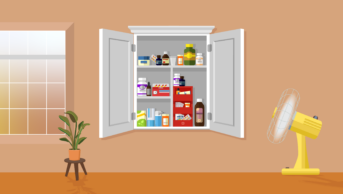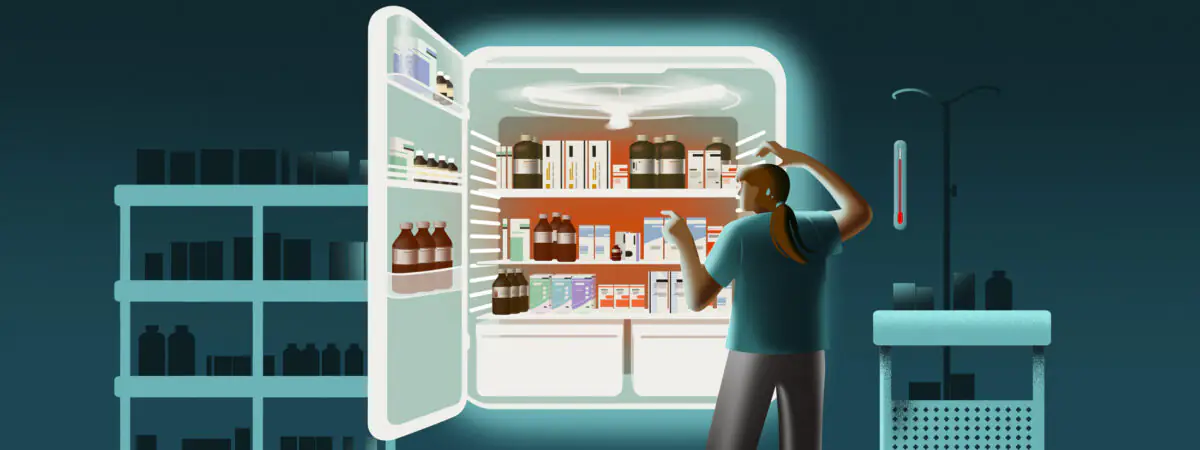
Even with optimal efforts to reduce greenhouse gas emissions, global temperatures are expected to keep increasing1. Incidences of overheating in English hospitals nearly doubled between 2016/2017 and 2021/2022. With 90% of England’s hospital buildings vulnerable to overheating, and some wards recording temperatures above 30°C, even when outdoor temperatures are just 22°C2, maintaining medicines within their recommended storage conditions is becoming an increasingly difficult challenge for an already overstretched pharmacy workforce.
If medicines are not stored correctly, it can affect their efficacy and, as noted by the General Pharmaceutical Council (GPhC) in 2025, there are a growing number of temperature-sensitive drugs for pharmacies to manage, with more inhalers, GLP-1 drugs for weight loss and vaccines requiring refrigeration.
The growing need for refrigeration has caught some pharmacies off guard. The same GPhC report in 2025 revealed that 86 pharmacies failed Standard 4.3 for reasons related to medication storage, while nearly 1 in 20 pharmacies (4.3%) could not show that medicines requiring refrigeration were being stored appropriately.
As our climate changes, it’s important that healthcare settings are equipped to cope with more frequent periods of extreme heat
Tase Oputu, president of the Royal College of Pharmacy
Common themes highlighted by the GPhC included:
- Pharmacy staff not recording maximum and minimum temperatures daily;
- Pharmacy staff recording fridge temperatures outside the appropriate range (between 2°C and 8°C) but not informing the pharmacist;
- Overstocked fridges;
- Medicines frozen to the back of fridges or ice compartments;
- A lack of knowledge about how to reset thermometers, the use of mercury thermometers, or the use of thermometers with a low battery;
- Incorrectly positioned temperature probes.
“As periods of extreme heat become more frequent, pharmacy teams face increasing pressures,” explains Tase Oputu, president of the Royal College of Pharmacy (see Box).
“As our climate changes, it’s important that healthcare settings are equipped to cope with more frequent periods of extreme heat, so that medicines can continue to be stored safely and pharmacy teams have the right environment to continue delivering safe patient care,” Oputu adds.
Importance of safe storage
Without safe storage, research has suggested that some antiseizure medications may be affected by high temperature and/or humidity3, while a paper published by the MHRA in 2024 highlighted concerns around the impact that heat-related medicine degradation could have on antimicrobial resistance (AMR)4.
To manage the heat at East Kent Hospitals University NHS Foundation Trust, Sam Coombes, lead medicines information technician and sustainability lead, is using electronic monitoring software EasyLog to monitor room temperatures.
But other than stock control, rotation and moving medicines to cooler areas, he suggests little more can be done in the short term. He highlights that long-term mitigations include improved ventilation and air conditioning, but the ageing building stock of England’s hospitals presents a major challenge.
“We simply don’t have the resource within the organisations to change the infrastructure. Chief pharmacists aren’t necessarily prioritising this when there is so much pressure to deliver on savings,” Coombes states.
Concerns around mitigating the impact of high temperatures on medicines have been noted widely. In 2025, a policy report published by UK Health Alliance on Climate Change recommended the integration of climate adaptation training into pharmacy curricula, highlighting that without mandating its inclusion, “implementation will likely remain limited”5.
Later that year, another paper suggested that further research was needed to develop better storage solutions and improved supply chain surveillance6. It also called for improved training for healthcare professionals on proper storage to protect the UK’s medicine supply in the long term.
“This includes the adoption of climate-controlled storage facilities equipped with real-time monitoring systems to ensure temperature and humidity stability,” it said.
In May 2026, a study commissioned by the Climate Change Committee concluded that, although the UK cold chain showed good levels of overall resilience, existing reactive measures will not be sufficient as climate change intensifies7.
In response, health minister Baroness Merron has said the government is “supporting trusts to target the most critical estates risks with £6.75bn over nine years, including risks that need to be dealt with in respect of cooling and ventilation”8.
“We do have a resilience plan, not just for overheating but for all threats to resilience arising from temperature,” she said. “We are also providing the funding… and ensuring that we are assisting the estate across the country to meet the challenges, the priority being those areas that need it most.”
No cause for panic
In the shorter term, Jen Smith, a senior medicines advice pharmacist at NHS Specialist Pharmacy Service, says short periods of heatwave temperatures are not a cause for panic as medicines are also stability tested for countries in higher ‘climatic zones’ — with warmer ambient temperatures — than the UK.
The UK is classified as ‘Climatic Zone I (Temperate)’ under the World Health Organization (WHO) and International Council for Harmonisation of Technical Requirements for Pharmaceuticals for Human Use (ICH) stability guidelines9. Much of western Europe falls under Zone I, including Germany and Austria, which on average see hotter summers than the UK. In Zone II, which includes countries in Southern Europe and Japan, products are stability tested under moderately warm and humid environments conditions. If a medicine has global distribution, it will be tested for a range of different climatic zones.
Consider putting suppositories, creams and ointments in the fridge during heatwaves, or at least moving them to a cool(er) place, unless the product information says otherwise
Jen Smith, a senior medicines advice pharmacist at NHS Specialist Pharmacy Service
For now, Smith says, medicines can be refrigerated when ambient temperatures pose a risk. “Consider putting suppositories, creams and ointments in the fridge during heatwaves, or at least moving them to a cool(er) place, unless the product information says otherwise,” she advises.
Pharmacists also have the option of using the Q10 calculation to determine whether the shelf life of medicines being stored at higher temperatures than stated on their packaging, such as during heatwaves, has been reduced10. The Q10 calculation looks at the manufacturer’s shelf life and how long a medicine can be stored at a specific temperature, and is the factor which the rate of a chemical reaction increases with every 10°C increase in temperature.
Medicines at home
The issue of climate control, however, is not limited to NHS estates. Coombes, who co-authored an article published by The Pharmaceutical Journal in June 2026, which urges pharmacy staff to make patients aware of the importance of safe storage11, points out that the issue is bigger than pharmacy storage.
“Most medicines in the UK aren’t stored in warehouses or pharmacies, but in patients’ back cupboards,” he explains.
His article highlighted “an under-recognised role for both hospital and community pharmacy teams in delivering clear, practical and seasonally relevant storage advice during routine consultations”12.
“Patients inherently stockpile medicines, for a number of reasons. It could mean that we rethink how much medicine we supply over the summer periods,” he adds.
We’ve got to work out a strategy of working within those boundaries, but also to highlight to patients that you don’t want to be storing your medicines just above the kettle
Sam Coombes, lead medicines information technician and sustainability lead at East Kent Hospitals University NHS Foundation Trust
Research by home climate management company Tado shows that homes in the UK — which has some of the oldest housing stock in comparison to other European countries — heat up more than twice as quickly as those in other western European countries, including Italy and Germany13. This compounds with findings of research by the then Royal Pharmaceutical Society, published in 2022, which indicated that medicines were often stored in areas of the home where temperature and humidity fluctuate significantly, such as bath and shower rooms12.
“Most patients store their medicines for reasons of convenience,” says Coombes. “We’ve got to work out a strategy of working within those boundaries, but also to highlight to patients that you don’t want to be storing your medicines just above the kettle.”
Aisling Considine, deputy chief pharmacist in emergency planning and business development at King’s College Hospital NHS Foundation Trust, explains how the trust distributes information leaflets about safe medicines storage with patient discharge prescriptions during heatwaves. However, she also highlights that certain patients — such as those without a fixed address or those living in supportive housing — could struggle to store medicines in optimal conditions. “And if they can’t, what can you do about that?”
Sarah Jones, a specialist mental health pharmacist working as a senior lecturer at the University of Bath and a PhD student at the Bristol Medical School, cautions about giving patients “idealised” advice that they may struggle to adhere to, as it may cause anxiety.
“Obviously, there are exceptions, but we need to make sure we don’t cause unnecessary panic,” she says.
More guidance needed
The Medicines and Healthcare products Regulatory Agency (MHRA) does provide some guidance on safe medicines storage. It states that pharmacy teams need to monitor storage conditions daily — or more frequently when temperatures rise above 25 degrees — ensuring medicines are kept away from direct sunlight and that refrigerators are operating at the right temperatures.
It advises that the delivery of cold chain products should be checked in as a matter of priority, and the person responsible for receiving the delivery must be satisfied that the goods have been transported under appropriate conditions14.
There is best practice, there is guidance out there, but there is nothing consistent — we want to be able to demonstrate it’s a problem so that it will inform policy and guidance
Aisling Considine, deputy chief pharmacist in emergency planning and business development at King’s College Hospital NHS Foundation Trust
However, Considine says there is an “absence of clear, concise guidance on what pharmacists and pharmacy technicians should do with regards to medication storage outside of a controlled area”.
“Most pharmacy dispensaries will have controlled ambient temperature… [but] when you distribute your inventory outside of that controlled environment to a general ward or outpatient area, a lot of those will not have air conditioning units,” she says.
Considine and Naoko Arakawa, associate professor at the University of Nottingham’s School of Pharmacy, are developing a proposal to research medication storage in secondary care during adverse weather.
“There is best practice, there is guidance out there, but there is nothing consistent. We want to be able to demonstrate it’s a problem so that it will inform policy and guidance, and we want to outline what we feel for those of us working at that front face is actually feasible.”
Considine adds that she and Arakawa want to ask: “What is the problem, what is the impact, what could be done? But make it very relevant to pharmacy and medicines storage.”
However, James Pound, interim executive director for innovation and compliance at the MHRA, says the current guidance is good enough: “The MHRA regulates wholesalers and manufacturers and provides clear Good Distribution Practice (GDP) guidance relating to the storage and transport of medicines to maintain their quality, regardless of temperature.
“If, in exceptional circumstances, some companies are unable to maintain the storage conditions required, the MHRA has clear expectations relating to the assessment and disposition of medicines to ensure their safety and protect patient health.
“We continue to work with [the Department of Health and Social Care] and other stakeholders regarding the impact of climate change in the UK and have contributed to the Climate Change Committee investigative reports and recommendations.”
With climate change making UK summers hotter and more intense, heatwaves are no longer an anomaly — they are a predictable challenge for the NHS. Both pharmacy teams and patients need to be confident in their knowledge on how to store medicines during extreme heat to protect medicine quality, reduce waste and — ultimately — ensure patient safety.
Box: Workforce wellbeing
The Guild of Healthcare Pharmacists (GHP) encourages pharmacists to speak to their Unite representatives about the impact of heatwaves on their working conditions and ability to deliver safe patient care.
“Climate change has become a workforce issue as well as a public health issue”, says Doha Ben-Hamed, clinical pharmacist and vice chair of sustainability at the GHP. “Working in extreme temperatures can affect staff wellbeing, concentration and productivity, while also increasing risks associated with medicines storage and patient safety.
“The GHP has highlighted the importance of documenting heat-related incidence as this evidence can support long-term improvements to NHS estates and working environments. If the NHS is to remain resilient in a warming climate, the impact of extreme heat on pharmacy services must be fully understood and addressed.”
Unite is campaigning for legislation requiring employers to take steps to reduce indoor temperatures if they exceed 24°C, and the introduction of a maximum working temperature15.
“As the climate changes, it is vital that health and safety law is updated in line with the serious challenges this presents for workers. We urge the government to get a move on with this so that there can be no ambiguities in the workplace,” says Unite national health and safety adviser Rob Miguel.
“In the meantime, employers have a legal and moral duty to ensure workers’ health is not damaged during the current hot weather,” he adds.
“Employers should be increasing the frequency and length of rest periods, while also ensuring that workers have free access to cool drinking water at all times.”
- 1.Williams ML. Global warming, heat-related illnesses, and the dermatologist. International Journal of Women’s Dermatology. 2021;7(1):70-84. doi:10.1016/j.ijwd.2020.08.007
- 2.Manton-Roseblade E. Climate emergency: 90% of NHS buildings are vulnerable to overheating, warns UK health alliance. BMJ. 2025;389:r1275. doi:10.1136/bmj.r1275
- 3.Gulcebi MI, Gavas S, Sisodiya SM. Medications, epilepsy and climate change: Added layers of complexity. Br J Clin Pharmacol. 2025;91(8):2205-2221. doi:10.1002/bcp.70108
- 4.Fagunwa OE, Ashiru-Oredope D, Gilmore BF, Doherty S, Oyama LB, Huws SA. Climate change as a challenge for pharmaceutical storage and tackling antimicrobial resistance. Science of The Total Environment. 2024;956:177367. doi:10.1016/j.scitotenv.2024.177367
- 5.Building a Climate-Resilient Health System in the UK. UK Health Alliance . 2025. https://ukhealthalliance.org/sustainable-healthcare/building-a-climate-resilient-health-system-in-the-uk/
- 6.Climate change as a challenge for pharmaceutical storage and tackling antimicrobial resistance. Science of the Total Environment. 2025. https://www.sciencedirect.com/science/article/pii/S0048969724075247?via%3Dihub
- 7.A Well-Adapted UK: The Fourth Independent Assessment of UK Climate Risk. Climate Change Committee. 2026. https://www.theccc.org.uk/publication/a-well-adapted-uk/
- 8.10 Year Capital Plan to rebuild NHS and bring care closer to home. Department of Health and Social Care . 2026. https://www.gov.uk/government/news/10-year-capital-plan-to-rebuild-nhs-and-bring-care-closer-to-home
- 9.Stability conditions for WHO Member States by Region. World Health Organization . 2021. https://cdn.who.int/media/docs/default-source/medicines/norms-and-standards/guidelines/regulatory-standards/trs953-annex2-appendix1-stability-conditions-table-2018.pdf
- 10.Risk management of medicines stored in clinical areas: Temperature control. NHS Pharmaceutical Quality Assurance Committee. 2015. https://www.sps.nhs.uk/wp-content/uploads/2022/12/Risk-management-of-medicines-stored-in-clinical-areas-temperature-control-1st-edition-June-2015.pdf
- 11.Medicines storage needs to change with the climate. Pharmaceutical Journal. Published online 2026. doi:10.1211/pj.2026.1.417223
- 12.Pickover E. Significant number of Britons ‘storing medicines incorrectly. The Independent. 2022. https://www.independent.co.uk/news/uk/experts-britons-royal-pharmaceutical-society-yougov-b2200761.html
- 13.UK homes heat up more quickly than those in western Europe. CIEH. 2021. https://www.cieh.org/ehn/environmental-protection/2021/august/uk-homes-heat-up-more-quickly-than-those-in-western-europe/
- 14.Refrigerated medicinal products, part 1: receipt and storage – some things to consider. MHRA. 2016. https://mhrainspectorate.blog.gov.uk/2016/01/26/refrigerated-medicinal-products-part-1-receipt-and-storage-some-things-to-consider/
- 15.Beat the heat – Unite is calling for a maximum working temperature. Unite the Union. https://www.unitetheunion.org/campaigns/beat-the-heat