Climate change is often discussed within the pharmacy profession through the lens of mitigation focusing on how the profession can reduce its environmental impact, through improved recycling, sustainable procurement or greener practices. While these discussions are essential, comparatively little attention is given to how pharmacy must adapt to the inevitable health consequences of a warming climate. Climate change is already a reality for the current generation and, while future generations will face even greater impacts, the effects are being felt today.
In 2025, a study by the London School of Hygiene and Tropical Medicine estimated that 1,147 deaths in the UK were heat-related and associated with climate change1. Extreme temperatures are becoming increasingly common. In 2022, the UK recorded temperatures exceeding 40°C for the first time since records began2. Alongside this, research commissioned by the Climate Change Committee found that approximately 55% of UK homes (15.7 million properties) now experience indoor overheating above 26°C during such heatwaves. If global warming exceeds the 2°C target, overheating is predicted to occur in almost all UK residential properties3. Given the current limited global response to climate change, warming is projected to exceed 1.5°C by the early 2030s4.
Impact of rising indoor temperatures
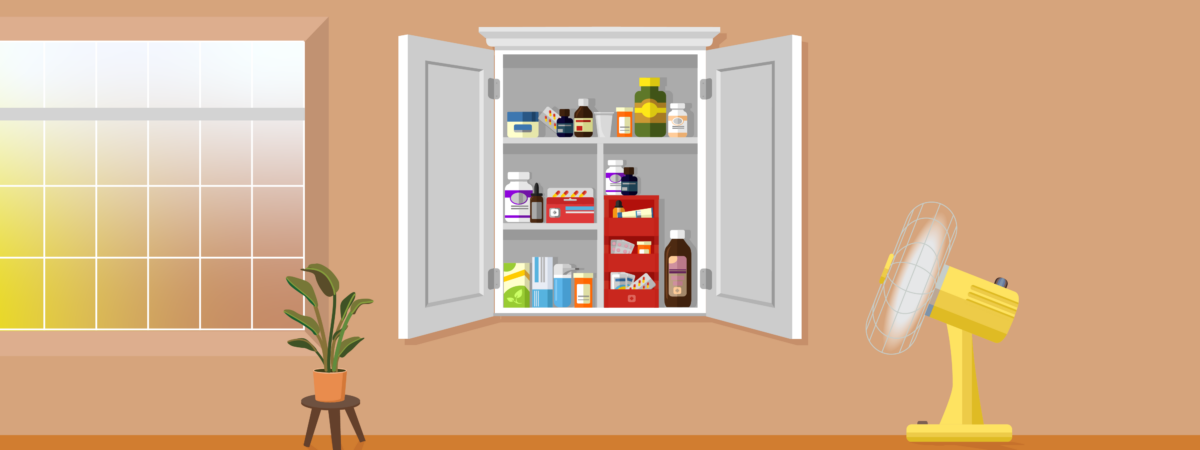
These changes raise important questions about medicines storage. Throughout the medicines supply chain from manufacture and distribution to storage within pharmacies temperature and humidity are tightly controlled and continuously monitored. However, this level of control ends after being dispensed and handed to our patients. Most medicines are licensed for storage at temperatures below 25°C, meaning that prolonged exposure to higher temperatures could potentially affect their stability and effectiveness5.
Beyond humidity, rising indoor temperatures present an additional challenge
Research conducted by the Royal Pharmaceutical Society in 2022 suggested that medicines are frequently stored in areas of the home where temperature and humidity fluctuate significantly6. Supporting this is a study completed by the pharmacy department at East Kent Hospitals University NHS Foundation Trust (EKHUFT), which explored how patients store their medicines at home and the factors influencing their practices. Among 283 participants, the majority (63%) reported storing medicines in the kitchen, consistent with the survey findings. However, 32% (91/283) reported storing medicines in the bedroom, diverging slightly from previous research. The bathroom was the third most common storage location. As highlighted by the Royal Pharmaceutical Society in its accompanying report, these environments may expose medicines to elevated humidity levels, potentially affecting their stability.
Beyond humidity, rising indoor temperatures present an additional challenge. Even when medicines are stored in rooms traditionally considered to have relatively stable humidity levels, many homes are now experiencing sustained periods of overheating during warmer months. Research commissioned by the Welsh government, published in January 2024, has also highlighted particular challenges associated with older housing stock, where overheating and elevated humidity levels are much more common7.
Although the East Kent Hospitals study revealed that 73.9% (209/283) of participants reported they were ‘very likely’ to follow instructions provided to them, only 30% (84/283) reported routinely checking instructions when they received a new medicine. Meanwhile, only 4.9% (14/283) reported regularly receiving advice on correct medicine storage. These findings highlight a gap between patients’ willingness to follow guidance and the provision of that guidance in practice.
Climate change is increasingly recognised within pharmacy discourse, which should be and is welcomed; however, the need to adapt to unavoidable impacts of climate change — such as rising indoor temperatures and the associated challenges for safe medicines storage — has received far less, if any, attention. While it may be argued that these issues are more immediately relevant to Southern Europe, it could equally be argued that the domestic infrastructure in these countries is better adapted to prolonged high temperatures, with households in Southern European countries significantly more likely to have access to air conditioning. In Spain, approximately 41% of the housing stock is equipped with air-conditioning8. In Greece, estimates suggest household ownership of around 70% and widely prevalent in urban residential buildings, particularly in Athens9. Italy also has comparatively high uptake, with approximately 49% of dwellings equipped with air-conditioning systems10.
UK homes heat up twice as quickly as those in western European countries … further compounding the effects of climate change and increasing the risks of indoor overheating
By contrast, estimates indicate that approximately 19% of UK households have access to air-conditioning11. This reflects historically moderate summer temperatures, but these assumptions are increasingly being challenged by the accelerating impacts of climate change. Added to this challenge is the fact that UK homes heat up twice as quickly as those in western European countries, including Germany and Italy, further compounding the effects of climate change and increasing the risks of indoor overheating during prolonged heat events12.
Given that most medicines are licensed under specific storage conditions determined by manufacturers, the increasing tendency for UK homes to overheat as a result of climate change raises the likelihood that these limits will be exceeded, potentially leading to a deterioration in medicine efficacy.
Gaps in patient knowledge and engagement
The East Kent Hospitals study further highlights gaps in patient knowledge and professional engagement. Fewer than one-third of participants (30.4%) routinely consulted manufacturer guidance, while more than half (59.7%) were unaware of the risks associated with improper storage. Only a small proportion (4.9%) reported receiving regular advice from pharmacy professionals, despite most indicating a willingness to follow guidance if it were provided. These results suggest an under-recognised role for both hospital and community pharmacy teams in delivering clear, practical and seasonally relevant storage advice during routine consultations. At present, the absence of structured guidance limits the consistency of such counselling.
The profession should now consider the actions needed to acknowledge this unavoidable situation and how best to engage patients to support safe medicine storage practices. More proactive engagement around safe storage, alongside standard counselling, could lead to positive outcomes by ensuring patients are better informed and able to make sensible and practical decisions.
- 1.Barnes C, Konstantinoudis G, Masselot P, et al. Summer heat deaths in 854 European cities more than tripled due to climate change. Grantham Institute and London School of Hygiene and Tropical Medicine. Published online September 17, 2025. doi:10.25560/123873
- 2.Record breaking 2022 indicative of future UK climate. Met Office. July 2023. Accessed June 2026. https://www.metoffice.gov.uk/about-us/news-and-media/media-centre/weather-and-climate-news/2023/record-breaking-2022-indicative-of-future-uk-climate
- 3.Addressing overheating risk in existing UK homes. Climate Change Committee. 2025. Accessed June 2026. https://www.theccc.org.uk/wp-content/uploads/2022/10/Addressing-overheating-risk-in-existing-UK-homes-Arup.pdf
- 4.Progress in adapting to climate change: 2025 report to Parliament. Climate Change Committee. April 2025. Accessed June 2026. https://www.theccc.org.uk/publication/progress-in-adapting-to-climate-change-2025/
- 5.Don’t let the heatwave affect your medicines: Three important tips from the MHRA . Medicines and Healthcare products Regulatory Agency. 2025. Accessed June 2026. https://www.gov.uk/government/news/dont-let-the-heatwave-affect-your-medicines-three-important-tips-from-the-mhra
- 6.Pickover E. Significant number of Britons ‘storing medicines incorrectly.’ The Independent. 2022. Accessed June 2026. https://www.independent.co.uk/news/uk/experts-britons-royal-pharmaceutical-society-yougov-b2200761.html
- 7.Considering summertime relative humidity in older properties. Welsh government. January 2024. Accessed June 2026. https://www.gov.wales/sites/default/files/publications/2024-01/factsheet-3b-considering-summertime-relative-humidity-in-older-properties.pdf
- 8.41% of Spain’s housing stock has air conditioning . Idealista. 2024. Accessed June 2026. https://www.idealista.com/en/news/property-for-sale-in-spain/2024/07/30/818081-41-of-the-housing-stock-in-spain-has-air-conditioning
- 9.Harlan C, Roser TP, Labropoulou E. With skepticism, a sweltering Europe surrenders to AC. Washington Post. 2025. Accessed June 2026. https://www.washingtonpost.com/climate-environment/2025/08/23/europe-heat-wave-air-conditioning/
- 10.Energy: ENEA tips to save on air conditioning . Media ENEA. 2024. Accessed June 2026. https://www.media.enea.it/en/press-releases-and-news/years-archive/year-2024/energy-enea-tips-to-save-on-air-conditioning.html
- 11.Simpson CH, Halai S, Price J, Petrou G, Heaviside C, Davies M. Air conditioning and the future electricity system in Great Britain. Energy Research & Social Science. 2026;136:104727. doi:10.1016/j.erss.2026.104727
- 12.UK homes heat up more quickly than those in western Europe . CIEH. 2021. Accessed June 2026. https://www.cieh.org/ehn/environmental-protection/2021/august/uk-homes-heat-up-more-quickly-than-those-in-western-europe/