RVillalon/Shutterstock.com
By the end of this article, you should be able to:
- Understand the multifaceted nature of drug–food interactions;
- Understand the biochemical mechanisms of drug–food interactions;
- Apply management strategies in clinical practice.
Introduction
Drug–food interactions are an important, but often underappreciated, aspect of both pharmacology and nutrition. These interactions occur when food alters the pharmacokinetics (absorption, distribution, metabolism and/or excretion) or pharmacodynamics (mechanism of action and therapeutic effects) of a medicine that has been co-administered. These interactions can be additive, synergistic or antagonistic in nature1. The influence dietary substances can have on medications depends on multiple variables, such as the physicochemical properties of the drug, the individual’s enzymes and transporters within the gastrointestinal system2.
The human body’s response to a medication is complex and can be significantly modified by the timing, composition and quantity of food intake. For example, certain foods may delay gastric emptying, modify intestinal pH, or influence enzyme activity in the liver and gut, thereby influencing drug bioavailability1. The consequence of drug–food interactions can range from minor to severe, life-threatening events, potentially leading to therapeutic failure owing to reduced efficacy of the drug or increased toxicity from raised serum drug levels. For patients on chronic therapy, particularly those taking narrow-therapeutic-index drugs, even minor dietary changes can lead to significant pharmacokinetic or pharmacodynamic alterations. As polypharmacy becomes increasingly common, being aware of and managing drug–food interactions is of paramount importance1.
This article explores the multifaceted nature of drug–food interactions, the biochemical mechanisms of the interactions and practical management strategies that pharmacists can use with patients in clinical practice.
Pharmacological basis of drug–food interactions
Medicines are rarely taken in isolation. Most patients consume medicines alongside meals, snacks, beverages and other supplements or substances. As food introduces a variety of nutrients, macronutrients and bioactive compounds into the gastrointestinal tract, this inevitably influences the pharmacokinetics of drugs. Understanding the pharmacological principles underlying drug-food interactions is therefore critical for doctors, nurses, pharmacists and patients3.
Drug–food interactions occur when both drugs and nutrients overlap in pathways of transport, enzymatic modification and elimination. Interactions can be divided pharmacologically into two broad categories:
- Pharmacokinetic interactions — where food alters the processes of drug absorption, distribution, metabolism and excretion;
- Pharmacodynamic interactions — where food components modify drug targets or physiological responses without necessarily altering drug concentrations (e.g. vitamin K intake reducing warfarin efficacy).
Two major processes that determine how food influences homeostasis is absorption within the gastrointestinal tract, and metabolism via the intestinal tract and hepatic system. These processes directly shape the bioavailability of a medicine (the fraction of an administered dose that reaches systemic circulation in an active form)4.
Absorption within the gastrointestinal tract
1. Gastric emptying and transit time
The first step in oral drug absorption is gastric emptying. Meals high in fat or protein slow down gastric emptying. This is because fat and proteins trigger the release of hormones that slow down the stomach’s muscle contractions. Sequentially, this can prolong the time it takes for the drug to reach the small intestine where drug absorption occurs.
A patient taking ibuprofen would be at a higher risk of bleeding or stomach lining irritation. Therefore, it may be appropriate to advise a patient to take with a meal low in fat. Conversely, for other medicines, slower gastric emptying may improve absorption if the drug has a narrow absorption window (e.g. levodopa) as this delay provides more time for dissolution2.
2. pH alteration
Food buffers gastric acid, temporarily increasing the pH level within the stomach as it mixes with the acid. The secretion of gastric acid from the parietal cells within the stomach is triggered in response to food ingestion, which serves to maintain the stomach acidity at a pH level of 1.0–3.05. Any changes to the pH level of gastric acid can drastically modify drug solubility. The influence of gastric pH on drug absorption is primarily seen in poorly soluble and highly permeable weak base drugs, especially those with low pKa values, for which an adequate gastric acidic environment is a prerequisite for optimal dissolution and absorption6.
Several clinical studies state that having low gastric acidity is associated with impaired and variable absorption of weak base drugs including ketoconazole, itraconazole, atazanavir, erlotinib and dasatinib7.
Many foods, including milk and other dairy products, can raise gastric pH by neutralising stomach acid, which in turn reduces the solubility and absorption of certain medications. Mitigation strategies may involve separating the time that the food and drug are taken ensuring that there is at least a two to four-hour gap. Adding this delay in time can reduce the impact pH may have on medication solubility. Altering therapy or formulation to one that is less pH dependant (e.g. Itraconazole capsules versus liquid) and monitoring therapeutic drug levels for critical medications can work in tandem to support effective treatment8.
3. Physical binding and chelation
Certain food components bind directly to drugs, preventing absorption. Dairy products such as cheese and yoghurt have calcium, which chelates to tetracyclines and fluoroquinolones, thus forming insoluble complexes that cannot be absorbed by the body. Iron supplements can form a chelate with bisphosphonates, levodopa and thyroid hormones thereby reducing their absorption2.
Fibre-rich foods — such as bran, wholegrains and oatmeal — can physically entrap drugs such as digoxin, lowering their bioavailability. This can render close drug-level monitoring unfeasible, which will affect the efficacy of narrow therapeutic range drugs (e.g. digoxin)9. Other notable interactions include soy-based/dairy products binding to levothyroxine. Given the increasing prevalence of vegan and vegetarian diets, healthcare professionals must apply greater caution when initiating levothyroxine therapy. A minimum four‑hour separation between levothyroxine administration and ingestion of interacting foods remains the recommended approach to minimise reduced absorption10.
Tea and coffee, widely consumed globally, contain polyphenols, which bind to iron supplements and antidepressants, creating insoluble complexes; however, owing to limited guidance on the impact of tea and coffee on treatment efficacy, the general advice is to take the medication on an empty stomach — either one hour before consuming food or two to six hours after eating6.
4. Dietary fat
Fat is a powerful modulator of absorption. High-fat meals are known to delay gastric emptying, therefore affecting hydrophilic medicines. Lipophilic drugs, such as griseofulvin, cyclosporine, or certain HIV protease inhibitors, show significantly higher absorption when taken with high-fat meals owing to enhanced solubilisation and stimulation of bile flow11.
In some cases, fat can increase bioavailability several-fold, which has clinical importance for dosing. Posaconazole is a good example where the oral suspension shows markedly improved bioavailability when taken with dietary fat11. High-fat meals can increase the systemic exposure by up to 400% compared to fasting12. Similarly, high-fat meals can increase the peak cannabidiol plasma concentrations by a factor of 17.4 owing to enhancing solubility in the gut, reducing first pass metabolism and promoting lymphatic transport13.
5. Active transport competition
Certain drugs are known to use the same transporters as nutrients. Levodopa and dietary amino acids compete for large neutral amino-acid transporters in the intestine and blood–brain barrier. Therefore, diets heavy in high-protein foods such as red meat, poultry and eggs can reduce levodopa absorption and brain availability14. Close discussion with dieticians is ideal for decisive changes to be made.
6. First-pass intestinal metabolism
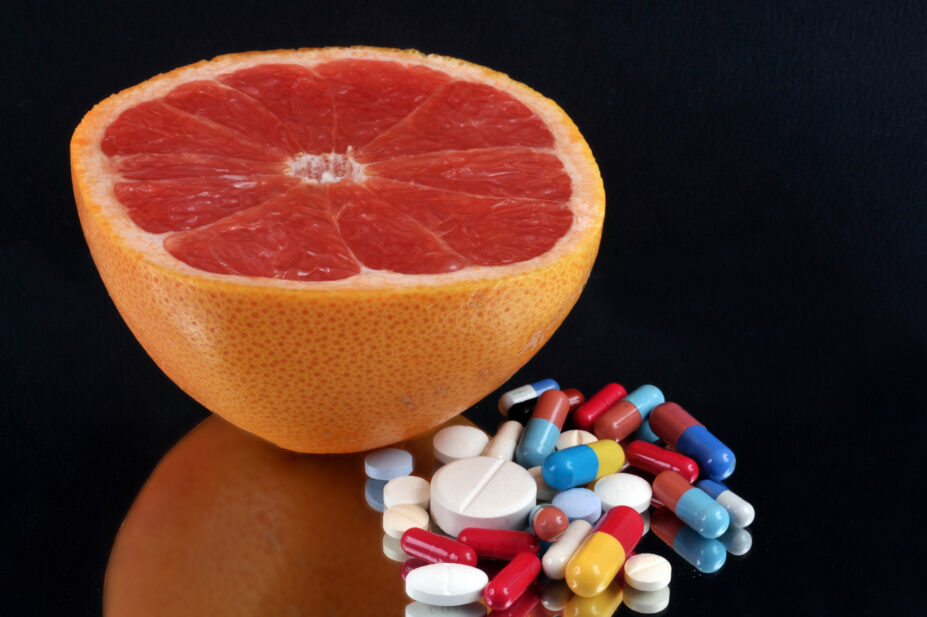
Prior to drugs reaching the liver, the intestinal wall can partially metabolise medicines. Food influences this by altering enzyme activity or transporter expression1. For instance, grapefruit juice inhibits intestinal CYP3A4, leading to increased absorption and systemic levels of drugs including felodipine and simvastatin8.
Metabolism via the intestinal tract and hepatic system
After absorption, drugs undergo extensive first-pass metabolism in the liver and intestines. Food can either inhibit or induce the enzymes and transporters responsible, thereby altering systemic bioavailability.
1. Cytochrome P450 enzymes
The cytochrome P450 (CYP) family, especially CYP3A4, CYP2D6, and CYP1A2, is central to drug metabolism. Certain foods or other medicines can impact the enzymes contributing towards inhibition or induction.
The mechanism of inhibition can be categorised as competitive or non-competitive. Competitive inhibition is where the food component and the drug compete for the same active site on the enzyme. The outcome depends on the relative concentrations and affinities of the food component and drug. Grapefruit juice is the most cited example; it contains furanocoumarins that irreversibly inhibit intestinal CYP3A4, leading to markedly higher plasma levels of drugs metabolised by this enzyme. Common medicines inhibited by this interaction are calcium channel blockers, benzodiazepines and statins15. Non-competitive inhibition occurs when the inhibitor binds to a different site on the enzyme, known as an allosteric site. This binding causes a conformational change in the enzyme, altering the shape of the active site so it can no longer bind the drug effectively.
Induction of CYP enzymes refers to an increase in enzyme expression and activity, typically triggered by exposure to certain substances, such as food and dietary components. This can lead to enhanced metabolism of drugs, potentially reducing their plasma concentration and therapeutic efficacy. Where diet cannot be adjusted, therapeutic drug level monitoring and dose adjustments may need to be carried out closely16.
Cruciferous vegetables such as broccoli and brussels sprouts contain indoles — aromatic organic compounds characterised by a six-membered benzene ring fused to a nitrogen-containing pyrrole ring. This induces CYP1A2, accelerating metabolism of drugs such as theophylline and clozapine, reducing their efficacy. St John’s wort, although used as a herbal treatment, is often consumed as a food supplement. St John’s wort is known to induce CYP3A4 and CYP2C9, which can reduce the efficacy of contraceptives and HIV medicines17.
2. Phase II metabolism
Phase II metabolism, also known as the conjugation phase, involves the attachment of endogenous hydrophilic molecules — such as glucuronic acid, sulfate, amino acids, or glutathione — to drugs or their phase I metabolites. These reactions enhance the water solubility of compounds, facilitating their excretion via urine or bile15.
Unlike phase I reactions, which often activate or modify drugs, phase II reactions typically deactivate them and reduce toxicity. The major conjugation reactions include glucuronidation, sulfation, acetylation, methylation and glutathione conjugation. These reactions are catalysed by transferase enzymes and are essential for detoxifying xenobiotics and maintaining drug safety [15]. Food can also alter conjugation reactions. For instance, cruciferous vegetables enhance glucuronidation pathways, while certain flavonoids in fruits inhibit UDP-glucuronosyltransferase, potentially modifying drug clearance15.
The impact of food on metabolism is also shaped by genetic polymorphisms in metabolic enzymes. For example, individuals who are poor metabolisers via CYP2D6 may experience exaggerated effects from drug–food interactions compared to extensive metabolisers. A patient taking dextromethorphan who is a poor metaboliser via CYP2D6 may have heightened central nervous system (CNS) effects. Adding in a CYP450 inhibitor, such as grapefruit juice, can further increase plasma levels and enhance CNS effects to a detrimental level18.
Clinical judgement: identifying the risk of an interaction
Pharmacists play an influential role in identifying and managing food–drug interactions, which can significantly impact therapeutic outcomes. In both hospital and community settings, clinical judgement involves assessing the timing of drug administration relative to meals, understanding the pharmacokinetics of medications and educating patients accordingly. For example, drugs affected by gastric pH or those that bind with dietary components, such as calcium or iron, require careful scheduling to avoid reduced absorption or increased toxicity19. In hospitals, pharmacists must collaborate with multidisciplinary teams to ensure safe prescribing and administration practices. In community settings, they rely heavily on patient-reported information and must provide tailored counselling, especially for vulnerable populations such as older adults or those with polypharmacy20.
Studies show that pharmacists’ knowledge of drug–food interactions varies and continuous professional education is essential to maintain competency21.
Summary of common drug–food interactions
The cards below summarise a collection of drug–food interactions and the mechanisms through which they occur. Some clinical advice is provided, but any changes made for these interactions should be done on a case-by-case basis22–27.
Effective clinical judgment includes recognising herbal supplement use, which may not be disclosed by patients but can lead to serious interactions. When speaking with patients, asking open ended questions will support in retrieving information with regards to herbal supplements. An example of this is the case study article: ‘The effect of sea kelp on thyroid function in hypothyroidism’.
Best practice for pharmacists
- Timing of administration: Advise patients when to take medications in relation to meals. For example, levothyroxine and bisphosphonates should be taken on an empty stomach to avoid reduced absorption, while non-steroidal anti-inflammatory drugs may be taken with food to reduce gastric irritation;
- Dietary consistency: When taking warfarin, patients should be advised to maintain a consistent intake of vitamin K-rich foods. Sudden dietary changes can alter international normalised ratio levels, increasing the risk of bleeding or clotting;
- Avoidance of specific foods: Grapefruit juice should be avoided with statins and calcium channel blockers owing to CYP3A4 inhibition, which can raise drug levels and toxicity risk. Similarly, dairy products should not be taken with tetracyclines or fluoroquinolones owing to chelation;
- Herbal supplements: Educating patients on the risks of herbal products can be beneficial. Common supplements, such as St John’s wort, can induce CYP enzymes and reduce the efficacy of oral contraceptives and HIV medications;
- Patient-centred counselling: Tailor advice based on age, comorbidities and polypharmacy. Older patients may have altered metabolism and higher interaction risks, requiring closer monitoring;
- Documentation and collaboration: All interactions must be recorded in patient profiles. Collaboration with the wider multidisciplinary team will ensure safe and effective therapy.
Conclusion
Drug–food interactions are a complex but clinically critical phenomenon. The primary mechanisms involve modifications of absorption through gastric emptying, pH, binding, transport and fat solubilisation and metabolism, mainly via CYP enzymes and P-glycoprotein. These processes directly influence drug bioavailability, altering therapeutic outcomes. Some interactions are beneficial and exploited clinically, while others pose serious risks of toxicity or treatment failure. Healthcare professionals must integrate knowledge of pharmacological principles with patient-specific factors, dietary habits and genetic variability to optimise safe and effective drug therapy. In an era of increasing polypharmacy and diverse diets, appreciating the subtle interplay of food and medicine remains an essential component of rational pharmacotherapy.
- 1.Bushra R, Aslam N, Khan A. Food Drug Interactions. OMJ. 2011;26(2):77-83. doi:10.5001/omj.2011.21
- 2.Custodio JM, Wu CY, Benet LZ. Predicting drug disposition, absorption/elimination/transporter interplay and the role of food on drug absorption. Advanced Drug Delivery Reviews. 2008;60(6):717-733. doi:10.1016/j.addr.2007.08.043
- 3.Koziolek M, Alcaro S, Augustijns P, et al. The mechanisms of pharmacokinetic food-drug interactions – A perspective from the UNGAP group. European Journal of Pharmaceutical Sciences. 2019;134:31-59. doi:10.1016/j.ejps.2019.04.003
- 4.Abuhelwa AY, Williams DB, Upton RN, Foster DJR. Food, gastrointestinal pH, and models of oral drug absorption. European Journal of Pharmaceutics and Biopharmaceutics. 2017;112:234-248. doi:10.1016/j.ejpb.2016.11.034
- 5.Schubert ML. Gastric acid secretion. Current Opinion in Gastroenterology. 2016;32(6):452-460. doi:10.1097/mog.0000000000000308
- 6.Choi JH, Ko CM. Food and Drug Interactions. J Lifestyle Med. 2017;7(1):1-9. doi:10.15280/jlm.2017.7.1.1
- 7.Yang E, Yu K, Lee S. Prediction of gastric <scp>pH</scp>‐mediated drug exposure using physiologically‐based pharmacokinetic modeling: A case study of itraconazole. CPT Pharmacom & Syst Pharma. 2023;12(6):865-877. doi:10.1002/psp4.12959
- 8.Thumbarambil AA, Venkateswaramurthy N V. The clinical pharmacology of milk-drug interactions: from pharmacokinetic principles to recent therapeutic recommendations. Asian J Pharm Health Sci. 2026;15(4):3182-3195. doi:10.5530/ajphs.2025.15.91
- 9.Johnson BF, Rodin SM, Hoch K, Shekar V. The Effect of Dietary Fiber on the Bioavailability of Digoxin in Capsules. The Journal of Clinical Pharma. 1987;27(7):487-490. doi:10.1002/j.1552-4604.1987.tb03054.x
- 10.Levothyroxine – Summary of Product Characteristics. Electronic Medicines Compendium . Accessed March 2026. https://www.medicines.org.uk/emc/product/12781/smpc
- 11.The Role of Lipids in Mitigation of Food Effect. American Pharmaceutical Review. January 2024. Accessed March 2026. https://www.americanpharmaceuticalreview.com/Featured-Articles/612574-The-Role-of-Lipids-in-Mitigation-of-Food-Effect/
- 12.Sansone-Parsons A, Krishna G, Calzetta A, et al. Effect of a Nutritional Supplement on Posaconazole Pharmacokinetics following Oral Administration to Healthy Volunteers. Antimicrob Agents Chemother. 2006;50(5):1881-1883. doi:10.1128/aac.50.5.1881-1883.2006
- 13.Saals BADF, De Bie TH, Osmanoglou E, et al. A high-fat meal significantly impacts the bioavailability and biphasic absorption of cannabidiol (CBD) from a CBD-rich extract in men and women. Sci Rep. 2025;15(1). doi:10.1038/s41598-025-87621-4
- 14.Camargo SMR, Vuille-dit-Bille RN, Mariotta L, et al. The Molecular Mechanism of Intestinal Levodopa Absorption and Its Possible Implications for the Treatment of Parkinson’s Disease. The Journal of Pharmacology and Experimental Therapeutics. 2014;351(1):114-123. doi:10.1124/jpet.114.216317
- 15.ul Amin Mohsin N, Farrukh M, Shahzadi S, Irfan M. Drug Metabolism: Phase I and Phase II Metabolic Pathways. Pharmaceutical Science. Published online February 14, 2024. doi:10.5772/intechopen.112854
- 16.Hakkola J, Hukkanen J, Turpeinen M, Pelkonen O. Inhibition and induction of CYP enzymes in humans: an update. Arch Toxicol. 2020;94(11):3671-3722. doi:10.1007/s00204-020-02936-7
- 17.Koe XF, Tengku Muhammad TS, Chong AS, Wahab HA, Tan ML. Cytochrome P450 induction properties of food and herbal‐derived compounds using a novel multiplex RT‐<scp>qPCR</scp>in vitro assay, a drug–food interaction prediction tool. Food Science & Nutrition. 2014;2(5):500-520. doi:10.1002/fsn3.122
- 18.Parietti R, Laura Bernardoni B, D’Agostino I, Campisi L, La Motta C. Structure, Function, and Genetic Variation of CYP2D6, a Cytochrome Metabolizing Drugs. Biochemistry. Published online December 19, 2024. doi:10.5772/intechopen.115466
- 19.Alhur A, Algathanin W, Aljafel R, et al. A comprehensive review of food–drug interactions: Mechanisms, clinical implications, and future perspectives. Mod phytomorphol. 2024;18:162-164. https://www.phytomorphology.com/articles/a-comprehensive-review-of-fooddrug-interactions-mechanisms-clinical-implications-and-future-perspectives.pdf
- 20.Osuala EC, Ojewole EB. Knowledge, attitudes and practices of healthcare professionals regarding drug–food interactions: a scoping review. International Journal of Pharmacy Practice. 2021;29(5):406-415. doi:10.1093/ijpp/riab049
- 21.Abualhasan M, Tahan S, Nassar R, Damere M, Salameh H, Zyoud H. Pharmacists’ knowledge of drug food administration and their appropriate patient counseling a cross-sectional study from Palestine. J Health Popul Nutr. 2023;42(1). doi:10.1186/s41043-023-00444-9
- 22.Miller LG. Herbal Medicinals. Arch Intern Med. 1998;158(20):2200. doi:10.1001/archinte.158.20.2200
- 23.Little TJ, Horowitz M, Feinle-Bisset C. Modulation by high-fat diets of gastrointestinal function and hormones associated with the regulation of energy intake: implications for the pathophysiology of obesity. The American Journal of Clinical Nutrition. 2007;86(3):531-541. doi:10.1093/ajcn/86.3.531
- 24.Izzo AA, Ernst E. Interactions Between Herbal Medicines and Prescribed Drugs. Drugs. 2009;69(13):1777-1798. doi:10.2165/11317010-000000000-00000
- 25.Mitra A, Kesisoglou F. Impaired Drug Absorption Due to High Stomach pH: A Review of Strategies for Mitigation of Such Effect To Enable Pharmaceutical Product Development. Mol Pharmaceutics. 2013;10(11):3970-3979. doi:10.1021/mp400256h
- 26.Ho HK, Chan JCY, Hardy KD, Chan ECY. Mechanism-based inactivation of CYP450 enzymes: a case study of lapatinib. Drug Metabolism Reviews. 2015;47(1):21-28. doi:10.3109/03602532.2014.1003648
- 27.Herb–drug interactions . National Center for Complementary and Integrative Health. December 2024. Accessed March 2026. https://www.nccih.nih.gov/health/providers/digest/herb-drug-interactions