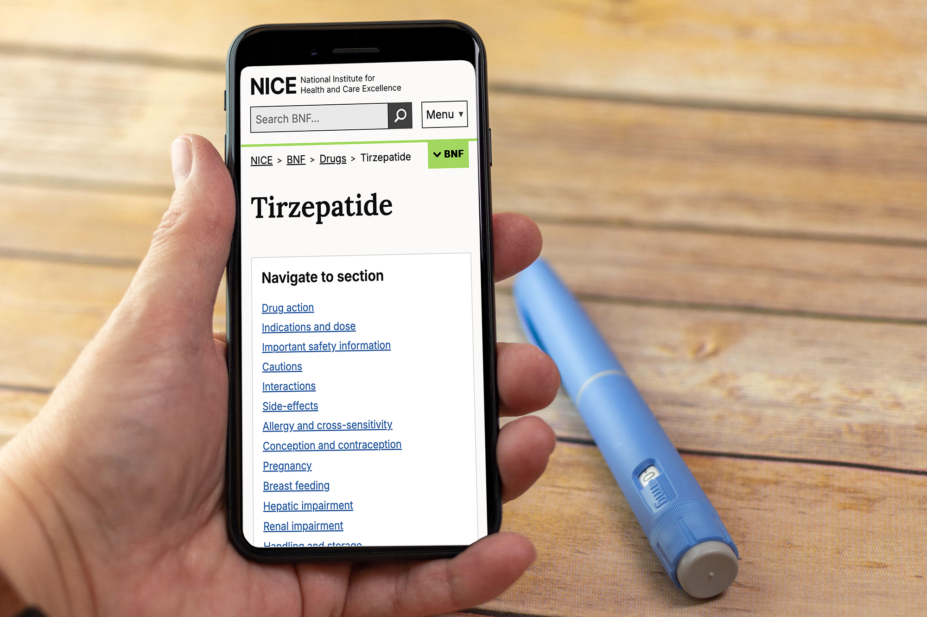
KKStock / Alamy Stock Photo, BNF Tirzepatide
After reading this article, you should be able to:
- Describe the current regulatory and clinical framework governing online prescribing of weight-management medicines in the UK;
- Identify patient safety risks associated with poorly governed digital weight-loss services;
- Recognise the clinical governance standards required to deliver safe remote prescribing;
- Advise patients on how to evaluate the legitimacy and safety of online pharmacy providers.
Obesity is recognised as a chronic, relapsing, multifactorial disease associated with significant morbidity and premature mortality1. In England, 30% of adults are living with obesity and a further 66% are overweight2. Obesity increases the risk of type 2 diabetes mellitus (T2DM), cardiovascular disease, certain cancers and musculoskeletal disorders3,4. It contributes substantially to NHS expenditure and wider population health burden, encompassing reduced quality of life, increased rates of disability and excess demand on health and social care services5.
Pharmacological treatment forms part of a stepped care approach to obesity management. NICE guidance recommends considering medicines as an adjunct to dietary, behavioural and physical activity interventions in defined clinical circumstances, including specified BMI thresholds, the presence of weight-related comorbidities, and concurrent engagement in lifestyle modification programmes6. The introduction and increased availability of glucagon-like peptide-1 receptor agonists (GLP-1 RAs), such as semaglutide, and dual GIP/GLP-1 receptor agonists, such as tirzepatide, have significantly increased public demand for pharmacological weight-management options7.
Access constraints to specialist weight-management services and growing public awareness of injectable therapies have contributed to a rapid expansion in online pharmacy providers supplying these medicines remotely8. Digital care models can widen access, reduce geographical barriers and improve convenience. However, the General Pharmaceutical Council (GPhC) has emphasised that pharmacy services delivered at a distance must meet the same standards as face-to-face services8.
Recent regulatory communications have highlighted concerns regarding online weight-loss services. In April 2026, the GPhC published an analysis of pharmacy inspection reports of online pharmacies prescribing GLP-1 medicines and identified multiple examples of unsafe practice, including services prescribing to patients who did not meet NICE eligibility criteria, failing to conduct meaningful clinical assessment, and supplying medicines without any prescriber interaction9. The Care Quality Commission (CQC) has raised similar concerns about independent online providers operating without adequate governance frameworks, safe recruitment processes or clinical oversight10.
Digital innovation offers opportunities to improve access and reduce stigma associated with obesity treatment; however, public trust depends on visible adherence to professional standards, evidence-based practice and transparent governance.
Pharmacists are experts in pharmacology, risk assessment and medicines optimisation. As increasing numbers qualify as independent prescribers, they are uniquely positioned to design and steward safe digital pathways that integrate assessment and supply within regulated frameworks.
Clinical and regulatory framework
NICE recommendations
NICE guidance on obesity management and associated technology appraisals recommend that pharmacological treatment is used in defined BMI categories and clinical contexts6. Criteria typically include:
- BMI ≥30 kg/m² (or ≥27 kg/m² with weight-related comorbidities such as T2DM, hypertension, obstructive sleep apnoea or dyslipidaemia);
- Engagement in lifestyle interventions, including structured dietary programmes, physical activity support or behavioural weight management services;
- Defined continuation criteria: for example, NICE recommends at least 5% weight loss after 12 weeks of treatment at the maintenance dose as a threshold for continued prescribing; where this is not achieved, discontinuation should be considered6.
These recommendations emphasise that medicines are adjuncts, not substitutes, for behavioural support.
Professional and pharmacy regulation
The GPhC ‘Standards for pharmacy professionals’ require pharmacists to exercise professional judgement, prioritise patient safety and provide person-centred care11. The GPhC ‘Standards for registered pharmacies’ require effective governance arrangements, including risk management, staff competence and appropriate record-keeping12.
The GPhC guidance on providing pharmacy services at a distance (including online) emphasises that identity verification, appropriate clinical assessment and safeguarding must be embedded within remote models8.
Where services are delivered by independent healthcare providers, the CQC regulates compliance with fundamental standards, including safe care and treatment under Regulation 12, which sets requirements for the provision of safe care and treatment, including appropriate assessment of patient needs, management of medicines and minimisation of risk of harm10.
Patient safety risks in poorly governed online services
Inadequate clinical assessment and screening
In remote settings, the risk of inadequate assessment is heightened: clinicians cannot observe the patient directly, cannot verify physical measurements independently and rely on patient-provided information that may be incomplete or inaccurate. Safe weight-management prescribing requires comprehensive assessment9,13. This should include:
- Confirmation of BMI using reliable data and independent verification;
- Full medical and medicines history;
- Assessment of comorbidities;
- Pregnancy and breastfeeding status;
- Exploration of eating disorders;
- Safeguarding considerations6.
NICE guidance specifically cautions against use of pharmacological treatments in individuals with active eating disorders6. This is of particular concern in remote models, where eating disorders may not be identified because patients are completing self-reported questionnaires rather than speaking with a clinician. Individuals with restrictive eating or purging behaviours may be motivated to seek weight-loss medication and are unlikely to self-disclose; without structured clinical screening, including use of validated tools, such as SCOFF, these presentations can be missed entirely9,14. More broadly, remote consultations carry an inherent risk that patients will not fully disclose medical history, medication use or relevant risk factors, whether owing to a desire to obtain treatment, embarrassment, or a belief that certain information is irrelevant. Prescribers should be alert to inconsistencies in self-reported data, use structured assessment frameworks and — where doubt exists — seek additional verification or decline to prescribe. Failure to screen appropriately may lead to clinically inappropriate prescribing and patient harm9,13.
The GPhC has stated that online models relying solely on self-completed questionnaires without meaningful clinician review may not meet regulatory expectations8. In January 2024, a BBC investigation found that journalists were able to purchase prescription-only medicines (POMs), including weight-loss medicines, from 20 online pharmacies without adequate checks15. The GPhC confirmed it was ‘very concerned’ by these findings and confirmed enforcement action had already been taken against at least one named provider16. Remote care does not reduce the standard of assessment required; the same threshold for safe prescribing applies as in face-to-face consultations8.
Over-reliance on automated decision tools
Clinical decision-support systems, such as consultation workflow tools that present eligibility criteria, flag contraindications and prompt documentation of clinical rationale, may assist in structuring consultations. However, prescribing decisions must be made by an appropriately qualified prescriber exercising independent judgement11.
Algorithm-driven approvals without documented review introduce risk, particularly where complex comorbidities, safeguarding issues or nuanced mental health considerations are present8,9. One area of concern is the significant rise in patients using AI tools to manipulate photographs submitted as part of online consultations and the ability of automated systems to detect this image manipulation17.
Commercial pressures and dose escalation
GLP-1 and GIP/GLP-1 therapies require gradual titration to minimise gastrointestinal intolerance. Escalation should occur only where lower doses are tolerated and clinically indicated18,19. Subscription-based commercial models are prevalent across online weight-loss providers in the UK and may create incentives for automatic dose progression or continued supply without structured review. NICE continuation rules require assessment of response at defined intervals, with discontinuation where clinically meaningful weight loss is not achieved6.
Prescribers employed by or contracted to commercial online providers face a potential conflict of interest: the financial sustainability of the business depends on patient retention and ongoing prescribing, which may create subtle or explicit pressure to continue treatment beyond what is clinically indicated. This misalignment of commercial and clinical incentives is ethically significant. Professional standards require separation between commercial drivers and prescribing decisions, and prescribers should document clearly the clinical basis for each decision to evidence this independence11. There should never be an incentive to prescribe for any patient.
Lack of continuity and follow-up
Absence of documented follow-up or unclear escalation pathways may place patients at risk. The majority of online weight-loss prescribing in the UK operate on a private, fee-paying basis, outside of NHS pathways. While NHS England funds GLP-1 medicines for eligible patients through specialist weight-management services and, increasingly, through primary care, most online pharmacy supply is self-funded. This creates particular challenges for continuity of care: GP records may not reflect medicines prescribed privately, creating risks of drug interactions, duplication of therapy, or missed clinical signals9. Communication with the patient’s GP, with consent, is therefore not merely good practice, but a fundamental component of safe, integrated prescribing.
Pharmacological weight management requires ongoing monitoring, and lack of structured follow-up is a well-documented problem for online providers. Unlike NHS weight-management services, many online pharmacy models supply medicines without any planned review appointments, relying instead on patients proactively contacting the provider if a problem arises. In practice, this means adverse effects, treatment failure or emerging contraindications may go undetected9.
This problem is not restricted to weight-loss medicines. In 2022, an analysis of GPhC inspection reports by The Pharmaceutical Journal highlighted examples of repeated supplies made to patients “without any pharmacy intervention”, including one patient who received 13 supplies of 100 dihydrocodeine 30mg tablets within a ten-month period20.
While receiving weight-loss medicines, patients should receive:
- Scheduled clinical review;
- Monitoring of adverse effects;
- Reinforcement of lifestyle measures;
- Clear advice on red-flag symptoms.
Figure shows best practice for individuals and organisations providing services relating to weight-loss medicines.12,18,19,21.
Figure: What good looks like — provider responsibilities
Advertising and promotion of weight-loss medicines: regulatory considerations
The promotion of POMs, including GLP-1 receptor agonists and dual GIP/GLP-1 receptor agonists, is strictly regulated in the UK. The Medicines and Healthcare products Regulatory Agency (MHRA) and the Advertising Standards Authority (ASA) enforce rules designed to protect the public from inappropriate or misleading promotion of medicines22,23.
Under the Human Medicines Regulations 2012, it is prohibited to advertise POMs to the public. This includes direct or indirect promotion via websites, social media, paid advertising or influencer partnerships. The ASA enforces the UK Code of Non-broadcast Advertising and Direct and Promotional Marketing (CAP Code), which similarly prohibits advertising POMs to the general public and requires that all healthcare-related claims are accurate, evidence-based and not misleading22,23. Some companies work within these regulations to advertise by using influencers as ‘affiliates’ and focusing the promotion on the service they provide rather than naming specific medicines24.
Common compliance risks in online weight-loss services
Recent regulatory activity has highlighted several recurring issues in the promotion of weight-loss medicines online:
- Indirect promotion of POMs through branded webpages or social media content that emphasises specific medicines (e.g. naming semaglutide or tirzepatide in a promotional context);
- Use of testimonials or before-and-after images suggesting guaranteed or rapid weight loss;
- Influencer marketing that promotes prescription medicines without appropriate regulatory oversight;
- Failure to present balanced information, including omission of risks, side effects or eligibility criteria;
- Financial promotions, such as discounts, subscription offers or time-limited deals linked to prescription medicines22–24.
Such practices risk breaching both MHRA requirements and ASA advertising standards and may undermine informed decision-making.
Pharmacists who identify potential advertising or promotional compliance concerns — whether in their own organisation or a competitor provider — should raise these via their organisation’s incident reporting system and, where appropriate, report directly to the MHRA via its reporting portal or to the ASA via its online complaints process. Patients who believe they have encountered misleading health claims or inappropriate promotion of prescription medicines online can also report directly to the ASA.
Responsibilities of prescribers and providers
Prescribers and pharmacy providers must ensure that all patient-facing content complies with MHRA and ASA requirements22,23. This includes:
- Avoiding any direct or indirect advertisement of POMs to the public;
- Ensuring that websites describe services rather than promote specific medicines;
- Presenting information in a factual, balanced and non-promotional manner;
- Avoiding testimonials or imagery that could create unrealistic expectations;
- Ensuring that any marketing activity does not incentivise inappropriate prescribing;
- Maintaining clear separation between clinical decision-making and commercial promotion22,23.
The GPhC standards further require that pharmacy professionals act with honesty and integrity and do not allow their professional judgement to be influenced by financial or commercial considerations11.
The increasing visibility of weight-loss medicines in digital and social media spaces has created a challenging regulatory environment. While public awareness of treatment options has grown, there is also an increased risk of misinformation and inappropriate promotion.
How patients can protect themselves
Community and online pharmacists occupy a privileged position in patient-facing care and have multiple opportunities to engage proactively with patients who are taking or considering weight-loss medications.
These include:
- Dispensing encounters where GLP-1 or other weight-loss medicines are presented for supply;
- Medicine use reviews or structured medication reviews in primary care settings;
- New medicines services following initial prescription; and
- Opportunistic conversations during consultations for related conditions such as type 2 diabetes, hypertension or contraception25,26.
Pharmacists should use these touchpoints to check eligibility, screen for adverse effects, reinforce lifestyle advice, and where concerns arise advise patients on how to evaluate or escalate concerns about their provider. Healthcare professionals should advise patients to be cautious of providers have the red flags shown in Box 1. These indicators may suggest that commercial priorities are overriding regulatory compliance and patient safety considerations.
Box 1: Provider red flags
- Promote specific named prescription medicines directly to the public;
- Make claims of “rapid”, “guaranteed” or “effortless” weight loss;
- Use influencer endorsements without clear clinical context;
- Offer discounts or promotional codes linked to prescription medicines;
- Downplay risks or fail to provide balanced safety information;
- Present weight-loss treatment as purely transactional rather than clinically assessed care.
Patients who are already using an online provider and become concerned about any of the above should not simply stop their medication without clinical guidance, as abrupt discontinuation of GLP-1 therapy may result in rapid weight regain and should be managed. Instead, they should: contact their GP to discuss their current treatment and request that it be added to their medical record; raise concerns directly with the online provider through its formal complaints process; report concerns about a registered online pharmacy to the General Pharmaceutical Council via its raise a concern service; and, if they believe medicines have been supplied unsafely or without proper assessment, report this to the Care Quality Commission (if the provider is registered with it) or to the Medicines and Healthcare Regulatory Agency.
Patients should be advised to check indicators of legitimacy shown in Box 2.
Box 2: Indicators of legitimacy
- Registration of the provider on the General Pharmaceutical Council (GPhC) register of registered pharmacies (searchable here), confirming the business is a legitimately registered pharmacy;
- That the web domain is exactly what the pharmacy licence is linked to on the GPhC website;
- Clear identification of UK-registered prescribers;
- Transparent contact details and complaints procedures;
- A two-way dialogue is initiated by the prescriber before any treatment is supplied.
Questions patients should ask
Patients should ideally raise these questions before committing to any payment. Most reputable online pharmacy providers publish answers to these questions in their FAQs or terms of service; a provider that does not clearly address how prescribing decisions are made, how follow-up is conducted or how side effects should be reported is a concern in itself. Where a consultation fee is charged prior to prescribing, patients should be able to receive a response to these questions before they are committed to a course of treatment. Patients are advised to retain records of any communications with their provider in case concerns arise later:
- Who reviews my consultation?
- How is my weight verified?
- What follow-up will I receive?
- What should I do if I develop side effects?
- Will my GP be informed?
The following are warning signs that patients should be aware of when initiating weight-loss medication with an online provider:
- Immediate approval without clinician interaction;
- Absence of medical history review;
- Offers to bypass BMI criteria;
- Unrealistic claims regarding rapid weight loss;
- Request to transfer money or place orders via social media;
- No identifiable UK pharmacy registration.
If a patient encounters any of these warning signs, they should not proceed with that provider. They should seek advice from their GP or community pharmacist, who can help identify a safe and appropriately regulated service. Patients who have already received medicines from a provider that displayed these characteristics should tell their GP what they have been taking. Any concerns about an online provider operating unsafely can be reported to the GPhC via its ‘Report a concern service’.
Practical points for pharmacists
- Prescribe in accordance with NICE guidance and licensed indications;
- Verify patient eligibility using structured, documented assessment;
- Ensure independent clinician review of all remote consultations;
- Provide explicit safety-netting advice and document consent;
- Apply continuation and stopping rules consistently;
- Conduct regular clinical audit of prescribing patterns;
- Maintain separation between commercial metrics and clinical decisions;
- Encourage patients to inform their GP of online-prescribed medicines;
- Report suspected adverse reactions via the Yellow Card Scheme27.
Conclusion
The expansion of online weight-loss prescribing reflects therapeutic innovation and unmet clinical need. When delivered within robust governance frameworks, digital pharmacy services can enhance access to evidence-based care. However, inadequate assessment, excessive automation and commercial pressure may introduce significant patient safety risks.
Pharmacists have a professional responsibility to ensure that remote prescribing meets the same standards as face-to-face care. Through rigorous assessment, ethical prescribing and transparent governance, the profession can support safe innovation while preserving public trust in pharmacy-led weight-management services.
Disclosure
ChatGPT was used for reference style and to generate the article structure during the planning stage. It was not used to generate any of the final content used.
- 1.Obesity and overweight. World Health Organization. 2023. Accessed May 2026. https://www.who.int/news-room/fact-sheets/detail/obesity-and-overweight
- 2.Health Survey for England. NHS Digital. 2023. Accessed May 2026. https://digital.nhs.uk/data-and-information/publications/statistical/health-survey-for-england
- 3.Prospective Studies Collaboration. Body-mass index and cause-specific mortality in 900 000 adults: collaborative analyses of 57 prospective studies. The Lancet. 2009;373(9669):1083-1096. doi:10.1016/s0140-6736(09)60318-4
- 4.Guh DP, Zhang W, Bansback N, Amarsi Z, Birmingham CL, Anis AH. The incidence of co-morbidities related to obesity and overweight: A systematic review and meta-analysis. BMC Public Health. 2009;9(1). doi:10.1186/1471-2458-9-88
- 5.Obesity: time for a new strategy. House of Commons health and Social Care Committee. 2022. Accessed May 2026. https://committees.parliament.uk/work/1534/obesity/
- 6.Overweight and obesity management. National Institute of Health and Care Excellence. January 2025. Accessed May 2026. https://www.nice.org.uk/guidance/ng246
- 7.Jackson SE, Brown J, Llewellyn C, Mytton O, Shahab L. Prevalence of use and interest in using glucagon-like peptide-1 receptor agonists for weight loss: a population study in Great Britain. BMC Med. 2026;24(1). doi:10.1186/s12916-025-04528-7
- 8.Guidance for registered pharmacies providing pharmacy services at a distance, including on the internet. General Pharmaceutical Council. 2023. Accessed May 2026. https://assets.pharmacyregulation.org/files/2026-01/gphc-guidance-registered-pharmacies-providing-pharmacy-services-distance-february-2025%20FINALa.pdf?VersionId=Jk4_FSWgqNJOCLI2ex.Yv_INDZnaPLxd
- 9.Weight management medicines and services: a review of GPhC inspections and concerns. General Pharmaceutical Council. 2026. Accessed May 2026. https://assets.pharmacyregulation.org/files/2026-04/Weight-management-medicines-and-services-a-review-of-GPhC-inspections-and-concerns-April-2026.pdf?VersionId=AmEhenCWSCNdIAcEmUO58xprGGFk7Iag
- 10.Regulation 12: Safe care and treatment. Care Quality Commission. 2023. Accessed May 2026. https://www.cqc.org.uk/guidance-providers/regulations/regulation-12-safe-care-treatment
- 11.Standards for pharmacy professionals. General Pharmaceutical Council. May 2017. Accessed May 2026. https://assets.pharmacyregulation.org/files/standards_for_pharmacy_professionals_may_2017_0.pdf?VersionId=C8dRrU1opDLdsuveSss5cKsPSwKObTi2
- 12.Standards for registered pharmacies. General Pharmaceutical Council. June 2018. Accessed May 2026. https://assets.pharmacyregulation.org/files/document/standards_for_registered_pharmacies_june_2018_0.pdf
- 13.Lewington M, Paterson RE, Rayamajhi S, Macvicar S. Adherence to Remote Prescribing Principles by Medical and Non‐Medical Prescribers; a Scoping Review. Journal of Advanced Nursing. 2025;82(5):4610-4624. doi:10.1111/jan.70198
- 14.Morgan JF. The SCOFF questionnaire: a new screening tool for eating disorders. Western Journal of Medicine. 2000;172(3):164-165. doi:10.1136/ewjm.172.3.164
- 15.Weight loss jabs: Prescription drugs sold online without full checks. BBC News. January 2024. Accessed May 2026. https://www.bbc.co.uk/news/health-67882285
- 16.GPhC responds to BBC investigation into online pharmacies. General Pharmaceutical Council. 2024. Accessed May 2026. https://www.pharmacyregulation.org/about-us/news-and-updates/gphc-responds-bbc-investigation-online-pharmacies
- 17.Ensuring patient safety: detecting altered images in online GLP-1 consultations. Pharmaceutical Journal. Published online 2026. doi:10.1211/pj.2026.1.410396
- 18.Wegovy 0.25 mg, FlexTouch solution for injection in pre-filled pen. Electronic Medicines Compendium. 2026. Accessed May 2026. https://www.medicines.org.uk/emc/product/13799/smpc
- 19.Mounjaro KwikPen 10mg solution for injection in pre-filled pen. Electronic Medicines Compendium. 2026. Accessed May 2026. https://www.medicines.org.uk/emc/product/15484/smpc
- 20.Online pharmacy boom prompts concern over patient safety. Pharmaceutical Journal. Published online 2022. doi:10.1211/pj.2022.1.139394
- 21.UK GDPR guidance and resources. Information Commissioner’s Office. 2023. Accessed May 2026. https://ico.org.uk/for-organisations/uk-gdpr-guidance-and-resources
- 22.Blue Guide: advertising and promoting medicines. Medicines and Healthcare products Regulatory Agency. December 2014. Accessed May 2026. https://www.gov.uk/government/publications/blue-guide-advertising-and-promoting-medicines
- 23.UK Code of Non-broadcast Advertising and Direct & Promotional Marketing. Advertising Standards Authority. 2023. Accessed May 2026. https://www.asa.org.uk/codes-and-rulings/advertising-codes/non-broadcast-code.html
- 24.How we’re trimming down problem ads for weight-loss prescription-only medicines. Advertising Standards Authority. July 2025. Accessed May 2026. https://www.asa.org.uk/news/how-we-re-trimming-down-problem-ads-for-weight-loss-prescription-only-medicines.html
- 25.Structured medication reviews and medicines optimisation. NHS England. Accessed May 2026. https://www.england.nhs.uk/primary-care/pharmacy/smr/
- 26.NHS New Medicine Service. NHS England. Accessed May 2026. https://www.england.nhs.uk/primary-care/pharmacy/pharmacy-services/nhs-new-medicine-service/
- 27.Yellow Card Scheme. Medicines and Healthcare products Regulatory Agency. 2024. Accessed May 2026. https://yellowcard.mhra.gov.uk/