Belga News Agency/ Alamy Stock Photo
Community pharmacy leaders have expressed concerns about a national pilot to offer cholesterol checks in community pharmacies.
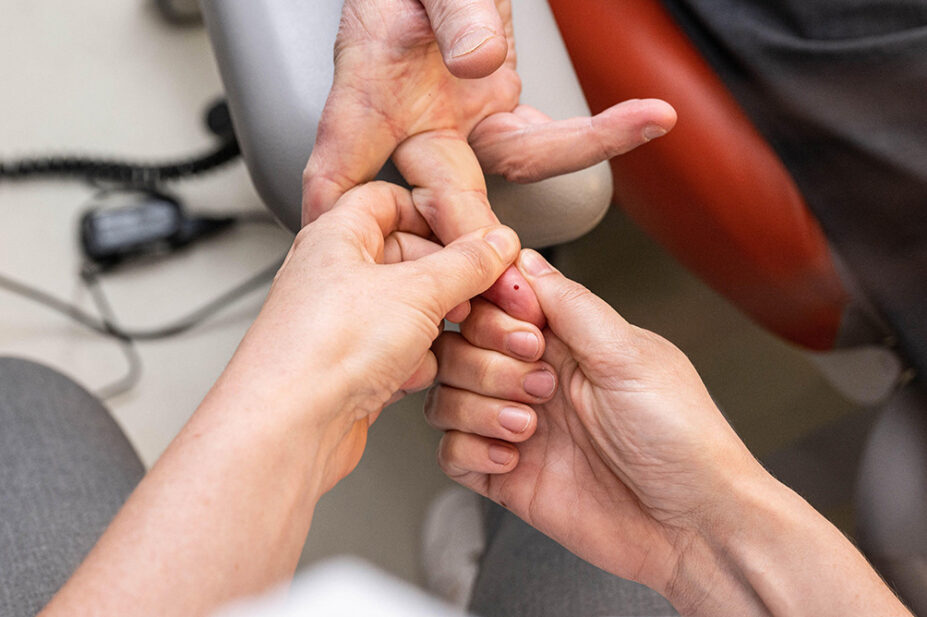
In a press release published on 31 August 2026, NHS England said that from autumn 2026, around 100 prescribing pharmacies in England will offer seven-minute cholesterol check-ups via a point-of-care finger prick test.
The check-ups will be offered as a walk-in service for people aged 40–84 years who are not pregnant and have not had a blood test in the past year, NHS England said, adding that the programme will run until spring 2027.
NHS England also highlighted that results of the check-ups will be shared with patients via email, while pharmacists will be able to offer additional interventions including blood pressure checks, lifestyle advice or recommendations concerning whether treatment is needed.
Integrated care boards (ICBs) will be able to commission add-on prescribing services from qualified pharmacists, it continued.
Commenting on the announcement, Henry Gregg, chief executive of the National Pharmacy Association, told The Pharmaceutical Journal on 1 September 2026 that though the pilot was “an historic and positive step forward” for pharmacies, it “will not be a success unless it is fully funded by the NHS”.
“At the moment, we are concerned that lack of clarity on funding levels will make it unviable for many pharmacies to participate in,” he added.
The cholesterol test, as well as relevant training and support, will be provided by Barts Health NHS Trust, which confirmed to The Pharmaceutical Journal on 2 September 2026 that participating pharmacies will receive £18 per completed test, while those new to the service will also receive £225 in set up costs.
However, any additional costs associated with prescribing, such as IT infrastructure, would need to be funded locally if commissioned, it added. Barts Health NHS Trust also said it will follow up with patients one week and three weeks after their test to discuss further interventions to improve their cholesterol.
The service fee for the pilot is similar to the fees agreed for the national Pharmacy First service, at £17 per consultation with a one-off setup payment of £500 and a monthly infrastructure payment of £525 for pharmacies delivering prescribing services.
At the time, Janet Morrison, chief executive of Community Pharmacy England, said the funding was “not enough” to cover the clinical governance, assurance, infrastructure, digital and workload required to run a prescribing service and warned that contractors “should think really carefully about whether to actually engage with the service”.
The latest pilot builds on a smaller pilot that ran in north-east London as a collaboration between Barts Health NHS Trust, UCLPartners and HEART UK. It tested 2,493 patients at 61 community pharmacies between January 2025 and March 2026.
Under the pilot, 19% of patients were found to be suitable for pharmacological intervention, while 88 people were started on statins.
Jagjot Kaur Chahal, cardiovascular disease prevention lead pharmacist at Barts Health NHS Trust and implementation lead on the latest pilot, told The Pharmaceutical Journal that the programme was “one of many solutions” to tackle the lack of pathology infrastructure highlighted as a barrier to community pharmacy prescribing.
An investigation conducted by The Pharmaceutical Journal in May 2026 revealed geographic variation in ICB support for prescribing.
Initial inquiries to ICBs suggest that pharmacies are participating in the cholesterol testing pilot, with six pharmacies in South Yorkshire ICB and three in NHS Bristol, North Somerset and South Gloucestershire ICB taking part.
In Hampshire and Isle of Wight, 29 pharmacies expressed interest in the pilot and five were selected as part of the pilot, the Hampshire and Isle of Wight ICB confirmed to The Pharmaceutical Journal on 2 September 2026.
Leyla Hannbeck, chief executive of the Independent Pharmacies Association, said more pharmacies should be included in the pilot.
“We already know from pilots in London that this service works,” she added.
There are currently no plans to expand the testing service beyond the participating pharmacies, Barts Health NHS Trust confirmed to The Pharmaceutical Journal.
In an evaluation of the north-east London pilot, published in 2025, UCL Partners Health Innovation said: “Residents mentioned the convenience, speed and quality of having a test in a community pharmacy as positive elements of their experiences. There is a clear preference for testing within a pharmacy rather than having this type of test in a GP surgery.
“They also appreciated the time taken to explain issues, with clear explanations and recommendations tailored to their personal circumstances. Some participants indicated that they would not have sought a GP appointment for this service, highlighting the programme’s capacity to engage underserved groups.”
Imtiaz Patel, pharmacy manager at RohPharm pharmacy in north-east London, who participated in the initial pilot, told The Pharmaceutical Journal on 2 September 2026 that the service was positively received by patients — many of whom were informed about the service by local GP surgeries by letter and text message.
However, he also noted that the service could be time-consuming for the pharmacist.
You may also be interested in

Community pharmacists can prescribe outside of existing Pharmacy First age limits, NHS England confirms

Negotiator says there is ‘very little evidence’ of pharmacy involvement in neighbourhood health plans