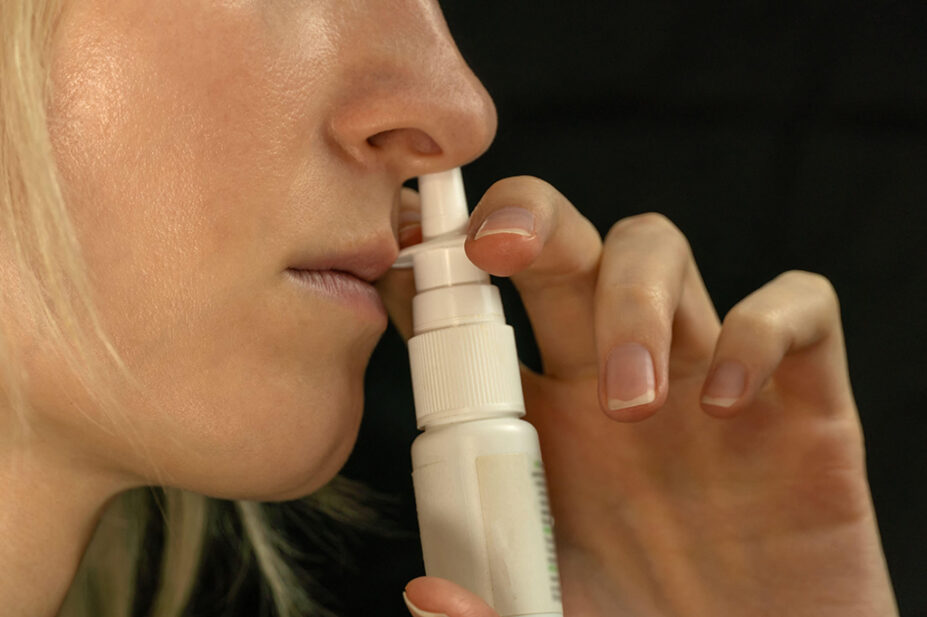
Yaroslav Mikheev / Alamy Stock Photo
Some over-the-counter nasal decongestant sprays are now limited to five days use, following a safety update from the Medicines and Healthcare products Regulatory Agency (MHRA).
In a statement published on 30 April 2026, the MHRA said that the new rules apply to sprays containing xylometazoline and oxymetazoline, which are used to relieve a blocked nose caused by cold, flu and allergies.
According to the drug safety update, the new rules follow reports of rebound congestion, a temporary condition in which nasal passages become swollen and congested, and rhinitis medicamentosa, a chronic condition which includes severe nasal congestion and visible changes to the nasal mucosa, related to prolonged use.
There have also been reports of tachyphylaxis, in which increased tolerance to the drugs results in reduced effectiveness, it added.
The MHRA advised that patients may, therefore, think that rebound congestion effect is continuation of the original congestion, when it is a response to prolonged use of the product.
In response to initial reports of these effects, expert advisory groups to the Commission on Human Medicines reviewed the evidence around prolonged use and recommended reducing the maximum duration of use from seven to five days in adults and children aged 12 years and older.
The expert advisory groups also recommended that packaging be updated to reflect this new recommendation.
The statement said that all new packaging will state that the duration of use is not to exceed five days, while the patient information leaflets will be “strengthened” to emphasise the risks associated with prolonged use of the products.
However, it said products in existing packaging can continue to be sold in the meantime.
In addition, the drug safety update provides information for healthcare professionals to use when advising patients on these products.
In January 2026, the Royal College of Pharmacy (then the Royal Pharmaceutical Society), said that there needed to be better public awareness of the risks of nasal decongestant sprays, following the results of a survey of community pharmacists, published in 2025, which found that almost two-thirds (63%, n=195) of respondents had intervened in cases of suspected over-use.
Responding to the MHRA’s update, Amira Guirguis, chief scientist at the Royal College of Pharmacy, said: “We support clearer product information and improved packaging, alongside consistent public messaging, to improve awareness that these products are for short-term use only and to avoid preventable harm.
“Pharmacists play a key role in supporting patients to use them safely and advising on safer alternatives where appropriate.”
Thao Huynh, head of respiratory imaging and critical care at the MHRA, advises that people who are still experiencing congestion after five days to talk to a healthcare professional about stopping use of the product and about possible alternative treatments.
“These nasal sprays are safe and effective treatments when used as directed. It is important to always read the patient information leaflet that comes with your medicine and information on the outer packaging,” he added.
A spokesperson for the consumer healthcare association PAGB said: “Whilst the guidance has now been updated to reflect the shorter recommended duration of usage, product packing and information on the medicines, including the patient information leaflet will not yet reflect this change, and will still contain information that states that they can be used for up to seven days.
“However, these products can still be used, in line with the new recommendations. Companies are currently activating their regulatory change processes, and we would expect to see the transition to new packs begin in the coming months.”
You may also be interested in
Risks of nasal decongestant spray overuse need to be made clearer, says RPS

More than 5,000 patients treated for ear problems under community pharmacy pilot