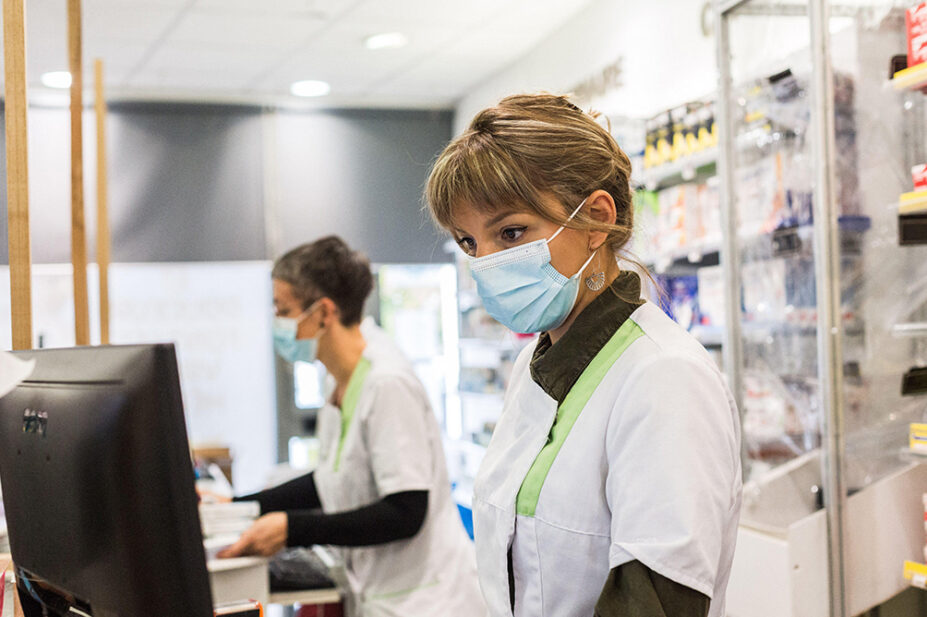
Phanie - Sipa Press / Alamy Stock Photo
The expectation for pharmacists to procure their own personal protective equipment (PPE) during the COVID-19 pandemic was “a major failure in planning”, the latest report from the UK COVID-19 inquiry has said.
In the report on procurement, published on 14 July 2026, Baroness Hallett noted that nearly two-thirds — almost £10bn — of approximately £14.9bn spent on PPE during the COVID-19 pandemic, was wasted.
“The spread of COVID-19 had a devastating impact beyond hospitals. PPE was needed in a wide range of settings, especially in the social care sector, but the stockpile was not established for this purpose,” the report said.
“During a pandemic, the social care sector and community healthcare providers, such as GPs and pharmacists, were expected by the Department of Health and Social Care [DHSC] to procure their own PPE. Given the size of the social care sector and the vulnerability of those in care requiring protection from the spread of disease, this was a major failure in planning.”
In the report, PPE distribution plans were described as “inadequate”, as the distribution of centrally procured PPE was not part of pandemic planning across the UK.
Supply Chain Coordination Ltd — the then DHSC-owned legal entity through which NHS Supply Chain undertook its procurement services — had not been instructed by the DHSC or Public Health England to create an emergency PPE distribution plan for a pandemic for the health and social care sectors in their entirety, it said.
The report’s recommendations include that the UK government and devolved administrations ensure, within 12 months, that pandemic stockpiles maintain a minimum three-month supply of PPE for the entire health and social care system in the UK.
Commenting on the latest inquiry report, Tase Oputu, president of the Royal College of Pharmacy, said: “The government and NHS repeatedly tried to provide reassurance that adequate supplies of PPE were available to the pharmacy profession and that the guidance was robust. This was not the reality experienced by our members, and we called for urgent change to reflect the real-world situation.
“The vast majority of frontline pharmacy teams were unable to maintain safe social distancing either from staff or patients and struggled to source PPE to protect themselves, their patients and their families. Pharmacies were one of the last places keeping their doors open to the public without an appointment and yet seemingly an afterthought when it came to sourcing PPE for staff.
“It is crucial that we learn lessons ahead of any potential future pandemic and ensure that pharmacy teams across care settings are protected so they can keep looking after patients.”
Henry Gregg, chief executive of the National Pharmacy Association (NPA), said: “We have been clear to the COVID[-19] inquiry that community pharmacy did not get the access to the PPE they needed at the start of the pandemic, despite being one of the only health care providers open through much of the pandemic and numerous warnings from the NPA and others.
“Pharmacies will be furious that at a time that the government wasted billions of pounds on untried providers, they had to dip into their own pockets to protect their own staff. Pharmacy teams undoubtedly took significant risks, particularly during the early stages of the pandemic, to serve their patients. In some instances, pharmacy teams were forced to use the same PPE for weeks on end. Tragically, some pharmacy staff died from the virus.
“The government must learn the lessons from this inquiry and treat pharmacies as equal partners in the NHS, providing them with the same access to support in a timely manner.”
In the COVID-19 inquiry’s previous reports, Baroness Hallett said community pharmacies should be used at an earlier stage in future pandemics and that they must be funded for any future medicine delivery programmes caused by health crises.