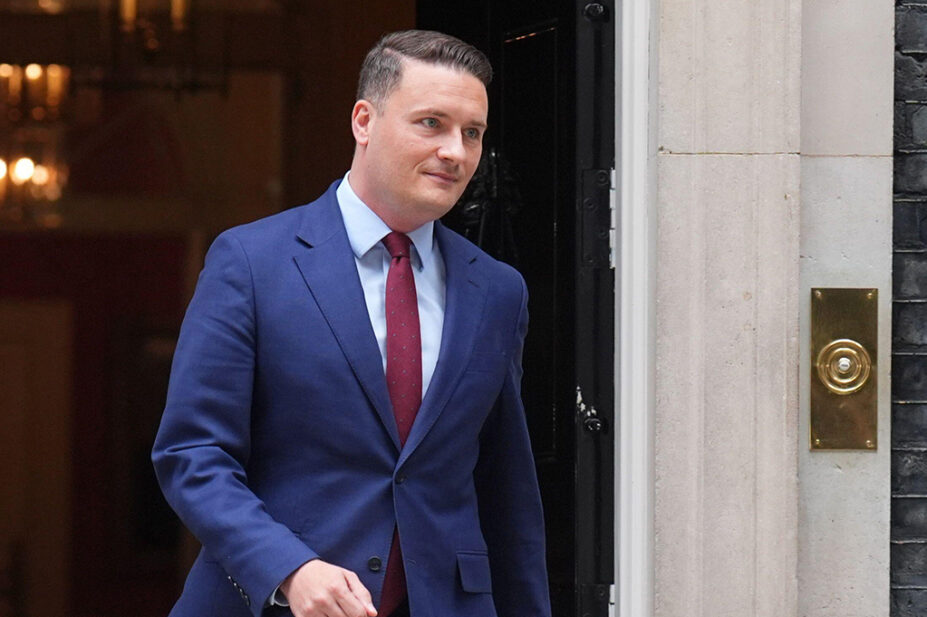
PA Images / Alamy Stock Photo
Wes Streeting has resigned as health secretary, saying that he has “lost confidence” in the leadership of prime minister Keir Starmer.
In an open letter to the prime minister, also published on X on 14 May 2026, Streeting said that he was “pleased to report that I have delivered against the ambitious targets you set for me when I became your secretary of state for health and social care”.
He cited improved ambulance response times for heart attacks and strokes — “the fastest in five years” — and reduced A&E waiting times, as well as the recruitment of 2,000 more GPs and “smashing the 2% NHS productivity target by achieving 2.8%”.
Streeting wrote that the NHS “is the embodiment of all that is best about Britain and our values”.
“Thanks to our Labour government, it is on the road to recovery: lots done, but so much more to do.”
“These are all good reasons for me to remain in post, but as you know from our conversation earlier this week, having lost confidence in your leadership, I have concluded that it would be dishonourable and unprincipled to do so.”
Streeting was appointed as secretary of state for health and social care on 5 July 2024 following Labour’s victory in the 2024 general election. Prior to that, he was shadow secretary of state for health and social care, from November 2021 to May 2024.
His resignation followed a meeting with Starmer, which lasted less than 20 minutes, on the morning of 13 May 2026.
In his letter, Streeting said: “Last week’s election results were unprecedented — both in terms of the scale of the defeat and the consequences of that failure. For the first time in our country’s history, nationalists are in power in every corner of the UK — including a dangerous English nationalism represented by Nigel Farage and Reform UK.
“There is no doubt that the unpopularity of this government was a major and common factor in our defeats across England, Scotland and Wales,” he added.
“You have many great strengths that I admire. You led our party to a victory few thought possible in 2024 and I was proud to fight alongside you in the trenches of that campaign. You have shown courage and statesmanship on the world stage — not least in keeping Britain out of the war in Iran. But where we need vision, we have a vacuum. Where we need direction, we have drift.
“Serving as your secretary of state for health and social care has been the greatest joy of my life and, regardless of our differences this week, I remain truly grateful to you for the opportunity to serve and I am deeply saddened to be leaving government in this way,” Streeting concluded.
Leyla Hannbeck, chief executive of the Independent Pharmacies Association, commented: “The resignation of yet another health secretary brings more uncertainty to a community pharmacy sector that is already on its knees.
“Last year alone, hundreds of pharmacies closed across England and Wales, with communities losing vital access to healthcare on their high streets. At the same time, pharmacies have been battling ongoing medicine supply problems linked to global instability and conflict in the Middle East.
“It was deeply disappointing that, despite the seriousness of these issues, Wes Streeting has failed to respond for more than two months to a letter outlining urgent concerns and practical solutions to support the sector during the worsening medicines supply crisis following the obstruction on the Strait of Hormuz.
“With rising national insurance contributions, higher national minimum wage costs and increasing business rates all placing further strain on the sector, it is vital that the next health secretary engages seriously with community pharmacy and delivers the support pharmacies urgently need, and we hope to have a constructive relationship with his replacement at a critical time for this sector. We look forward to working with his successor.”
In response to the announcement, the Pharmacists’ Defence Association (PDA) called for “an orderly transition in health leadership, continued focus on NHS priorities and meaningful engagement with frontline pharmacists’ representatives to protect patient care and maintain workforce confidence”.
“Pharmacists, like other healthcare professionals, need clear direction, sustained support and a sense that long-term priorities will be carried through consistently rather than repeatedly reset,” a spokesperson said.
“Recent structural and organisational changes within the NHS in England have already created significant uncertainty for many pharmacists. PDA members have seen how rapid change can affect careers, wellbeing and the way services are organised, as well as potential impacts on capacity for service delivery. In that context, stable and accountable leadership becomes even more important.”
Henry Gregg, chief executive of the National Pharmacy Association (NPA), warned: “These political events should not detract from the focus we need on stabilising the pharmacy network and unleashing its potential to realise the government’s ambition to move care closer to communities, which is what both pharmacies and patients want.
“Pharmacies are still in the dark about their funding for this financial year, which began a month and a half ago. It would be very damaging to the pharmacy network if political uncertainty was to delay a financial settlement which is already hopelessly late.”
He added that the NPA looked forward to working with the future health secretary.
Amandeep Doll, director for England at the Royal College of Pharmacy, noted: “As we await news on the community pharmacy contract, the NHS workforce plan, and with major changes to integrated care boards, this comes at a crucial time for the health service.
“We urge the government to fully support pharmacy teams in delivering the ambitions in the ten-year health plan, including expanding pharmacist prescribing services and making better use of pharmacists’ clinical skills across the NHS.
“We look forward to working with the new health secretary and the wider government to help improve patient care and strengthen the health system.”