

Jeremy Sutton-Hibbert/ Alamy Stock Photo
Scotland will face a significant and growing burden of disease across many major conditions unless the healthy life expectancy gap is addressed, Paul Johnston, chief executive of Public Health Scotland (PHS), has said.
Speaking to attendees at the Royal College of Pharmacy Scotland conference, held in Glasgow on 21 August 2026, Johnston said the “case for urgent, energetic, system-wide action is compelling”.
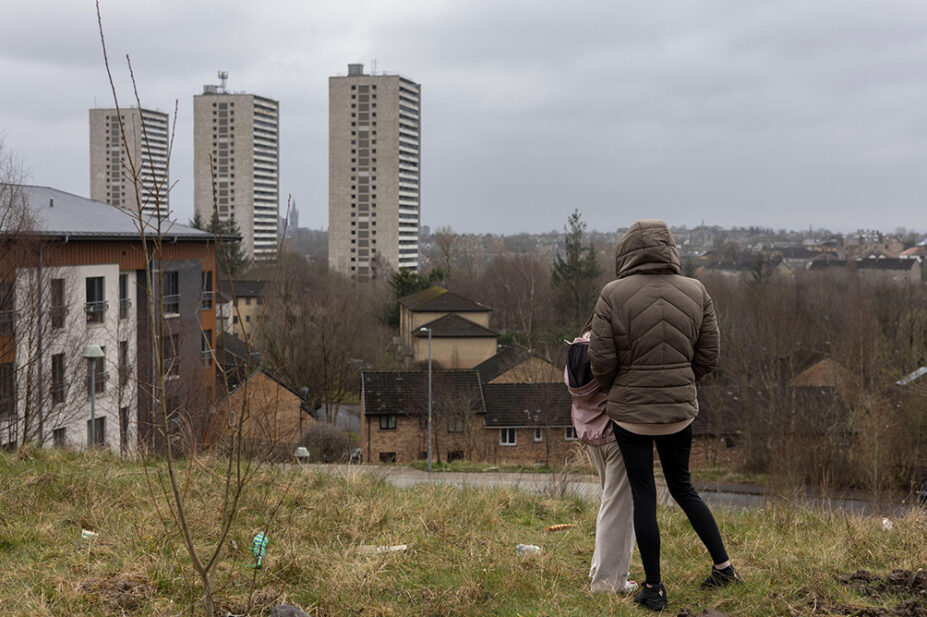
Johnston told delegates that in the 10% most deprived areas in Scotland, healthy life expectancy for females has fallen to 44.2 years — whereas healthy life expectancy for females in the 20% least deprived areas is 70.9 years. For males, the difference is 44.8 years and 70.4 years, he added.
“It is not normal for developed countries to have a gap in healthy life expectancy of more than 26 years, based only on the place where you were born, live and grow up,” Johnston told the conference.
He also noted that overall life expectancy in Scotland was increasing, but added that “the challenge may be that if healthy life expectancy is reducing while life expectancy is increasing, you’re going to have a population more and more unwell, less able to work, less able to contribute the sort of tax base that a country needs in terms of prospering”.
“Community pharmacy has such a vital role to play in providing equitable access to health and care,” he continued.
“It is very clear that many of you are already enabling healthy living, and I know there’ll be so much more going on of which I am unaware.”
In addition, Johnston said that he was “delighted to hear about some of your engagement in hepatitis C prevention work, a huge success story where again pharmacy has an important role to play”.
Many health metrics are already improving in Scotland, including reduction in drug deaths and smoking prevalence, child dental health and improved air quality targets, he highlighted.
PHS’s ten-year strategic vision, which runs from 2025 to 2035, is aimed to see life expectancy improve by at least one year over the next ten years, Johnston said, adding that “crucially, we want to narrow the life expectancy gap between the poorest 20% of areas and the average”.
He also emphasised that “we need to shift the whole system more into a prevention focus”, and pharmacy plays a “really important preventative role”.
‘Scotland’s Population Health Framework‘, published in June 2025, has “withstood an election”, while “one of the things we are doing now is urging the new Scottish parliament to put their shoulder to the wheel behind the whole-hearted adoption [of it]”, Johnston noted.
He announced that later this year, PHS will launch a report on its first two years of work with Michael Marmot and the University College London’s Institute of Health Equity.
Johnston invited pharmacy colleagues to think about the barriers and enablers to system change around health inequalities, as well as consider where pharmacy and the royal college could have a role to play.
“The evidence points to the need for power to shift to the front-line practitioners and to the communities that are grappling with these health inequalities issues day in, day out,” he said.
“Together, we can change the direction of Scotland’s health.”
2 comments
You must be logged in to post a comment.


Is the healthy life expectancy gap in some areas in Scotland a function of some kind of Government action or inaction, I wonder? Or is it something that is simply an "emergent phenomenon" arising from human behaviour in a particular population? How amenable is human behaviour to change by Government action?
Some wise words from Anneliese Cadena (a Clinical Advisor / Nurse)
[see https://www.medscape.com/p11/what-nurses-wish-their-patients-knew-2026a1000qkk?ecd=WNL_physrep_260822_MSCPEDIT_nurses-wish_etid8619290 ]:
"How we age is influenced by the small choices we make every day. The quality of our sleep, the food we eat, how much we move our bodies, how we manage our stress, and the quality of our relationships all shape our long-term health."
"As a nurse, I often see patients searching for the next quick fix while overlooking the foundations of health. While medications can be lifesaving and are sometimes necessary, they work best when paired with healthy habits. Many of the chronic conditions we treat today, like obesity, diabetes, high blood pressure, and heart disease, are directly influenced by our daily habits. Our daily habits can positively or negatively affect our energy, recovery, metabolic health, and hormone balance. The goal isn't to stop aging. The goal is to age gracefully. My hope is that patients understand they don't have to settle for feeling unwell. Starting today, we can make better, consistent choices that will have a profound impact on our health and quality of life."
Nuff said?
The 10 year PHS strategy says Collaboration is how change happens.
We work to align priorities, pool expertise and deliver joined-up action with:
COSLA
NHS boards
local government
business
the voluntary sector
national partners
It makes no mention of collaborating with professionals or professional bodies to enable their vision.
I suggest RCP uses this to get involved and uses or establishes a public health group linking companies, pharmacy organisations, hospital and community pharmacists, academics, and involves all pharmacy staff
The answer to Richard’s question is multifactorial including both Government action and inaction in and beyond healthcare including education, employment, transport, prisons, access to services, but also environments, addictions, smoking and drinking habits, social class, genetics, attitudes to employment and health etc
Remote islands and rural areas pose additional problems as do prison care interfaces, recidivism, religion, ethnicity, sex and asylum seekers and more.
In Glasgow around 50% of postcodes are deprived and some of these adjacent to affluent areas, so a step either side of the boundary say between Bearsden and Drumchapel can give a large difference in statistical life expectancy.
In my time in the 90s making remand prisoners go cold turkey on admission led to deaths when courts released them and they took their old doses.