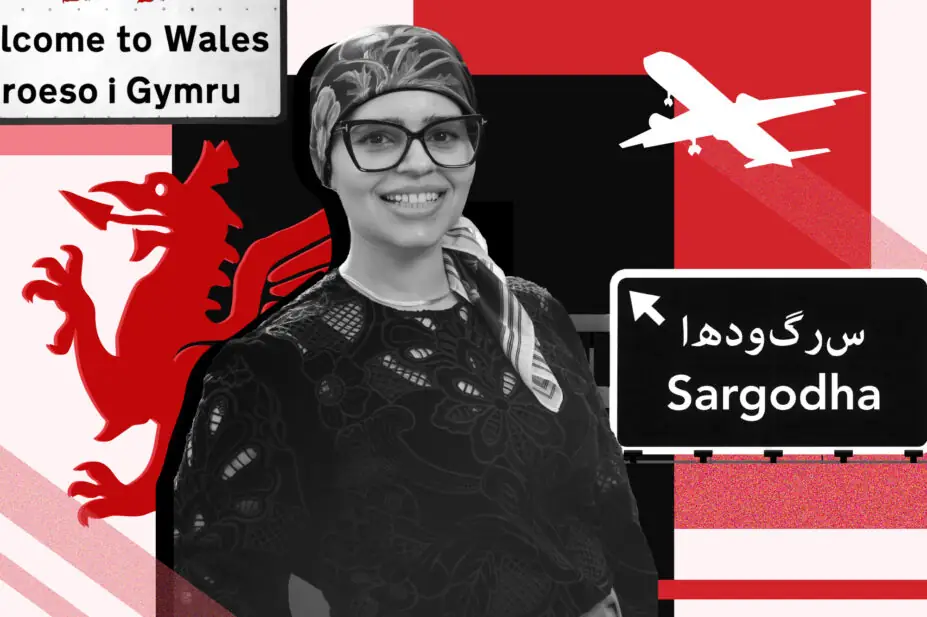
Courtesy of Rafia Jamil, graham bell/Alamy stock photo, Boscorelli/Alamy Stock Photo, The Pharmaceutical Journal
There was nothing dramatic about my decision to leave Pakistan in 2011 — no defining moment, no sudden epiphany. I had completed my PharmD degree at the University of Sargodha, which was introduced in Pakistan in 2003, with the ambition of embedding clinical and community pharmacy services nationally. The PharmD degree promised progress, professional recognition and meaningful patient impact. Yet, when the political instigator behind these reforms was removed from office, the initiatives were also reversed, with little regard for the thousands of students who had already invested into a future that would never arrive.
A privately arranged six-month clinical pharmacy residency offered me a glimpse of the career I wanted: exposure to evidence-based practice, participation in clinical decision-making, working within a professional culture that valued multidisciplinary working and where my gender would not limit my access to opportunity. And so, I took a leap of faith.
The UK appealed to me for many reasons: the scope of clinical pharmacy, the emphasis on evidence-based practice, the opportunity to train as an independent prescriber and the prospect of working within a national healthcare system. There were personal reasons too: ambition, curiosity and the privilege of making my own decisions despite coming from a patriarchal culture, where autonomy for women is not always assumed.
What I did not fully appreciate at the time was how profoundly that decision to leave would shape my identity, resilience and understanding of what it means to grow into a self-aware, assertive and independent woman. Despite how common international mobility has become, the transition itself is rarely discussed openly. We speak frequently about routes, exams, registration pathways and visas but not about the emotional cost, the invisible labour and the strength required to rebuild a professional identity while navigating uncertainty and personal limitations.
Reality became apparent as soon as I began navigating the General Pharmaceutical Council (GPhC) registration process. Understanding the Overseas Pharmacists Assessment Programme (OSPAP), registration assessments and visa regulations was overwhelming. Guidance existed; however, it felt fragmented, impersonal and difficult to interpret from thousands of miles away, particularly when planning a life-changing move with little margin for error.
Like many overseas pharmacists, I arrived carrying assumptions. I believed strong academic performance, hard work and dedication speak for themselves, that progression would naturally follow effort and that international experience would translate seamlessly into recognised capability. It did not. System-wide inequities became apparent early. Within the first week of OSPAP, my cohort was informed that the hospital application window had already closed before we had even arrived in the UK. While UK MPharm graduates had secured placements months earlier, OSPAP students were left to apply for unfilled roles, often geographically distant, lower paid and less than ideal.
Community pharmacy is often underestimated and dismissed as non-clinical, yet it became one of the most formative experiences of my career
There were also frequent silent battles. I remember arriving in London and learning to navigate the underground transport system to reach the GPhC office for my passport check, only to get lost on the streets of south London. I walked from Lambeth North to Elephant and Castle, unaware that the multistorey building I was searching for had been behind me all along. In a single day, I transitioned from being a protected and pampered girl who had everything done for her to being fully responsible for every aspect of my life. Everything felt unfamiliar: accents, professional language, workplace culture, urban slangs, weather and food. I was learning how to live, work and communicate within a new system simultaneously. I also vividly remember getting soaked on my walk home from work one evening and crying at the bus stop, questioning whether I had made the right decision at all.
OSPAP prepared me academically but becoming a clinical pharmacist in practice required far more than knowledge. Clinical pharmacy meant working in a hospital, which meant working within the NHS, and the NHS felt impenetrable. Like many international pharmacists, I began my career in community pharmacy, largely to secure a visa that allowed me to practise. Community pharmacy is often underestimated and dismissed as non-clinical, yet it became one of the most formative experiences of my career. It taught me resilience, communication, accountability and patient-centred care at pace. I learned to manage complexity with limited resources, advocate assertively for patients and lead without formal authority.
What sustained me was purpose, the unwavering support of my family — particularly my husband — and an inner drive forged through adversity
The most important reflection of my community pharmacy experience was that a pharmacist can be as clinical as they choose and train to be, irrespective of the sector they work in. So, I did. Completing an advanced clinical diploma and independent prescribing qualification as a community pharmacist in 2015 was almost unheard of at the time. There was no established pathway and minimal system support. One local GP became my clinical mentor — another agreed to supervise my prescribing training. I worked in a GP surgery on my days off to build my portfolio and confidence. I completed these qualifications with distinction and went on to establish pharmacist-led asthma clinics in community pharmacy, supported by forward-thinking colleagues. That work ultimately led to national recognition and awards.
Yet for many years, I carried the feeling of “overseas pharmacist”: capable and competent yet living in the margins. I once read the phrase: “If the opportunity doesn’t knock, build a door.” That is what I did by engaging actively with the Royal Pharmaceutical Society (RPS). Completing my RPS Faculty portfolio in 2017 was more than a professional milestone — it was an act of belonging. Through mentorship, networks and leadership opportunities, I began contributing beyond my job role, often in my own time.
Recognition followed. National and regional awards, including the Chwarae Teg Rising Star Award in 2019 — while later becoming a member of the RPS Welsh Pharmacy Board in 2023 – marked moments when I felt recognised not for where I came from but for what I brought. I no longer saw myself as an overseas pharmacist who had “made it”. I saw myself as a healthcare professional with global experience, local impact and a responsibility to lead.
Alongside this success, I had struggles that remained invisible: visa insecurity, cultural adaptation, loneliness, lack of support system and the constant pressure to outperform simply to be considered equal. These experiences shaped my resilience in ways no leadership programme ever did. What sustained me was purpose, the unwavering support of my family — particularly my husband — and an inner drive forged through adversity.
To my overseas pharmacist peers: you belong, even when the system makes you feel otherwise
My experience of equality, diversity and inclusion within pharmacy has been complex but hopeful. Progress exists; however, inclusion does not happen by accident. Systems must recognise the additional — often invisible — labour carried by internationally trained professionals. I am committed to creating spaces where overseas pharmacists feel supported earlier, progress faster and are valued for the perspectives they bring. I no longer measure my journey by titles or milestones but by the resilience it built, the perspective it offered and the responsibility it placed on my shoulders to make the path easier for others. Belonging is not about where you start but about how bravely you show up, again and again, and break barriers.
If I could speak to my younger self — or to any overseas pharmacist considering this journey — I would say this: the process is as emotional as it is professional and progress is rarely linear. Community pharmacy holds immense, often untapped clinical opportunity. Mentorship is not optional — it is essential. And you are allowed to take up space. You do not need to shorten your name because it sounds “foreign”, silence parts of your identity or make yourself smaller to fit in. You are allowed to ask for cultural and religious accommodations, for flexibility and for understanding rather than tolerance.
To my overseas pharmacist peers: you belong, even when the system makes you feel otherwise. To UK-trained peers and leaders: champion inclusion, shared learning and understanding. Because when we truly value global contributions, we do not just strengthen pharmacy, we strengthen healthcare. Our patients are diverse and so should be our workforce and leadership.