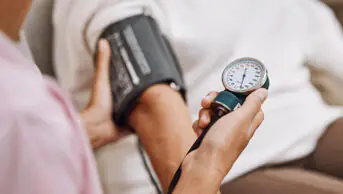
Fotoas13/ Alamy Stock Photo
An updated version of the ‘Community pharmacy hypertension case-finding service‘ (HCFS) specification has attracted calls for the changes to be subject to an impact assessment.
The specification document, published by NHS England on 6 August 2026, noted that the updates to the HCFS, which come into force on 3 September 2026, are aimed at people without a current diagnosis of hypertension, with a focus on hypertension case-finding.
In a press release published on the same day as the updated specification, Community Pharmacy England (CPE) said: “This revised version has been agreed by CPE and it contains a number of changes to the service requirements which were agreed as part of the 2025/2026 CPCF [Community pharmacy contractual framework] negotiations.”
The updated service specification states that people who have had their blood pressure checked at a pharmacy as part of this service within the previous five years will be excluded from a further check, apart from in “exceptional clinical services”.
Previously, there was no time limit on a previous blood pressure check.
The National Pharmacy Association (NPA) has called for a full impact assessment to be carried out before the changes to the service specification are implemented.
Henry Gregg, chief executive of the NPA, said: “Imposing a five-year limit on pharmacy’s ability to check blood pressure will undermine the government’s ambition to promote health prevention and could leave health problems undiagnosed. It’s a clear retrograde step that flies in the face of efforts to prevent disease.
“If the NHS has evidence that blood pressure checks are being done unnecessarily frequently on some individuals, they need to take this up with the individual contractors rather than put in place arbitrary rules that undermine our shared goal of reducing the number of cases of undiagnosed hypertension.”
The Independent Pharmacies Association (IPA) also warned that new restrictions on the service could cut chances to identify people with undiagnosed hypertension and undermine the role pharmacies can play in preventing cardiovascular disease (CVD).
Leyla Hannbeck, chief executive of the IPA, said “Whilst we welcome the push to find and treat as many people as possible with high blood pressure, limiting pharmacy checks to once every five years is simply too restrictive.
“Blood pressure does not stand still for five years and can change significantly in a relatively short period of time, particularly as people get older or their health circumstances change. Someone with a perfectly normal reading today could develop hypertension within the next few years. We should be using the accessibility of community pharmacies to identify those changes early, rather than excluding people simply because they have had a check within the previous five years.
“A two-year interval would provide a much more sensible balance.”
The HCFS launched in October 2021. Speaking at the 2025 Pharmacy Show, held in Birmingham on 12–13 October 2025, Tasneem Mueen-Iqbal, deputy director of community pharmacy clinical strategy, policy and reform at NHS England, said that service had delivered “more than 6.9 million clinic and ambulatory blood pressure monitoring checks” between its launch and June 2025.
In the updated specification document, NHS England says: “Early detection of hypertension is vital and there is evidence that community pharmacy has a key role in detection and subsequent treatment of hypertension and CVD, improving outcomes and reducing the burden on general practices.
“As community pharmacists increasingly become able to independently prescribe, the ten-year health plan highlights an opportunity to increase their role in the management of long-term conditions, including the management of high blood pressure,” it adds.