Six years ago, the COVID-19 pandemic exposed the need for a robust and effective medicines manufacturing sector. The lack of a trained and experienced workforce was one of the factors leading to disruption as pharmaceutical companies rushed to produce vaccines at record speed, while the broader supply chain struggled to meet the demand for routine and critical medicines.
Yet in 2026, advanced medicines manufacturing is still suffering from an acute skills gap, and not enough young people are entering the sector.
The UK is already at the forefront of the science behind these medicines, but this needs to be matched in manufacturing capability. In 2025, a report published by labour analytics company Lightcast calculated that 70,000 new and 75,000 replacement jobs would be needed in medicines manufacturing in the UK over the next ten years, as new medicines are approved that require complex handling and processing.
The challenges are significant, ranging from encouraging young people to take science, technology, engineering and mathematics (STEM) subjects at school through to developing training programmes that teach the necessary skills for working in the sector.
This latter issue is made more challenging by the nature of the work. Gaining access to laboratories or advanced manufacturing facilities for training is inevitably disruptive and expensive. People must travel there, materials are consumed, training staff must be on-hand and working days are interrupted.
A virtual solution
Virtual reality (VR) and augmented reality (AR) technologies hold out the promise of overcoming all these limitations and have the added benefit that they are, simply, ‘cool’.
Mixed reality is a combination of VR and AR, which makes it possible to see virtual objects in the real world and interact with them.
It means we can simulate real-world environments that would otherwise be impractical, disruptive or expensive to experience. A prime example of this is medicines manufacturing.
Much of the core training is about orientation, building confidence, familiarity and process knowledge, so VR is a highly efficient and cost-effective delivery method
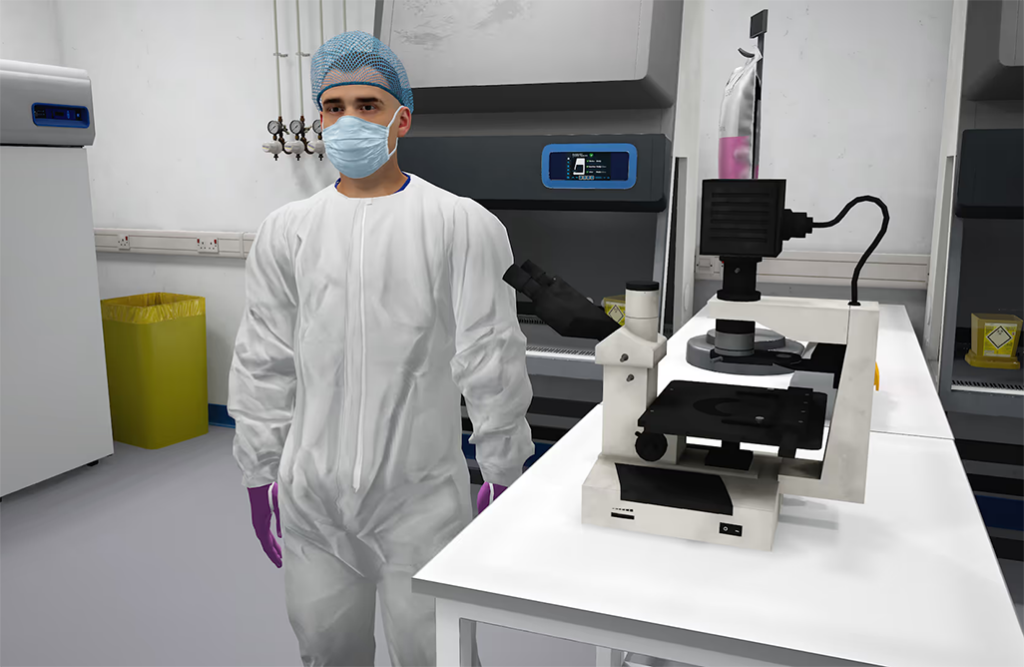
With VR, it is possible to learn vital practices without being in a real facility. Gowning and cleaning are two examples of simple, yet vitally important activities.
Much of the core training is about orientation, building confidence, familiarity and process knowledge, so VR is a highly efficient and cost-effective delivery method.
Training time is on-demand, unlimited and can be repeated at will. Perhaps, obviously, there’s no need to travel to an actual manufacturing site — and, of course, no expensive consumables need to be used.
Critically, training can be standardised across geographies and sites, and there’s no limit on class sizes.
From cleanrooms to complex manufacturing tools, a VR-based tour of a real-world facility allows you to explore every corner with unprecedented detail and precision.
Achieving climate goals
In 2020, the NHS became the world’s first health service to commit to reaching net zero. For the emissions, the NHS controls directly (i.e. the NHS Carbon Footprint). The aim is to reach net zero by 2040, with an intermediate target of an 80% reduction by 2028 to 2032.
Travel is widely recognised as one of the most significant causes of emissions for the NHS
Travel is widely recognised as one of the most significant causes of emissions for the NHS — including staff and patient travel, as well as the NHS’ vehicle fleet.
The ability to recreate, in detail, real-world environments means the programme can deliver high-value training without the need for trainees to travel to actual manufacturing facilities.
In 2020, a report published by the Faculty of Public Health claimed that there are more than 9.5 billion NHS-related road miles per year in England — around 3.5% of all road travel in England — so anything that can help address this is welcome.
Single-use plastics are extensively used in medicines manufacturing, chosen for their chemical resistance, flexibility and sterility.
Particularly during training, actions must be repeated many times to ensure the handler is familiar and the process is perfected. Processes, such as cleaning, do not necessarily use complex materials, but they still make up a large volume of waste.
This means that if the real manufacturing process is mimicked exactly during training, the volume of single-use materials, including plastics, created in a single day would be extraordinary.
Opportunities in medicine
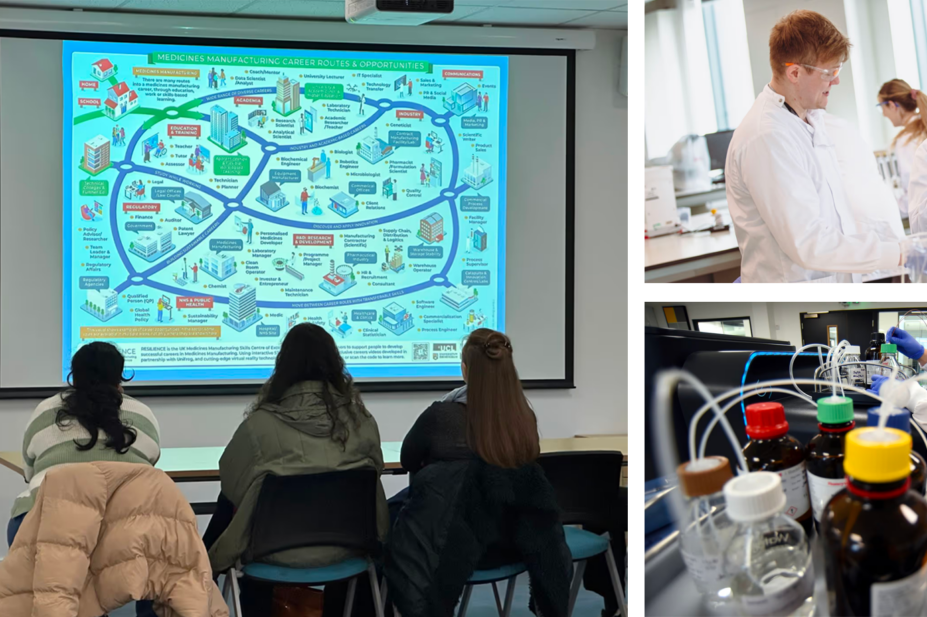
A major challenge when it comes to recruiting for the life sciences sector is helping people understand the vast range of opportunities available.
According to the Cambridge Industrial Innovation Policy’s ‘UK Innovation Report 2025’, about 28.7% of the UK’s total working-age population is employed in STEM fields.
Medicines manufacturing is experiencing a significant skills shortage and it is a great example of an area in science where skills can be taught
For those with a passion for science, but who are concerned about the intellectual barriers to a career as a research scientist, there are many examples of achievable careers in STEM with much lower barriers to entry. There is a diverse range of roles, many of which involve skills that can be taught, as long as there is that curiosity and interest. Medicines manufacturing is experiencing a significant skills shortage, and it is a great example of an area in science where skills can be taught.
Conclusion
VR technology will continue to evolve to become a crucial enabler for training in industry and manufacturing. For advanced medicines manufacturing, this means even better training and an even more exciting and engaging career path for young people.
About RESILIENCE
RESILIENCE is the UK Medicines Manufacturing Skills Centre of Excellence. It is a £4.3m programme funded by the Office for Life Sciences, part of the UK government’s Department for Science, Innovation and Technology, and managed through Innovate UK.
The programme, which started in April 2024, uses virtual reality to train medicine makers in core skills that would be impractical, disruptive and expensive to gain in the real world.
Partner organisations across the UK delivering the programme include the University of Birmingham, University College London (UCL), Teesside University, Heriot-Watt University and Britest. Professor Ivan Wall of the University of Birmingham and Professor Gary Lye of UCL are co-directors.
As well as bridging the skills gap, RESILIENCE is helping the NHS to meet its long-term goal of achieving net zero. Some 25% of NHS emissions are in the medicines supply chain, and VR will help the industry deliver net-zero medicines manufacturing by reducing laboratory waste.