Jasni / Shutterstock.com
After reading this article, you should be able to:
- Know the principles of harm reduction and the role of pharmacy;
- Understand changing drug trends and how they can influence harm in individuals with substance use disorder;
- Provide harm reduction advice, equipment and signpost to other services.
Introduction
Substance use disorder (SUD) — also known as substance dependency — is used to describe the condition suffered by people who misuse substances such as alcohol, illicit substances or prescribed medicines. SUD carries a high risk of overdose, especially in the context of the ever-changing drug market, such as the advent of new psychoactive substances (NPS) and ‘legal highs’, which have evolved to avoid regulatory controls1,2, as well as contamination with potent substances such as nitazenes, medetomidine and xylazine1,3,4.
In 2024, the Scottish drug-related death (DRD) rate was 2.8 times that of England and Northern Ireland, and 1.9 times the rate in Wales5. The most recent National Records of Scotland figures show that 1,017 people in Scotland died of a DRD in 20245. England and Wales recorded at least 3,736 deaths related to drug misuse in 2024, which has doubled since 20126. In 2022, 47.1% of DRDs in England and Wales involved opioids6.
Harm reduction approaches in substance use are pragmatic activities based upon an acceptance that the provision of evidence-based efforts to minimise the negative effects and outcomes from substance use, while not preventing or promoting the problematic health behaviour itself, promotes improved health outcomes for individuals7–9. This can come in many forms — for example, by providing health education to raise overdose awareness, naloxone provision, injecting equipment provision (IEP) and blood-borne virus (BBV) testing.
Pharmacy plays an important role in the provision of harm reduction to people at risk within their own communities, particularly in deprived communities where harms are felt most10. In addition, pharmacy teams can counsel on the use of naloxone and support patients not known to alcohol and drug services who might access the pharmacy for IEP or advice.
This article will provide an overview of different harm reduction strategies and highlight the role of pharmacy in reducing drug-related harm in individuals with SUD.
Principles of harm reduction associated with substance use
The rapid spread of HIV infection among people who injected drugs in the 1980s led to the pragmatic introduction and expansion of several previously existing harm reduction approaches (e.g. IEP)11. These approaches were further expanded as pressure from drug use-related harms increased in the 2010s and continue to evolve today, such as the growing popularisation of injectable NPS — particularly synthetic analogues of cocaine and stimulants — and the introduction of synthetic opioid agents into the drug market1,12,13.
Harm reduction seeks to prevent avoidable damage to the body, mind and social framework to keep an individual who uses substances as healthy as possible, for as long as possible, while efforts are made to support and encourage engagement with less risky behaviours and, ultimately, resolve the problematic behaviours through care and treatment as part of a recovery journey from substances14.
Aside from the clear humanitarian justifications for harm reduction approaches in the care of individuals, these are also often shown to be cost-effective, or even cost-saving, to healthcare systems — more so when wider societal benefits and avoidance of future care costs following preventable harms are considered15,16.
An argument often mooted against harm reduction is that removing risk and consequences may drive compensatory increases in drug use behaviours17. In the case of addiction, it is important to note that a clear diagnostic criterion for the mental disorder is the persistence of use despite clear and overt negative outcomes. Therefore, risk and consequences are not effective barriers to ongoing or escalating drug use18.
Future programmes, such as drug testing, drug checking or safe inhalation pipe introduction, may further aid harm reduction options within pharmacy19,20.
New substance trends and emerging concerns
Across the UK, there is an evolving landscape in substances that are being used by the population. Polypharmacy is recognised as a major risk factor in the incidence of DRD. National Records of Scotland data show that in over 80% of all drug deaths recorded in 2024, more than one substance was implicated5. Office for National Statistics (ONS) figures for England and Wales demonstrate that polypharmacy was present in over 50% of DRDs in 20246.
There has also been a notable change in the substances presenting in drug death toxicology reports, data collection, as well as drug checking and testing services21. Changes in both the presence of more potent synthetic versions of opioids (e.g. nitazenes) and benzodiazepines, as well as in the substances that people are choosing to use, such as the increase in use of gabapentinoids, ketamine and cocaine have also been observed5,22,23.
The emergence of potent synthetic opioids, such as nitazenes, orphines, fentanyl analogues and non-prescribed benzodiazepines, such as etizolam and bromazolam, is of significant concern. These substances are often unknowingly sold in place of, or contaminate, “traditional” street drugs. The uncertain and unsafe supply of these substances can result in a significant risk of harm or death as people may not know what drug or the quantity they are taking22.
ONS figures show that in 2024, cocaine-related deaths increased by 14.4% in England and Wales compared with the previous year6. National Records of Scotland figures show that in 2024, cocaine was implicated in 47% of DRDs compared with 6% in 20085,22. There has been evidence of increased use of injected cocaine. According to the results of a study published in 2024, the incidence of injection of powdered cocaine in Scotland rose from 9% in 2010 (n=217) to 60% in 2022/2023 (n=761). Owing to the shorter duration of action of cocaine, frequency of injection can increase, with the associated increase in the risk of BBV transmission, such as the identified link between cocaine injection and the HIV outbreak in NHS Greater Glasgow and Clyde (GGC) in 201524.
Within Scotland, gabapentinoids were implicated in less than 1% of deaths in 2008 compared with 37% in 20245. This finding is despite changes to legislation passed in 2019 to restrict the supply of gabapentinoids by reclassifying them to a class C and schedule 3 controlled drug25. The Advisory Council on the Misuse of Drugs (ACMD) is currently reviewing the evidence on the misuse and harms of gabapentinoids in the UK26.
Responses to changes in drug trends have been implemented across the UK, while strategies have been developed to monitor and respond to emerging trends and risks. In England, the Office of Health Improvement and Disparities published guidance on planning for and mitigating the effects of the arrival of potent synthetic opioids in 202427. In Scotland, Public Health Scotland (PHS) co-ordinates local intelligence and trends across the country and publishes a quarterly Rapid Action Drug Alerts and Response (RADAR) report to provide early warning of emerging drug trends and identify actions to reduce and prevent harms and deaths. PHS alerts are also published where significant risks are evident, such as those produced for nitazenes, xylazines and bromazolam3,28,29.
Treatment standards
Evidence-based standards for drug treatment have been introduced across the UK to improve the quality of care and consistency in delivery30–32. The standards are designed to address issues, such as access to treatment, commencing treatment quicker, retention in treatment and involving the patient in the decisions about treatment.
Treatment choice is an important aspect within UK clinical guidance33. Individuals accessing treatment should be included in the discussion and participate in making an informed decision on the treatment they would like to receive.
As an example, the medication-assisted treatment (MAT) standards in Scotland, published in May 2021, consist of ten individual standards relating to the care of individuals (see Table30). Although originally introduced for opioid dependence, the principles and standards can be expanded to other substances.
Examples of harm reduction activity
Naloxone provision and importance
Naloxone is an opioid receptor antagonist with a higher affinity for mu opioid receptors than most other opioids. It is also used for reversing opioid overdose because it quickly displaces and blocks the effects of other opioids34. Although naloxone has a rapid onset of action, it has a short duration of action of around 30-90 minutes; therefore, if opioids are still circulating in the person’s system after this time period, they are at risk of relapsing back into overdose35.
Naloxone is a prescription-only medicine (POM) and is available in several formulations for administration via injection and intra-nasal routes. Although naloxone is a POM, the Human Medicines Regulations state that “anyone is permitted to administer naloxone to another individual in order to save their life in an emergency”. An exemption is also in place for any drug treatment services to enable supply of take-home naloxone without a prescription to people at risk of witnessing an overdose36. UK legislation changes in December 2024 enabled a wider range of people to supply naloxone without a prescription37.
In October 2023, the Scottish government, along with Community Pharmacy Scotland (CPS), agreed to add a naloxone emergency supply service to the community pharmacy public health service. This enables community pharmacies to hold a supply of naloxone for use in an emergency to any individual and ensures that pharmacy teams are suitably trained and equipped to be able to recognise an overdose and administer naloxone38. The Scottish government has described this as the first phase, with a second phase being the role out of take-home naloxone, details for which are still to be agreed39. National and local programmes exist across the UK to increase availability and access within communities40. See ‘How to implement a naloxone supply approach in hospitals’ for more information.
National Records of Scotland data show that opiates/opioids were implicated in 80% of DRD in Scotland in 2024, which highlights the importance of naloxone being readily available in communities and individuals at risk of witnessing an overdose having a supply and training to recognise an overdose and administer this life-saving medicine5.
Injecting equipment/foil provision and advice
Injecting drug use carries an inherent significant risk of harm, as it breaches the body’s defences and introduces foreign materials directly into the tissues and blood stream. The supply of sterile and appropriate drug administration equipment (IEP) — formerly ‘needle exchange’— is a well-evidenced harm reduction intervention41,42, most commonly provided through community pharmacies.
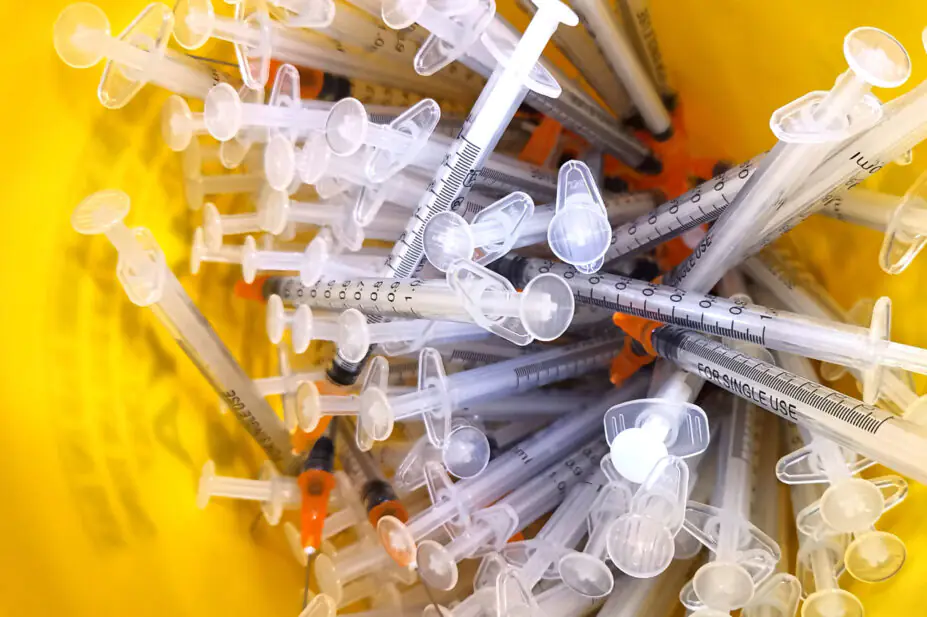
Principally, introduced to reduce the transmission of BBVs via needle sharing, such as HIV and hepatitis C11. This intervention also serves to reduce other injecting-related harms, such as wounds and bacterial tissue infections43. Sharp, sterile, single-use needles/syringes, often with a design to minimise residual blood volume, are provided. Service users are additionally provided with appropriate paraphernalia, such as swabs, filters, acidifiers and spoons, to reduce risks associated with drug administration44. Foil sheets, along with advice on use, may also be provided to encourage a change in drug administration route from injecting to smoking45.
Individuals smoking stimulant drugs may also have additional unmet care needs20. Currently, pipes for using with crack cocaine are not allowed to be supplied; however, work is underway to generate robust evidence to inform legislative review and improve crack cocaine harm reduction services20.
The use of image and performance enhancing drugs, such as steroids and weight-loss drugs, are a rapidly growing issue and may carry many of the same injecting-related risks, such as infection and wounds, but require different support46.
IEP services provide access to equipment, along with prevention education around risk factors to help reduce risky drug use. This includes demonstrations of equipment, advice on safer drug-use practices and referral to specialist care services for support, testing and treatment for infection. In addition, IEP services provide an avenue for the safe disposal of used equipment, reducing the risk of ‘contaminated’ sharps within communities. Anonymous demographic and drug use information is gathered within IEP services alongside the supply of equipment. This helps to support service improvement and identify changes in drug use.
Lifetime treatment costs for HIV can range between £280,000–360,00047 and a course of hepatitis C medication can cost around £13,00048; therefore, sterile, single-use, ‘one-hit-kits’ which cost 22p, are well-justified from a health economics perspective.
Impact of polysubstance use
Polysubstance use is a major risk factor for both non-fatal and fatal overdoses for people who use substances, some of which may be prescribed to the individual, including opioids, alcohol, gabapentinoids and benzodiazepines (i.e. CNS depressants). The most potent combinations likely to cause DRD are mixtures of substances, which may cause respiratory depression49.
As many substances are illicit and are not subject to quality assurance, it is not possible to be confident of the type or quantity of substance being taken. This situation has recently been exacerbated through the contamination and/or substitution, either intentional or unintentional. For example, the presence of high potency opioids, such as nitazenes, being found in illicit products sold as benzodiazepines, opioids (e.g. heroin or oxycodone) and cocaine3.
Best practice and actions for pharmacy teams
Pharmacy teams should:
- Be aware of what substances may be being used nationally and locally;
- Advise individuals on the risks of using more than one substance at a time;
- Encourage people using substances not to use alone and to have a person with them available to help in an emergency or stagger substance use if using within a group;
- Have naloxone available (preferably multiple kits as more than one may be required owing to the potency of synthetic opioids);
- Be aware of symptoms that may be related to substance use (e.g. bladder issues associated with ketamine use, which may present as a urinary tract infection);
- When completing polypharmacy reviews enquire about the use of non-prescribed substances, including those sourced illicitly or purchased, to create a complete risk picture and develop holistic recommendations;
- Encourage people using substances to link in with alcohol and drug services, voluntary services and peer support networks;
- Provide harm reduction advice, equipment and signpost to other services;
- Revisit with individuals on an ongoing basis how you can support their care needs.
- 1.European Drug Report 2025: Trends and Developments . European Union Drugs Agency . 2025. https://www.euda.europa.eu/publications/european-drug-report/2025_en
- 2.Rapid Action Drug Alerts and Response (RADAR) Alert: New benzodiazepines in Scotland. Public Health Scotland. 2026. https://publichealthscotland.scot/publications/rapid-action-drug-alerts-and-response-radar-alert-new-benzodiazepines-in-scotland/rapid-action-drug-alerts-and-response-radar-alert-new-benzodiazepines-in-scotland/public-health-alert-for-action-new-benzodiazepines-in-scotland/
- 4.Rapid Action Drug Alerts and Response (RADAR) Alert: New xylazine-type drug – medetomidine. Public Health Scotland. 2026. https://publichealthscotland.scot/publications/rapid-action-drug-alerts-and-response-radar-alert-new-xylazine-type-drug-medetomidine/rapid-action-drug-alerts-and-response-radar-alert-new-xylazine-type-drug-medetomidine/public-health-alert-for-action-new-xylazine-type-drug-medetomidine/
- 5.Drug-related deaths in Scotland, 2024. National Records of Scotland . 2025. https://www.nrscotland.gov.uk/publications/drug-related-deaths-in-scotland-2024/
- 6.Deaths related to drug poisoning in England and Wales: 2024 registrations. Office for National Statistics. 2025. https://www.ons.gov.uk/peoplepopulationandcommunity/birthsdeathsandmarriages/deaths/bulletins/deathsrelatedtodrugpoisoninginenglandandwales/2024registrations
- 7.Taylor JL, Johnson S, Cruz R, Gray JR, Schiff D, Bagley SM. Integrating Harm Reduction into Outpatient Opioid Use Disorder Treatment Settings. J GEN INTERN MED. 2021;36(12):3810-3819. doi:10.1007/s11606-021-06904-4
- 8.Hawk M, Coulter RWS, Egan JE, et al. Harm reduction principles for healthcare settings. Harm Reduct J. 2017;14(1). doi:10.1186/s12954-017-0196-4
- 9.A Caring, Compassionate and Human Rights informed Drug Policy for Scotland. The Scottish government. 2023. https://www.gov.scot/publications/caring-compassionate-human-rights-informed-drug-policy-scotland/
- 10.Zied Abozied E, Munford LA, Copeland A, et al. The Positive Pharmacy Care Law revisited: an area-level analysis of the relationship between community pharmacy distribution, urbanicity and deprivation in England. BMJ Open. 2025;15(5):e095540. doi:10.1136/bmjopen-2024-095540
- 11.Stimson GV. Aids and injecting drug use in the United Kingdom, 1987–1993: The policy response and the prevention of the epidemic. Social Science & Medicine. 1995;41(5):699-716. doi:10.1016/0277-9536(94)00435-v
- 12.McAuley A, Palmateer NE, Goldberg DJ, et al. Re-emergence of HIV related to injecting drug use despite a comprehensive harm reduction environment: a cross-sectional analysis. The Lancet HIV. 2019;6(5):e315-e324. doi:10.1016/s2352-3018(19)30036-0
- 13.Trayner KM, Palmateer N, Metcalfe R, et al. From outbreak to endemic: the evolving epidemiology of an HIV outbreak among people who inject drugs in Glasgow, Scotland. International Network on Health and Hepatitis in Substance Users. 2024. https://inhsu.org/resource/from-outbreak-to-endemic-the-evolving-epidemiology-of-an-hiv-outbreak-among-people-who-inject-drugs-in-glasgow-scotland/
- 14.Nurchis MC, Di Pumpo M, Perilli A, Greco G, Damiani G. Nudging Interventions on Alcohol and Tobacco Consumption in Adults: A Scoping Review of the Literature. IJERPH. 2023;20(3):1675. doi:10.3390/ijerph20031675
- 15.Wilson DP, Donald B, Shattock AJ, Wilson D, Fraser-Hurt N. The cost-effectiveness of harm reduction. International Journal of Drug Policy. 2015;26:S5-S11. doi:10.1016/j.drugpo.2014.11.007
- 16.Making the investment case: Cost-effectiveness evidence for harm reduction. Harm Reduction International. 2020. https://hri.global/publications/making-the-investment-case-cost-effectiveness-evidence-for-harm-reduction/
- 17.Jones JD, Campbell A, Metz VE, Comer SD. No evidence of compensatory drug use risk behavior among heroin users after receiving take-home naloxone. Addictive Behaviors. 2017;71:104-106. doi:10.1016/j.addbeh.2017.03.008
- 18.ICD-11: International classification of diseases (11th revision). World Health Organization. 2022. https://icd.who.int/browse/2026-01/mms/en
- 19.Measham F. City checking: Piloting the UK’s first community‐based drug safety testing (drug checking) service in 2 city centres. Brit J Clinical Pharma. 2020;86(3):420-428. doi:10.1111/bcp.14231
- 20.Harris M, Scott J, Hope V, et al. Safe inhalation pipe provision (SIPP): protocol for a mixed-method evaluation of an intervention to improve health outcomes and service engagement among people who use crack cocaine in England. Harm Reduct J. 2024;21(1). doi:10.1186/s12954-024-00938-7
- 21.First street drug-checking service approved in Scotland. Pharmaceutical Journal. Published online 2025. doi:10.1211/pj.2025.1.380738
- 22.Deaths related to drug poisoning in England and Wales: 2023 registrations. Office for National Statistics. https://www.ons.gov.uk/peoplepopulationandcommunity/birthsdeathsandmarriages/deaths/bulletins/deathsrelatedtodrugpoisoninginenglandandwales/2023registrations
- 23.WEDINOS homepage. Welsh Emerging Drugs & Identification of Novel Substances Project . https://www.wedinos.org/
- 24.Needle Exchange Surveillance Initiative (NESI) 2022–23 report. Public Health Scotland. 2024. https://publichealthscotland.scot/publications/needle-exchange-surveillance-initiative-nesi/needle-exchange-surveillance-initiative-nesi-13-august-2024/
- 25.Control of pregabalin and gabapentin under the Misuse of Drugs Act 1971. Home Office. 2018. https://www.gov.uk/government/publications/circular-0192018-control-of-pregabalin-and-gabapentin-under-the-misuse-of-drugs-act-1971/control-of-pregabalin-and-gabapentin-under-the-misuse-of-drugs-act-1971
- 26.Call for evidence: The misuse and harms of gabapentin and pregabalin. Advisory Council on the Misuse of Drugs . 2025. https://www.gov.uk/government/calls-for-evidence/the-misuse-and-harms-of-gabapentin-and-pregabalin
- 27.Guidance for local areas on planning to deal with potent synthetic opioids. UK Government Office for Health Improvement & Disparities. 2024. https://www.gov.uk/government/publications/fentanyl-preparing-for-a-future-threat/guidance-for-local-areas-on-planning-to-deal-with-fentanyl-or-another-potent-opioid
- 28.Rapid Action Drug Alerts and Response (RADAR) quarterly report: January 2025. Public Health Scotland. 2025. https://publichealthscotland.scot/publications/rapid-action-drug-alerts-and-response-radar-quarterly-report/rapid-action-drug-alerts-and-response-radar-quarterly-report-january-2025/#section-1
- 29.Bromazolam alert form: July 2023. Public Health Scotland. 2023. https://publichealthscotland.scot/publications/rapid-action-drug-alerts-and-response-radar-quarterly-report/rapid-action-drug-alerts-and-response-radar-quarterly-report-july-2023/
- 30.Medication Assisted Treatment (MAT) Standards for Scotland: Access, Choice, Support. Scottish government. 2021. https://www.gov.scot/publications/medication-assisted-treatment-mat-standards-scotland-access-choice-support/
- 31.10-year strategic plan for the drug and alcohol treatment and recovery workforce (2024–2034). Department of Health & Social Care. 2024. https://www.england.nhs.uk/publication/10-year-strategic-plan-for-the-drug-and-alcohol-treatment-and-recovery-workforce-2024-2034/
- 32.Preventing Harm, Empowering Recovery: A Strategic Framework to Tackle the Harm from Substance Use (2021-31). Department of Health NI. 2021. https://www.health-ni.gov.uk/publications/preventing-harm-empowering-recovery-substance-use-strategy
- 33.Drug misuse and dependence: UK guidelines on clinical management -Clinical Guidelines on Drug Misuse and Dependence update. Independent Expert Working Group: Department of Health. 2017. https://www.gov.uk/government/publications/drug-misuse-and-dependence-uk-guidelines-on-clinical-management
- 34.Robinson A, Wermeling DP. Intranasal naloxone administration for treatment of opioid overdose. American Journal of Health-System Pharmacy. 2014;71(24):2129-2135. doi:10.2146/ajhp130798
- 35.Naloxone DrugFacts. National Institute on Drug Abuse . 2022. https://nida.nih.gov/publications/drugfacts/naloxone
- 36.Consultation outcome Expanding access to naloxone. Department of Health & Social Care. 2024. https://www.gov.uk/government/consultations/expanding-access-to-naloxone-supply-and-emergency-use
- 37.Guidance Supplying take home naloxone without a prescription. Department of Health and Social Care. 2025. https://www.gov.uk/guidance/supplying-take-home-naloxone-without-a-prescription
- 38.NHS Circular: PCA(P)(2023) 34 additional pharmaceutical services naloxone emergency supply service. Chief Medical Officer Directorate: Pharmacy and Medicines Division. 2023. https://www.publications.scot.nhs.uk/files/pca2023-p-34.pdf
- 39.Community Pharmacy Naloxone Emergency Holding Service Equality Impact Assessment – results. Scottish government. 2024. https://www.gov.scot/publications/community-pharmacy-naloxone-emergency-holding-service-equality-impact-assessment-results/
- 40.Re: ACMD Review of the UK Naloxone Implementation: Availability and Use of Naloxone to Prevent Opioid-Related Deaths. Advisory Council on the Misuse of Drugs . 2022. https://www.gov.uk/government/publications/acmd-naloxone-review/acmd-review-of-the-uk-naloxone-implementation-accessible
- 41.Injecting equipment provision in Scotland good practice guidance. Public Health Scotland and Scottish Drugs Forum. 2021. https://sdf.org.uk/wp-content/uploads/2024/05/Injecting-Equipment-Provision-in-Scotland-Good-Practice-Guidance.pdf
- 42.Needle and Syringe programmes. National Institute for Health and Care Excellence . 2014. https://www.nice.org.uk/guidance/ph52
- 43.Needle and Syringe programmes – Evidence Statements. National Institute for Health and Care Excellence . 2014. https://www.nice.org.uk/guidance/ph52/evidence/evidence-statements-pdf-431670349
- 44.Research and analysis. Shooting Up: infections and other injecting-related harms among people who inject drugs in the UK, data to end of 2021 . UK Health Security Agency. 2023. https://www.gov.uk/government/publications/shooting-up-infections-among-people-who-inject-drugs-in-the-uk/shooting-up-infections-and-other-injecting-related-harms-among-people-who-inject-drugs-in-the-uk-data-to-end-of-2021
- 45.Report into the physical effects of smoking heroin/crack cocaine and the risks of infections. Advisory Council on the Misuse of Drugs . 2011. https://assets.publishing.service.gov.uk/media/5a7a3ac0e5274a34770e52ce/acmd-foil-report-2011.pdf
- 46.Guidance: Services for image and performance enhancing drug (IPED) users: turning evidence into practice. Public Health England. 2014. https://www.gov.uk/government/publications/treating-substance-misuse-and-related-harm-turning-evidence-into-practice/services-for-image-and-performance-enhancing-drug-iped-users-turning-evidence-into-practice
- 47.HIV testing: increasing uptake among people who may have undiagnosed HIV Economic assessment: resource impact of recommendations. National Institute for Health and Care Excellence . 2016. https://www.nice.org.uk/guidance/ng60/chapter/Recommendations-for-research
- 48.Joint Formulary Committee. British National Formulary (electronic edition) Glecaprevir with pibrentasvir. 2026. https://bnf.nice.org.uk/drugs/glecaprevir-with-pibrentasvir/medicinal-forms/#oral-tablet
- 49.Adam A, Dillon J, Strang J. Diagnostic definitions of overdose and (opioid-induced) respiratory depression relevant to remote monitoring via accelerometry. Heroin Addict Relat Clin Probl. 2025;27(1):1-20. doi:10.62401/2531-4122-2025-18