

Adrià Voltà
Glucagon-like peptide-1 (GLP-1) receptor agonists were touted as “breakthrough” drugs in 2023 — and their popularity has soared since.
More than 4 million items of tirzepatide and semaglutide were dispensed on the NHS in England in 2025/20261, while around 2.5 million people each month accessed GLP-1s privately at the end of 2025, according to James Kingsland, chair of the Digital Clinical Excellence (DiCE) network of primary care digital health providers.
According to a YouGov poll commissioned by the National Pharmacy Association, an estimated 3.3 million UK adults are expected to use weight-loss injections in 2026. This article collates the latest evidence supporting GLP-1 use for weight loss, including trials in which they are being evaluated, while signposting to relevant articles from The Pharmaceutical Journal for detailed information related to their safe and effective use. It will be updated on a regular basis.
Contents
- What are GLP-1s?
- Which GLP-1s can be prescribed in Great Britain for weight loss?
- What are the known side effects and safety concerns?
- Can GLP-1s cause pancreatitis?
- Does GLP-1 use cause muscle loss and reduced bone density?
- Can GLP-1s affect the eyes?
- Can GLP-1s be used in pregnancy?
- Are weight-loss injections available on the NHS?
- What is current best practice when prescribing GLP-1s for weight loss?
- Switching GLP-1s
- Stopping GLP-1s
- Wraparound support in weight loss
- Inappropriate access to GLP-1s
What are GLP-1s?
GLP-1 receptor agonists work by targeting GLP-1 receptors: increasing insulin, decreasing glucagon and delaying gastric emptying2.
Originally developed for use in type 2 diabetes mellitus, GLP-1s are increasingly being licensed for weight-loss and other cardiometabolic applications.
Some newer drugs combine GLP-1 receptor agonists with other metabolic targets or additional mechanisms to achieve more effective weight loss. For example, tirzepatide (Mounjaro; Eli Lilly) combines a GLP-1 receptor agonist with a glucose-dependent insulinotropic polypeptide (GIP) receptor agonist.
For weight loss, all are licensed as an adjunct to a healthy diet and exercise.
Figure 1 outlines the GLP-1 receptor agonists that can be prescribed in Great Britain for weight loss3–16.
Figure 1: Which GLP-1s can be prescribed in Great Britain for weight loss?
Two types of GLP-1 drug are no longer in use in the UK: exenatide (Bydureon BCise; AstraZeneca UK) 2mg/0.85mL prolonged-release suspension for injection pre-filled pen was discontinued in October 2025, and lixisenatide (Lyxumia; Sanofi) 20 micrograms/0.2mL solution for injection 3mL pre-filled disposable devices were discontinued in 2023. Dulaglutide is currently only licensed for people with diabetes, as Trulicity (Eli Lilly)17.
Other weight-loss drugs are currently in development or regulatory approval stages, including:
- Once-daily GLP-1 pill orforglipron (Eli Lilly), which, when taken alongside a healthy diet and exercise, resulted in a 7.5% weight loss over 72 weeks on the 6mg dose, 8.4% loss with 12mg of orforglipron, and 11.2% loss with 36mg of orforglipron, as compared with 2.1% loss with placebo (funded by Eli Lilly; ATTAIN-1)18. A NICE committee is due to meet in July 2026 to discuss NHS use in England and Wales;
- Retatrutide (Eli Lilly) an injectable triagonist adds a glucagon receptor agonist to its mechanism of action, promising an even greater impact on weight loss19. Topline results from the phase III TRIUMPH-1 studyshowed up to 30% weight loss over 104 weeks20;
- AstraZeneca’s GLP-1 pill, elecoglipron, which in phase II trials showed clinically meaningful weight loss of up to 10.5% at 26 weeks and 11.8% at 36 weeks in the highest-dose groups of adults without diabetes21.
Read more about weight-loss treatments in development: ‘Beyond GLP-1: the next wave of weight-loss medication innovation’
What are the known side effects and safety concerns?
Gastrointestinal side effects make up around half of the side effects reported to the MHRA via the Yellow Card Scheme for tirzepatide, semaglutide and liraglutide between 2020 and 2025 (43,475 out of 78,171 side effects; see Figure 2)18,22. In April 2026, a study published in Nature suggested medication-related nausea or vomiting could be linked to genetic variation among patients23.
Skin and nervous system effects also make up a high proportion of adverse reaction reports. And in diabetes management, dysaesthesia — abnormal and unpleasant touch-based sensations — has already been added to side effect profiles for semaglutide products.
Figure 2: Around half of GLP-1 side effects are gastrointestinal
GLP-1s have previously been suggested to be linked to self-harm and suicidal thoughts, but the MHRA concluded in September 2024 that the available data do not support a causal association between GLP-1s and depression, suicidal ideation and suicide, following a review by the European Medicines Agency’s pharmacovigilance risk assessment committee24.
Can GLP-1s cause pancreatitis?
While the majority of side effects so far reported to the MHRA for tirzepatide and semaglutide are non-serious22, there are growing warnings about serious conditions, such as acute pancreatitis, associated with GLP-1 use, although studies currently remain inconclusive25.
On 29 January 2026, the MHRA updated product information for GLP-1s and issued a drug safety alert to highlight that acute pancreatitis is a known but infrequent side effect that can be fatal, stressing that patients and clinicians should be alert to initial symptoms, such as severe, persistent stomach pain that may radiate to the back and may be accompanied by nausea and vomiting26.
Data show that there were 1,176 cases of acute and chronic pancreatitis following tirzepatide use reported between January 2023 and June 2026, 18 of which had a fatal outcome. Between January 2019 and June 2026, 383 cases of acute and chronic pancreatitis associated with semaglutide use were reported to the MHRA, 5 of which had a fatal outcome12.
For liraglutide, there were 137 reports of acute and chronic pancreatitis made to the MHRA’s Yellow Card scheme between 2020 and 2026, one of which had a fatal outcome27. Yellow Card reports for liraglutide more generally record a higher rate of serious adverse effects, but a lower total of reports overall, which may reflect less widespread use of the drug27.
Acute pancreatitis can be caused by gallstones or bile duct stones when they block the tubes leading from the pancreas to the stomach, which can be caused by rapid weight loss28. To investigate further, the MHRA and UK Biobank are working together to understand if there is a genetic link between GLP-1s and drug-induced acute pancreatitis, similar to that with immunosuppressant drug thiopurine.
Read more about how GLP1-RAs can affect different areas of the body: ‘How safe are GLP-1s?’
Does GLP-1 use cause muscle loss and reduced bone density?
GLP-1s are thought to cause higher muscle loss (25–39%) than non-pharmacological methods of weight loss, such as diet and exercise (10-30%)29.
Excess body weight puts stress on the joints, increasing risk of fractures, but weight loss from calorie restriction is associated with reductions in bone mineral density (BMD) with increased bone turnover; however, emerging evidence suggests that GLP-1s may pharmacologically mitigate against the negative bone health impacts of weight loss30.
Can GLP-1s affect the eyes?
Analysis of GLP-1 side effects reported to the US FDA suggest an increased reporting of various eye disorders across both patients with diabetes and those without; however, a 2025 study concluded that further research is required to support these findings and confirm a biological causation31.
In patients with diabetes, GLP-1 RAs have been linked to an increased risk of age-related macular degeneration, although the overall risk is still low[38]. But, in patients without diabetes, preliminary studies suggest GLP-1 use could be associated with lower risk, although more research is needed32.
According to a review conducted by the European Medicine’s Agency safety committee in 2025, non-arteritic anterior ischemic optic neuropathy is a very rare side effect of semaglutide that could affect 1 in 10,000 people33.
Can GLP-1s be used in pregnancy?
GLP-1s should not be used in pregnancy. There are not enough data to determine the impact of GLP-1 medicines on human pregnancies but, in some animal studies, GLP-1 medicines were found to be harmful to the unborn foetus34. An analysis of studies — which involved 49,395 human pregnancies with periconceptional GLP-1 RA exposure — found a small but statistically significant association with renal malformations in children, but the researchers said this likely reflects “residual confounding by maternal disease severity”.
Senior author Javier Tello, lecturer in pharmacology at the School of Medicine at the University of St Andrews, said: “Our findings offer cautious reassurance for women who become pregnant unexpectedly while on these medications but do not endorse routine use during pregnancy”35.
The MHRA advises patients on all GLP-1s to use contraception while taking GLP-1 medicines (including an additional barrier method for patients starting or increasing tirzepatide who are using oral contraception), as well as for a defined “wash-out” period afterwards before trying to get pregnant (see Figure 3). GLP-1 drugs should not be used while breastfeeding36.
Meanwhile, the Faculty of Sexual and Reproductive Healthcare (FSRH) has warned that if patients experience severe diarrhoea or vomiting whilst using GLP-1 agonists and oral contraception, they should follow FSRH recommendations, including manufacturers advice for a missed pill and use of condoms37.
Read more about how GLP1-RAs can affect different areas of the body: ‘How safe are GLP-1s?’
Figure 3: How many months should GLP-1s be stopped before a pregnancy?
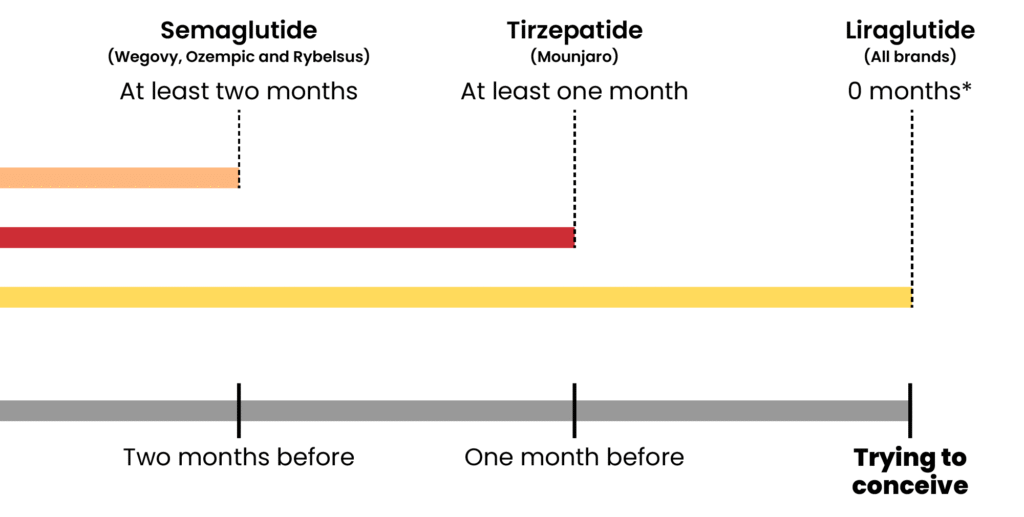
*These medicines leave your body much quicker than the other GLP-1 medicines, which means they should be stopped just before trying to become pregnant.
Source: Medicines and Healthcare products Regulatory Agency
Are weight-loss jabs available on the NHS?
Semaglutide is currently only available on the NHS in England and Wales via specialist weight management services38. It is available for people with weight-related health problems with:
- A BMI of 35 or more, or 32.5 or more for people of Asian, Chinese, Middle Eastern, Black African or African-Caribbean origin;
- A BMI of 30 to 34.9, or 27.5 to 32.4 for people of Asian, Chinese, Middle Eastern, Black African or African-Caribbean origin, who meet other criteria to be treated by a specialist weight management service.
Provision may vary by integrated care board39.
In Scotland, semaglutide is only available on the NHS for patients with established cardiovascular disease and a BMI of 27 or higher40.
Tirzepatide is currently only available on the NHS in England and Wales via specialist weight management services, with a phased roll out to primary care settings in England including GPs. Initially, only patients with four weight-related health problems and a BMI of 40 or more (adjusted for ethnicity) will be eligible to access tirzepatide (Mounjaro) through primary care settings in England41.
In October 2025, the Welsh government confirmed plans to develop a new clinical pathway to treat obesity as a chronic, recurring condition and support equitable access to weight-loss drugs and wrap-around care, including in appropriate primary care and community settings42.
Tirzepatide is available in Scotland to people with a BMI of 30 or more, or between 27–30 if they have at least one weight-related comorbidity, such as hypertension, cardiovascular disease, or type 2 diabetes mellitus43.
Just 1% of eligible patients are currently accessing weight-loss services on the NHS, the Health and Social Care Committee (HSCC) told NHS England and Department of Health and Social Care (DHSC) representatives on 3 June 202644.
Clare Hambling, national clinical director for diabetes and obesity at NHS England, said that owing to “affordability challenges”, NHS England pathways currently prioritise patients with complex care needs where GP oversight was “essential”.
However, community pharmacies have called for NHS commissioning of their weight-loss services as “the most effective way” to meet demand for the treatment.
The Obesity Pathway Innovation Programme — funded by government and weight-loss drug manufacturer Eli Lilly to test methods of offering weight management services across the UK — is expected to include some community pharmacies. In addition, some pharmacies have explored using pharmacist prescribing for weight management as part of the NHS England pathfinder programme.
What is current best practice when prescribing GLP-1s for weight loss?
Switching GLP-1s
Patients or clinicians might consider switching between weight-loss medications; for example, owing to adverse effects, patient preference, cost pressures or formulary decisions. There is little clinical guidance on this, so pharmacists must prioritise patient safety and, since there is no validated dose equivalence, the safest approach is to start the new medication its lowest available dose then titrate gradually per standard schedule.
For oral semaglutide, the MHRA has said that patients receiving a 2.4mg semaglutide injection once weekly can be transitioned straight to semaglutide 25mg tablets once daily, but otherwise the dose must be started at 1.5mg daily and escalated with one month minimum at each dosage.
Read our learning article for practical advice on safe and effective switching between weight loss medication: ‘Switching between weight-loss medications’
Stopping GLP-1s
There is some evidence to suggest that rapid weight loss is much more effective than gradual weight loss in achieving and sustaining a clinically meaningful drop in weight.
However, a 2025 study found that people who used weight-loss medication regained weight more rapidly, with an average monthly weight regain of 0.4kg compared with 0.1kg in those who followed behavioural weight management programmes.
John Wilding, professor of medicine in the Department of Cardiovascular and Metabolic Medicine at the University of Liverpool, said this was unsurprising, adding: “Obesity is a chronic disease that usually relapses when treatment is stopped.”
Tricia Tan, professor of metabolic medicine, diabetes and endocrinology at Imperial College London/Imperial College Healthcare NHS Trust, said: “There is increasing evidence that structured exercise is important to prevent weight regain after cessation of weight-loss drugs,” but noted that this was not discussed in the study.
Trials of orforglipron and lower-dose tirzepatide suggest that if and when these drugs are licensed, they could be used to maintain weight loss after higher-dose injectable incretin therapies45.
Wraparound support in weight loss
Experts have stressed the “multi-factorial” causes of obesity and therefore the need for a multi-faceted approach, considering other factors like lifestyle, trauma and psychological support46.
Obesity and dietitian societies have issued a joint consensus statement on the use of obesity drugs for weight-loss treatment, which highlights the role of dietitians in medical nutritional therapy, psychological vulnerabilities that may exist around weight loss, the importance of physical activity and other socioeconomic factors that should be considered47.
GLP-1s are only licensed for weight loss as an adjunct to a calorie-controlled diet and exercise, and should be offered as part of a holistic weight management service.
In August 2025, the National Institute for Health and Care Excellence quality standard for overweight and obesity management was updated to add that people who are stopping weight-loss medicines should be given advice for maintaining changes and support for improving their health and wellbeing.
Read more about GLP-1s and support for eating disorders: ‘The dark side of the ‘miracle jab’
Inappropriate access to GLP-1s
Concerns have been raised about patients accessing GLP-1s inappropriately; for instance, when they do not meet BMI eligibility criteria. To combat this, the General Pharmaceutical Council set out guidance in September 2024 that said pharmacies must:
- Not rely solely on an online questionnaire but use two-way communication between patient and prescriber;
- Independently verify the person’s weight, height and/or body mass index — for example, through a video consultation (where they may need to detect altered images in online GLP-1 consultations), in-person, from the person’s clinical records or by contacting another healthcare provider, such as the person’s GP;
- Consider the person’s wellbeing given that eating disorders, body dysmorphia and mental health issues can play a part in the reason for requesting these medicines;
- Carry out or signpost to appropriate ongoing monitoring;
- Advise on side effects48.
Read more about online prescribing and safety: ‘Staying safe with online pharmacies — what patients and providers need to know about weight-loss prescribing’
Weight-loss advertising is also a concern: some providers have fallen foul of the Association of the British Pharmaceutical Industry regulations that ban the promotion of prescription drugs to patients, while social media and affiliate advertising increases the risk of prescription-only-medication promotion, including to teenagers and other vulnerable people.
The demand for weight-loss medication also makes it a potential hotspot for criminal activity, with unregulated suppliers acting illegally and sometimes selling drugs that do not contain medication as labelled and put patients’ health at risk. In 2025, the MHRA reported the seizure of more than 5,000 illegally traded GLP-1 pens.
A survey commissioned by LloydsPharmacy Online Doctor (survey size n=2,000, of those 285 are current and active users of GLP-1s for weight loss and 216 have recently stopped) found that 28% (n=140) of those surveyed who were using or had previously used weight-loss injections had knowingly bought from unlicensed sellers, 12% (n=60) think they may have done, and 20% (n=100) bought drugs that are unlicensed and untested for weight loss in the UK.
One-third (32%, n=91) of those currently taking weight-loss jabs said they had not taken their medication as prescribed. Of those, 28% (n=25) reported ‘microdosing’ (taking a smaller amount of medication than prescribed to make it last longer), 23% (n=21) reported combining residual medication to create an additional “golden dose” and 32% (n=29) reported taking a short break from the medication to save money or make the most of life events, such as weddings or holidays.
This off-label use is corroborated by the ongoing ‘Smoking Toolkit Study’, which added questions around weight-loss jabs to its representative monthly surveys in January to March 2025 (5,893 total respondents). These revealed that 12% of weight-loss drug users (20 out of 171) were using medication not licensed for this purpose.
The researchers also found that weight-loss medication use was higher among women than men (4.0% versus 1.7%) and higher among those of middle age (4.2% of 45 and 55-year-olds compared to 1.2% of 18-year-olds and 1.5% of 75-year-olds). Prevalence was higher among those who reported moderate or severe psychological distress in the past month (3.7% vs. 2.4% among those reporting no/low distress) and — while usage levels were similar across social grades — interest in using drugs to support weight loss in future was greater among more typically disadvantaged groups (among whom obesity is more prevalent).
This article will be updated regularly as more information emerges. If there are any trials or treatments we have missed, please get in contact to let us know.
- 1.Prescription Cost Analysis – England 2025/26. NHS Business Services Authority. June 4, 2026. Accessed July 2026. https://www.nhsbsa.nhs.uk/statistical-collections/prescription-cost-analysis-england/prescription-cost-analysis-england-202526
- 2.Liu QK. Mechanisms of action and therapeutic applications of GLP-1 and dual GIP/GLP-1 receptor agonists. Front Endocrinol. 2024;15. doi:10.3389/fendo.2024.1431292
- 3.MHRA Products — Substance: Liraglutide . Medicines and Healthcare products Regulatory Agency. Accessed July 2026. https://products.mhra.gov.uk/substance/?substance=LIRAGLUTIDE
- 4.Obesity: Scenario — Management. National Institute for Health and Care Excellence. September 2025. Accessed July 2026. https://cks.nice.org.uk/topics/obesity/management/management/
- 5.Effect of Liraglutide on Body Weight in Non-diabetic Obese Subjects or Overweight Subjects With Co-morbidities: SCALETM – Obesity and Pre-diabetes. Clinical Trials. January 2018. Accessed July 2026. https://clinicaltrials.gov/study/NCT01272219
- 6.Pi-Sunyer X, Astrup A, Fujioka K, et al. A Randomized, Controlled Trial of 3.0 mg of Liraglutide in Weight Management. N Engl J Med. 2015;373(1):11-22. doi:10.1056/nejmoa1411892
- 7.Yellow Card results: Wegovy. Medicines and Healthcare products Regulatory Agency. Accessed July 2026. https://products.mhra.gov.uk/product/?product=WEGOVY
- 8.Research Study to Look at How Well Semaglutide is at Lowering Weight When Taken Together With an Intensive Lifestyle Program (STEP 3). Clinical Trials. November 2021. Accessed July 2026. https://clinicaltrials.gov/study/NCT03611582
- 9.Wadden TA, Bailey TS, Billings LK, et al. Effect of Subcutaneous Semaglutide vs Placebo as an Adjunct to Intensive Behavioral Therapy on Body Weight in Adults With Overweight or Obesity. JAMA. 2021;325(14):1403. doi:10.1001/jama.2021.1831
- 10.A Research Study to See How Semaglutide Helps People With Excess Weight, Lose Weight (STEP UP) (STEP UP). Clinical Trials. April 2026. Accessed July 2026. https://clinicaltrials.gov/study/NCT05646706
- 11.Wharton S, Freitas P, Hjelmesæth J, et al. Once-weekly semaglutide 7·2 mg in adults with obesity (STEP UP): a randomised, controlled, phase 3b trial. The Lancet Diabetes & Endocrinology. 2025;13(11):949-963. doi:10.1016/s2213-8587(25)00226-8
- 12.Yellow Card reaction profile: Tirzepatide. Yellow Card. Accessed July 2026. https://yellowcard.mhra.gov.uk/idaps/TIRZEPATIDE
- 13.A Study of Tirzepatide (LY3298176) in Participants With Obesity or Overweight (SURMOUNT-1). Clinical Trials. July 2025. Accessed July 2026. https://clinicaltrials.gov/study/NCT04184622
- 14.Jastreboff AM, Aronne LJ, Ahmad NN, et al. Tirzepatide Once Weekly for the Treatment of Obesity. N Engl J Med. 2022;387(3):205-216. doi:10.1056/nejmoa2206038
- 15.Yellow Card: semaglutide. Medicines and Healthcare products Regulatory Agency . Accessed July 2026. https://products.mhra.gov.uk/search/?search=semaglutide&page=2
- 16.Wharton S, Lingvay I, Bogdanski P, et al. Oral Semaglutide at a Dose of 25 mg in Adults with Overweight or Obesity. N Engl J Med. 2025;393(11):1077-1087. doi:10.1056/nejmoa2500969
- 17.Yellow Card: dulaglutide. Medicines and Healthcare products Regulatory Agency . Accessed July 2026. https://products.mhra.gov.uk/search/?search=dulaglutide&page=1
- 18.Wharton S, Aronne LJ, Stefanski A, et al. Orforglipron, an Oral Small-Molecule GLP-1 Receptor Agonist for Obesity Treatment. N Engl J Med. 2025;393(18):1796-1806. doi:10.1056/nejmoa2511774
- 19.A Study of Retatrutide (LY3437943) in Participants Who Have Obesity or Overweight (TRIUMPH-1). Clinical Trials. June 2026. Accessed July 2026. https://clinicaltrials.gov/study/NCT05929066
- 20.Lilly’s triple agonist, retatrutide, delivered powerful weight loss in pivotal Phase 3 obesity trial. Eli Lilly. May 2026. Accessed July 2026. https://investor.lilly.com/news-releases/news-release-details/lillys-triple-agonist-retatrutide-delivered-powerful-weight-loss
- 21.Davies MJ, Aroda VR, Rosenstock J, et al. Elecoglipron, an oral small molecule GLP-1 receptor agonist in adults with obesity or overweight (VISTA): a multicentre, phase 2, randomised, placebo-controlled clinical trial. The Lancet. 2026;407(10547):2503-2514. doi:10.1016/s0140-6736(26)00748-8
- 22.Yellow Card Reporting. Yellow Card. Accessed July 2026. https://yellowcard.mhra.gov.uk
- 23.Su QJ, Ashenhurst JR, Xu W, et al. Genetic predictors of GLP1 receptor agonist weight loss and side effects. Nature. 2026;653(8115):770-775. doi:10.1038/s41586-026-10330-z
- 24.Bezin J, Bénard-Laribière A, Hucteau E, et al. Suicide and suicide attempt in users of GLP-1 receptor agonists: a nationwide case-time-control study. eClinicalMedicine. 2025;80:103029. doi:10.1016/j.eclinm.2024.103029
- 25.Ayoub M, Chela H, Amin N, et al. Pancreatitis Risk Associated with GLP-1 Receptor Agonists, Considered as a Single Class, in a Comorbidity-Free Subgroup of Type 2 Diabetes Patients in the United States: A Propensity Score-Matched Analysis. JCM. 2025;14(3):944. doi:10.3390/jcm14030944
- 26.MHRA updates guidance for GLP-1 prescribers and patients. Medicines and Healthcare products Regulatory Agency. January 2026. Accessed July 2026. https://www.gov.uk/government/news/mhra-updates-guidance-for-glp-1-prescribers-and-patients
- 27.Yellow Card reaction profile: Liraglutide. Yellow Card. Accessed July 2026. https://yellowcard.mhra.gov.uk/idaps/LIRAGLUTIDE
- 28.GLP-1 Receptor Agonists (GLP-1RAs). Yellow Card. Accessed July 2026. https://yellowcard.mhra.gov.uk/biobank-glp-1medicines-pancreatitis
- 29.Prado CM, Phillips SM, Gonzalez MC, Heymsfield SB. Muscle matters: the effects of medically induced weight loss on skeletal muscle. The Lancet Diabetes & Endocrinology. 2024;12(11):785-787. doi:10.1016/s2213-8587(24)00272-9
- 30.Gatto A, Liu K, Milan N, Wong S. The Effects of GLP-1 Agonists on Musculoskeletal Health and Orthopedic Care. Curr Rev Musculoskelet Med. 2025;18(10):469-480. doi:10.1007/s12178-025-09978-3
- 31.Murray M, Schifano F, Chiappini S, Corkery JM, Guirguis A. Potential Eye Disorders in People With and Without Type 2 Diabetes Mellitus Exposed to GLP-1 Receptor Agonists: An Examination of the FAERS (FDA Adverse Event Reporting System) Database. American Journal of Ophthalmology. 2026;283:279-290. doi:10.1016/j.ajo.2025.12.015
- 32.Shor R, Mihalache A, Noori A, et al. Glucagon-Like Peptide-1 Receptor Agonists and Risk of Neovascular Age-Related Macular Degeneration. JAMA Ophthalmol. 2025;143(7):587. doi:10.1001/jamaophthalmol.2025.1455
- 33.PRAC concludes eye condition NAION is a very rare side effect of semaglutide medicines Ozempic, Rybelsus and Wegovy. European Medicines Agency. June 2025. Accessed July 2026. https://www.ema.europa.eu/en/news/prac-concludes-eye-condition-naion-very-rare-side-effect-semaglutide-medicines-ozempic-rybelsus-wegovy
- 34.Qiao L, Lu C, Zang T, Dzyuba B, Shao J. Maternal GLP-1 receptor activation inhibits fetal growth. American Journal of Physiology-Endocrinology and Metabolism. 2024;326(3):E268-E276. doi:10.1152/ajpendo.00361.2023
- 35.Hakim J, Rajesh D, Tello JA. Neonatal and obstetric outcomes following periconceptional exposure to glucagon-like peptide-1 receptor agonists: a systematic review and meta-analysis. American Journal of Obstetrics and Gynecology. Published online April 2026. doi:10.1016/j.ajog.2026.04.037
- 36.GLP-1 medicines for weight loss and diabetes: what you need to know. Medicines and Healthcare products Regulatory Agency. February 2026. Accessed July 2026. https://www.gov.uk/government/publications/glp-1-medicines-for-weight-loss-and-diabetes-what-you-need-to-know/glp-1-medicines-for-weight-loss-and-diabetes-what-you-need-to-know
- 37.Ahuja AS, Paredes AA III, Young BK. Glucagon-Like Peptide-1 Receptor Agonists and Age-Related Macular Degeneration. JAMA Ophthalmol. 2025;143(12):999. doi:10.1001/jamaophthalmol.2025.3821
- 38.Weight management injections. NHS England. Accessed July 2026. https://www.england.nhs.uk/ourwork/prevention/obesity/medicines-for-obesity/weight-management-injections/
- 39.Oral evidence presented to the Health and Social Care Select Committee session on food and weight management. UK Parliament. June 2026. Accessed July 2026. https://committees.parliament.uk/oralevidence/17655/html/
- 40.Semaglutide (Wegovy). Scottish Medicines Consortium . Accessed July 2026. https://scottishmedicines.org.uk/medicines-advice/semaglutide-wegovy-full-smc2872/
- 41.What next for weight loss medication in Wales? . Welsh Parliament. November 2025. Accessed July 2026. https://research.senedd.wales/research-articles/what-next-for-weight-loss-medication-in-wales-updated-november-2025/
- 42.New clinical pathway for treating and managing obesity (WHC/2025/043). Welsh Government . October 2025. Accessed July 2026. https://www.gov.wales/new-clinical-pathway-treating-and-managing-obesity-whc2025043-html
- 43.Tirzepatide (Mounjaro). Scottish Medicines Consortium. Accessed July 2026. https://scottishmedicines.org.uk/medicines-advice/tirzepatide-mounjaro-obesity-full-smc2653/
- 44.West S, Scragg J, Aveyard P, et al. Weight regain after cessation of medication for weight management: systematic review and meta-analysis. BMJ. 2026;392:e085304. doi:10.1136/bmj-2025-085304
- 45.Lilly’s Foundayo and lower-dose Zepbound helped people maintain weight loss after switching from higher doses of injectable incretin therapy in two late-phase trials. Eli Lilly. May 2026. Accessed July 2026. https://investor.lilly.com/news-releases/news-release-details/lillys-foundayo-and-lower-dose-zepbound-helped-people-maintain
- 46.Beyond GLP-1: the next wave of weight-loss medication innovation. Pharmaceutical Journal. Published online 2025. doi:10.1211/pj.2025.1.375713
- 47.Koskinas KC, Van Craenenbroeck EM, Antoniades C, et al. Obesity and cardiovascular disease: an ESC clinical consensus statement. European Heart Journal. 2024;45(38):4063-4098. doi:10.1093/eurheartj/ehae508
- 48.Weight loss medications- FAQ. General Pharmaceutical Council. Accessed July 2026. https://www.pharmacyregulation.org/patients-and-public/standards-you-can-expect-using-pharmacy-services/weight-loss-medications-faq
1 comment
You must be logged in to post a comment.

Under the section “are weight loss jabs available on the NHS” you have not mentioned TA1152 (https://www.nice.org.uk/guidance/ta1152), where nice recommends semaglutide for use in cardiovascular secondary prevention. The only criteria for this indication is previous stroke (haemorrhagic or ischaemic) or myocardial infarction or peripheral vascular disease together with a BMI over 27
ICBs have 90 days from date of publication to establish pathways for this indication, which means by the end of August this should be available across England